

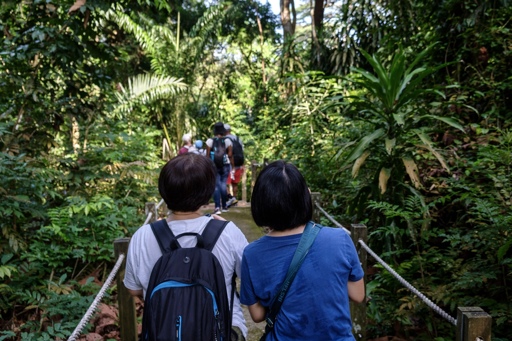
ANG MO KIO, Singapore — On the edge of a bustling Singapore suburb, Lay Hoon steps into the shade of a forest reserve she’s visited monthly for eight years to search for one of the world’s most threatened primates. Scanning the dense canopy for signs of movement, she listens intently. “Before we see the langurs, we usually hear them,” she says. The foliage rustles above, but it turns out to be a plantain squirrel (Callosciurus notatus), one of a surprising number of small mammals found here at the Lower Peirce Reservoir Park, a 10-hectare (25-acre) patch of maturing secondary forest to the northeast of Singapore’s Central Catchment Nature Reserve. Hoon is looking for the Raffles’ banded langur (Presbytis femoralis), a leaf-eating monkey confined to pockets of fragmented forest in Singapore and the southern tip of Peninsular Malaysia. Listed as critically endangered on the IUCN Red List, its total global population is estimated to be only 200-250 mature individuals, fewer than 80 of them in Singapore. The extent of habitat loss in Singapore over the past two centuries cannot be overstated. Today, less than 1% of the primary forest that once stretched across much of the main island remains; and of the island’s roughly 20% secondary forest cover, only about 4.3% is considered high-quality mature forest. With their habitats devastated, many groups of terrestrial vertebrates plunged into decline. Yet even after rapid urbanization since the 1960s, small groups of langurs have clung on in isolated forest fragments. However, as treetop specialists,…This article was originally published on Mongabay
From Conservation news via This RSS Feed.