


By Joseph Essertier, World BEYOND War, April 23, 2026
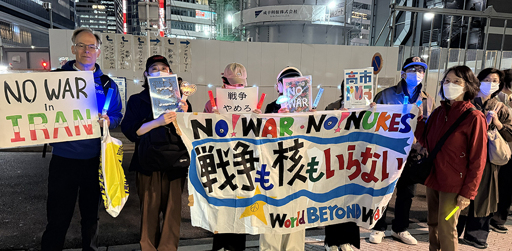
This “pen light” peace movement in Japan could soon rival the peace movement of the 1960s, in terms of significance. And for me, it is more inspiring than what I know of the 1960s, because it is less violent and the vast majority of activists are women.
Even the numbers of people at street protests now are getting close to those in Japan during the period around the time the U.S. invaded Iraq. Even the Guardian, one of the newspapers that spread lies about Iran and thereby helped build support for the war on Iran, notes the widespread opposition to Japan’s involvement in the U.S.-Israeli invasion of Iran. Iran! There is a huge prejudice against Iran in this country, so this new, visible opposition to attacks there is remarkable.
I myself have seen the passion and yearning for peace among these young people, mostly young ladies. Some on social media are proposing now, in so many words, “Let’s learn from Korea’s recent non-violent overthrows of their government.” That’s soooo refreshing. That is what I was saying in 2018, which was after the 2017 Candlelight Revolution, when South Korean President Park Geun-hye was nonviolently impeached. Candles, or fake battery powered candles, were so effective in Korea, so trying to learn from them, we organized “candlelight action” street protests (or candlelight vigils) here in Nagoya back when Trump seemed to be on the verge of ending the Korean War. (I’ve learned to never expect him to follow through on any of his promises of peace!)
These young people may not know about the Candlelight Revolution, but they seem to know what happened in 2024 in South Korea, i.e., the impeachment of President Yoon Suk Yeol. Despite the strong anti-Korean racist bias in this country, they seem to be learning from pro-peace and pro-democracy Koreans. I’ve never seen that before. And anti-racism is a big part of this movement. There are lots of “no hate” signs.
Their movement is so lively and creative. They have the best placards, flags, banners, lights, etc., of any movement in Japan that I’ve seen or heard of before. I was not there in the 1960s of course, but I have seen many documentaries and photos of those street protests. The outstanding feature of the 1960s protests was opposition to “Ampo,” the U.S.-Japan Security Treaty. The number one message here on placards, at least at the big demo in Nagoya I participated in, is “no war.” And there is little violence now, unlike during the Ampo Riots.
After I gave a 5-minute or 10-minute speech on April 8th at Nagoya Station, at least 10 individual people—mostly women, judging by the sound of their voices—called out “thank you” to me as I was walking back to my spot in front of and along this 50-meter long crowd! (Our crowd was just one of the multiple areas because there was not enough space for all of us on one side of the street. There were over one thousand people on sidewalks—one or two hundred here, one or two hundred over there—in front of Nagoya Station). “Thank you,” walk a few steps, “thank you,” a few more steps, “thank you.” Wow! They were very welcoming and encouraging toward all the people who came up to the mic to give a quick speech. These are people I don’t know. That’s a first. I was not expecting that kind of verbal expression of support at all.
I’ve been opposing war on Iran since the Twelve Day War last year, but I had never heard a “thank you” until that day, on the 8th. I have seen people nodding in agreement with me as I spoke about Iran at rallies before marches against the Genocide in Gaza, and several times people chatted with me individually and expressed agreement, but nobody ever called out to me. And besides my own placard, I never saw any placards against the Israeli-U.S.-Iran War until last month, and I have joined a dozen or so demos in the last few months, mostly anti-Genocide demos.
(Among elderly protesters, I saw five little A4-size placards at one demo, where there were around 50 participants, last month, so opposition to the war in Iran has been growing, I think, but opposition among young people seems much stronger. That’s just my impression).
Why so many women? Because so many more women in Japan, than men, want to keep Article 9, the peace section, in the Constitution, as well as some of the other liberal, human rights elements of it. The Constitution is very popular among women. (Women were major beneficiaries of the postwar reforms, so that makes sense to me). Women of all ages oppose ultranationalist reform of the Constitution in much larger numbers than do men. Professor KONDO Makoto, a constitutional law scholar in Japan, has done research, going back to a decade ago, on the differences between men and women’s views of the Constitution. He published some of his research in English in New Zealand, and in one oral presentation, a copy of which he kindly sent me upon my request, he wrote that the intent of his paper was to “inform men who are not interested in gender equality but are interested in Article 9 protection” about the strong support among women for the peace clause (i.e., Article 9) in the Constitution. He made the strong claim that “Article 9 is protected mainly by women now.” And I agree with him that if one cares about peace in this country, then one must pay attention to the views Japanese women toward the Constitution.
Antiwar, anti-racism, anti-Iran War, opposition to the current Liberal Democratic Party Prime Minister Sanae Takaichi, non-violence, openness to learning from democratic struggle in South Korea—these various progressive elements, in this new combination, this movement seem totally new to me.

The post Welcome to Japan’s Pen Light Movement appeared first on World BEYOND War.
From World BEYOND War via This RSS Feed.