

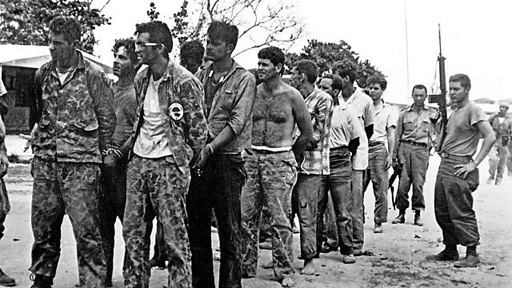
On April 17, the Anti-Fascist Friday Forum in South Africa convened at the Forge in Johannesburg, marking two historic milestones: the centenary of Fidel Castro and the 65th anniversary of the victory at Playa Girón. The event was organized as a political intervention linking past revolutionary victories to the urgent tasks of confronting imperialism today. The event was addressed by Cuban diplomat Jesús Pérez and veteran figure of the South African liberation struggle Ronnie Kasrils.
“Imperialism is not invincible” – Cuba’s defining moment
Opening the discussion, Jesús Pérez delivered a detailed historical account of the events leading up to the invasion, emphasizing the political clarity and mass mobilization that defined Cuba’s response.
“On April 15, United States forces bombarded Cuban airfields to destroy our capacity to defend ourselves on air,” Pérez explained. “But instead of weakening us, it prepared our people politically and militarily for what was coming.”
He described how, just a day later, a mass demonstration in Havana became a turning point.
“It was on April 16, during a massive gathering to honor those killed in the bombings, that Fidel Castro declared the socialist character of the Cuban Revolution,” Pérez said. “He called on the people: ‘Let us march to the front, let us take up arms, and let us face the enemy with conviction.’”
The location holds symbolic importance. Playa Girón, he said, “Was an area where poor and humble Cubans lived, people for whom the revolution was made. The choice of that site by US imperialism shows clearly who they were targeting, the most oppressed.”
According to Pérez, the battle that followed was fundamentally unequal, yet transformative.
“On one side, CIA-trained mercenaries. On the other, workers, peasants, women, Black Cubans, people who had never before held power,” he said. “And in less than 72 hours exactly, the invasion was defeated.”
Read more: Why the US wants to destroy Cuba
He stressed the broader significance of the victory:
“This was not only a military defeat of the United States. It was a defeat of imperialism by socialism. It showed the world that a small nation, organized and conscious, can defeat a superpower.”
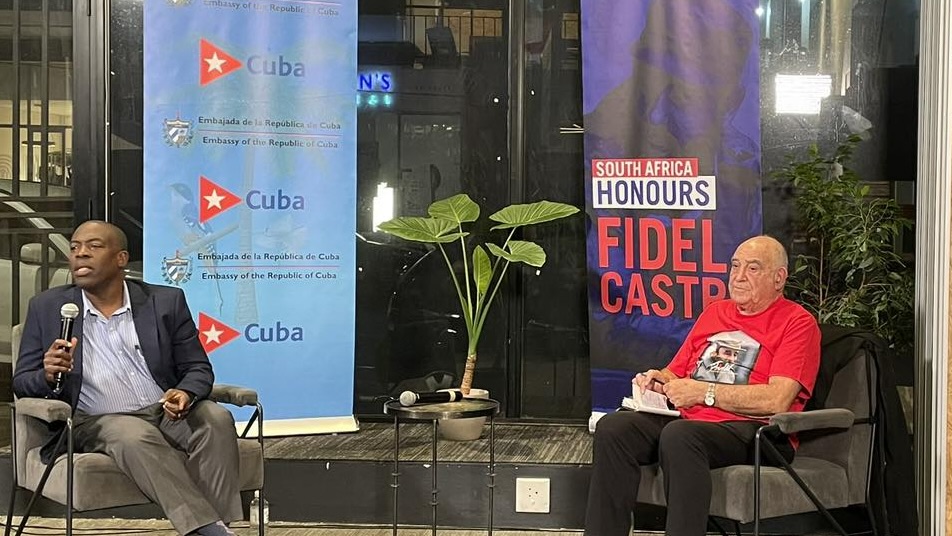
Cuban diplomat in South Africa Jesús Perez and renowned South African anti-apartheid activist and veteran of the struggle Ronnie Kasrils. Photo: PAT
From military defeat to economic warfare
Pérez explained that after its failure at Playa Girón, the United States shifted its strategy toward long-term destabilization.
“In 1960, US officials made it clear, if they could not defeat the revolution militarily, they would try to suffocate it economically,” he said. “The objective was to create hardship, lack of food, lack of medicine, so that the Cuban people would turn against their own government.”
He drew direct parallels to the present:
“What we are experiencing today is not new. The blockade, the pressure, the attempts to isolate Cuba, these are continuations of that same policy.”
Despite these pressures, Pérez pointed out Cuba’s refusal to abandon its principles.
Read more: “This is our Moncada, our Bay of Pigs,” says young Cuban communist leader
“In the 1980s, we were told that if we stopped supporting African liberation struggles, the blockade could be lifted,” he said. “Our answer was clear; no. There is no possibility of abandoning our brothers and sisters in Africa.”
He situated this stance as important to Cuban identity:
“Internationalism is not optional for us. It is how we repay our debt to humanity. Our ancestors came from Africa, our strength, our resistance, our courage are rooted there. To abandon Africa would be to abandon ourselves.”
Kasrils: “The Cuban Revolution shaped our struggle”
Taking the floor, Ronnie Kasrils connected Cuba’s revolutionary experience to Africa’s liberation struggles, drawing from decades of personal involvement in the anti-apartheid movement.
Looking at the Cuban flag hanging on the wall, Kasrils remarked, “The Cuban flag stands for national independence, freedom, and anti-fascism.” “Its meaning has penetrated deeply into the consciousness of our struggle here in South Africa.”
He described how Cuba entered his political consciousness in the early 1960s.
“I had just joined the struggle as a young student after the Sharpeville massacre,” he recalled. “Within the movement, we began singing, ‘Go take the country the Castro way…’ That was the mood.”
Kasrils highlighted the decisive role Cuba played in Africa, particularly in Angola.
“When Angola was under threat from apartheid South Africa, from CIA-backed forces, it was Cuba that responded,” he said. “Not as invaders, but at the request of the Angolan people, to defend their sovereignty.”
He described the impact of this intervention:
“The Cuban presence changed the balance of forces. It was central to the defeat of apartheid’s regional aggression and contributed directly to our own liberation.”
Read more: Angola’s debt to Cuba is unfinished
Further he said; “[I] had the privilege of being in Cuba in a delegation led by Joe Slovo. We met Fidel Castro in the defense headquarters. He explained the battle of Cuito Cuanavale, how Cuban and Angolan forces dealt a decisive blow that led to Namibia’s independence and impacted South Africa’s freedom. Our freedom was driven by internal forces, but international solidarity was enormous.”
Humanity in struggle
A recurring theme in Kasrils’ remarks was the centrality of ordinary people in revolutionary struggle.
“Fidel said the revolution is of the humblest, by the humblest, and for the humblest,” he said. “When the humblest are armed with consciousness as well as weapons, real change becomes possible.”
He stressed that this principle remains relevant today.
“Revolutionary intellectuals are vital,” Kasrils noted, “but the link must always be with the humblest. They are the ones who stay with you to the end.”
National sovereignty and global struggle
Both speakers discussed the importance of sovereignty in contemporary struggles.
“The most important principle,” Kasrils argued, “is national sovereignty and independence. Without it, nothing else is possible.”
However, he warned against viewing struggles in isolation.
“The connection between Havana and Tehran, between Palestine and Africa, is not accidental,” he said. “These are all fronts in the same struggle against imperialism.”
Read more: Iran shows that sovereignty stems from military self-sufficiency and anti-colonialism, says Iranian professor
Pérez echoed this sentiment:
“We are always open to dialogue with any country,” he said. “But it must be based on respect for our sovereignty, our independence, and our dignity as a people.”
With deepening crisis, widening inequalities, and intensifying imperialist interventions, the Anti-Fascist Friday gathering made clear that the anniversaries of Fidel Castro and the victory over the Bay of Pigs invasion are more than moments of remembrance, they are calls to action.
The post Cuba’s victory at Playa Girón and Castro’s legacy inspire renewed calls for global anti-imperialist solidarity appeared first on Peoples Dispatch.
From Peoples Dispatch via This RSS Feed.