

This coverage is made possible through a partnership between Grist and WABE, Atlanta’s NPR station.
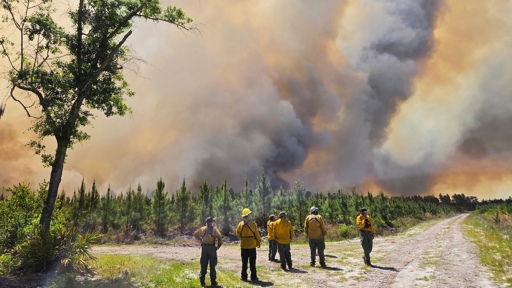
Wildfires are burning across more than 27,000 acres in south Georgia, according to the Georgia Forestry Association. Governor Brian Kemp has declared a state of emergency in 91 counties.
One fire, the Brantley Highway 82 fire, began Monday night and has since prompted evacuation orders. On Tuesday morning, that fire covered a few hundred acres and was 75 percent contained. But it rapidly spread and intensified later in the day and overnight. By Wednesday morning, it had reached 5,000 acres and was just 10 percent contained, according to Western Fire Chiefs Association, which tracks fires around the country. Local officials say 54 homes have been destroyed.
“I will be very honest with you and say it’s a miracle that there have not been any lives lost,” said Brantley County Manager Joey Cason in a press conference Wednesday afternoon.
Brantley County and several area churches have set up shelter sites for displaced residents and begun collecting donations for firefighters and people who’ve lost their homes. The Pinelands Road fire in Clinch County, near the Florida border, began over the weekend and has since spread over 16,000 acres. It is just 10 percent contained.
Both counties are heavily forested and sit on the edges of the vast Okefenokee swamp, Clinch to the west and Brantley to the northeast.
Fires are burning in northern Florida, too, which is experiencing similar drought conditions. Officials in both states were monitoring more than 100 fires as of Wednesday, though many were small and quickly contained.
While it’s common for fires to start in Georgia forests due to lightning strikes, stray cigarettes, sparks from backyard fires, and a number of other causes, thanks to forest management and plenty of rain, most don’t normally burn very far. Officials say this year is different. Rainfall and water levels are far below normal across Georgia, increasing fire risk. Conditions like this are becoming more likely in many places as climate change worsens the intensity and duration of droughts.
“Under drought conditions, we have that much less water available either in the water table or in our swamps, ditches, drains, lakes,” said State Forester Johnny Sabo. “So the wildfires can spread more rapidly.”
A large swath of South Georgia is in an “exceptional drought,” the driest category under the federal drought monitoring system. Much of the rest of the state is in “extreme drought,” the next most severe designation. Many Georgia forests also still have downed trees from Hurricane Helene, providing more potential fuel for large fires, said Erin Lincoln, director of the Center for Forest Business at the University of Georgia.
“This is a serious and evolving situation,” said Tim Lowrimore, president and CEO of the Georgia Forestry Association, in a statement on the group’s Facebook page. “We urge all Georgians to remain vigilant. Preventing additional fires right now is critical as responders work to manage this emergency.”
Hazy, smoky air has reached as far north as Atlanta, in the middle of the state, downgrading the air quality there to moderate, meaning it could be risky to some people. In Macon and Columbus, unhealthy air quality levels have been reported.
The state has issued a burn ban for south and central Georgia, asking people not to light any fires outdoors. “Our number one cause of wildfires in the state are humans, unfortunately — people being careless,” Sabo said. It’s critical that Georgians heed those warnings, he continued.
This story was originally published by Grist with the headline What’s driving the catastrophic wildfires in Georgia on Apr 22, 2026.
From Grist via This RSS Feed.
Ask the Maya or incans
O wait…