

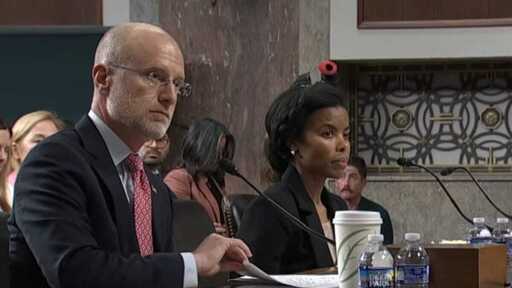
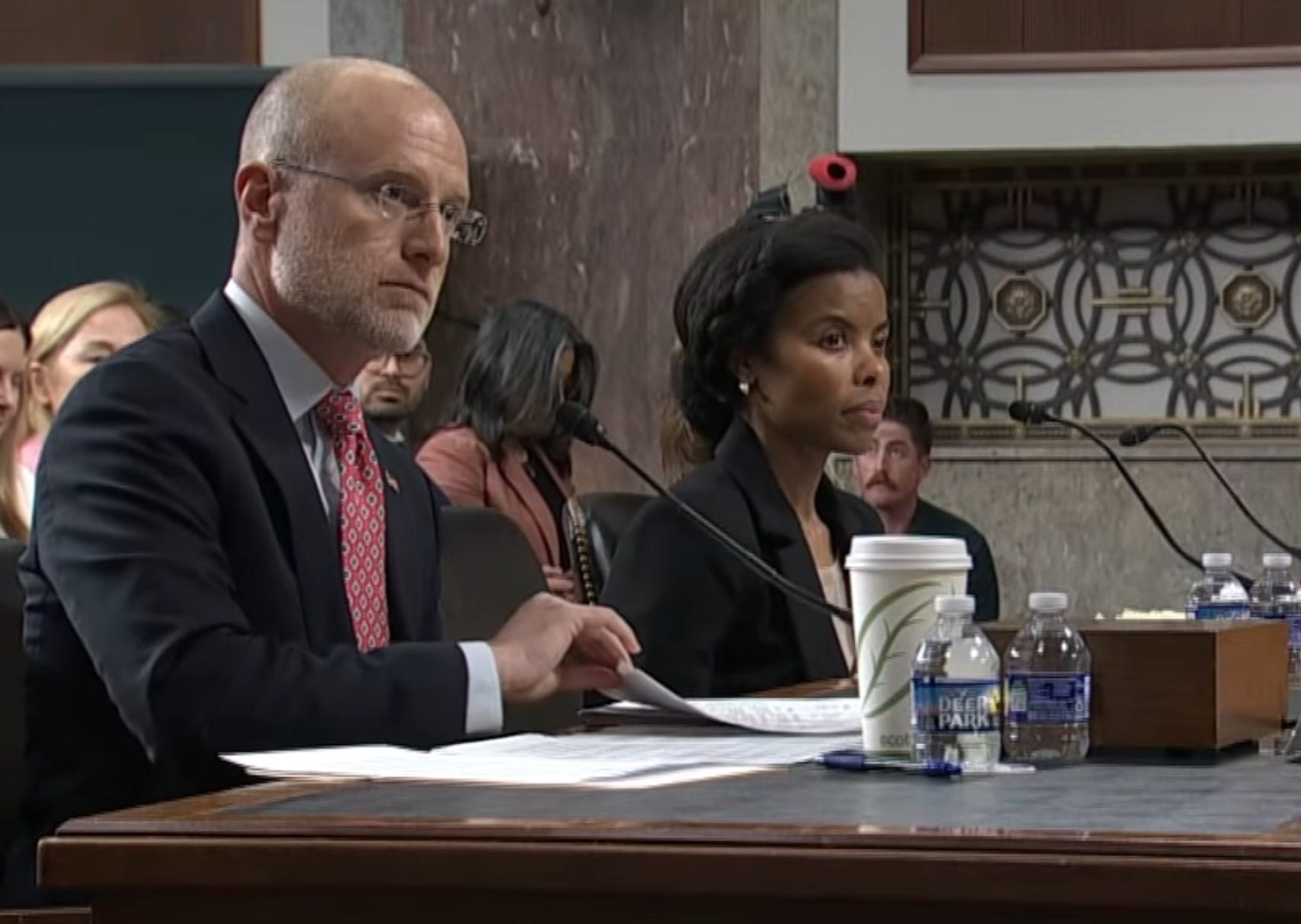
Brendan Carr // CSPAN
Erin In The Morning is a reader-supported publication. To receive new posts and support my work, consider becoming a subscriber.
Today, FCC Chairman Brendan Carr announced that the FCC would be seeking comment on whether the TV Parental Guidelines rating system needs to be changed to address shows with transgender or nonbinary characters. The public notice, which Carr posted on twitter this morning, seeks to weaponize the TV ratings system to restrict shows that include such characters—asking whether programs that contain “the discussion or promotion of gender identity themes” should “be rated differently or contain relevant descriptions.” Though the FCC’s direct authority over the TV ratings system is limited—the system is voluntary and industry-run, and streaming platforms like Netflix and Disney+ can maintain their own standards—the FCC retains enormous coercive power over broadcast networks and their parent companies, many of which also operate streaming platforms. The move comes after a series of attacks on network television weaponizing the FCC for political purposes, including Carr’s threats to revoke broadcast licenses over news coverage of the Iran war and his targeting of ABC over late-night host Jimmy Kimmel. It appears to be an attempt to extend “Don’t Say Gay”-style policies—which have restricted discussion of LGBTQ+ people in classrooms across red states—to national television ratings.
“Years ago, Congress passed a law that empowers parents to decide the types of TV programs that are appropriate for their kids by standing up a TV show ratings system. But recently, parents have raised concerns with the industry’s approach—including with ratings creep. Specifically, they argue that New York & Hollywood programmers are promoting controversial issues in kids programming without providing any transparency or disclosures to parents. This undermines the whole point of the law and the ratings system parents rely on. The FCC is now seeking comment on whether the industry’s approach provides parents with the types of information and disclosures relevant to them today,” Carr wrote on twitter. However, the actual document posted alongside his statement tells a more specific story—it primarily centers on gender identity.
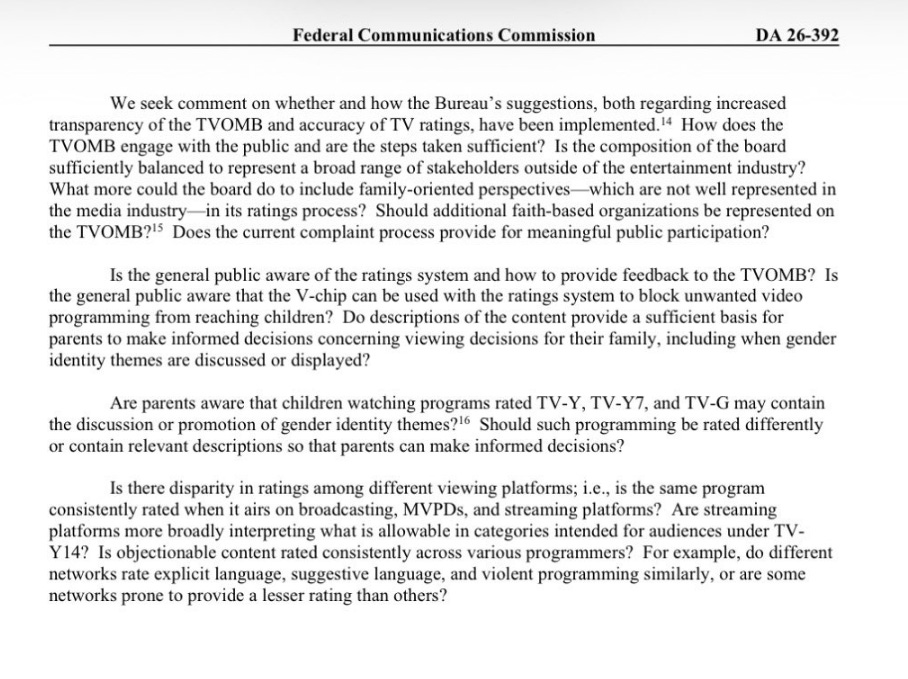
The document states, “Recently, parents have raised concerns that controversial gender identity issues are being included or promoted in children’s programs without providing any disclosure or transparency to parents. Specifically, the industry guidelines that parents rely on are rating shows with transgender and gender non-binary programming as appropriate for children and young children, and doing so without providing this information to parents, thereby undermining the ability of parents to make informed choices for their families.” It then poses a series of loaded questions: “Are parents aware that children watching programs rated TV-Y, TV-Y7 and TV-G may contain the discussion or promotion of gender identity themes? Should such programming be rated differently or contain relevant descriptions so that parents can make informed decisions?” The document also asks whether “additional faith-based organizations” should be given seats on the TV Parental Guidelines Monitoring Board—the industry body that oversees the ratings system.
The TV Parental Guidelines rating system was established in 1997, after Congress passed the Telecommunications Act of 1996. The TV Parental Guidelines Monitoring Board has overseen the system since, applying familiar ratings like TV-G and TV-PG to programming across broadcast television. Cable television and streaming platforms like Netflix, Disney+, and Hulu are not subject to the FCC’s regulatory authority and are not required to use the system, but have voluntarily adopted the same rating categories for consistency—meaning that any changes to how the system treats transgender content could ripple across the entire television landscape even without a legal mandate. While the FCC cannot directly change how the industry rates its programming, under Carr it hasn’t needed to—the agency has repeatedly used legally dubious threats to pressure networks into self-censorship, and this public notice sends the same kind of signal to an already skittish industry.
If networks bow to this pressure, the impact on LGBTQ+ programming could be enormous. Transgender and nonbinary characters in children’s television are already vanishingly rare—GLAAD’s most recent report found just one transgender character on all of broadcast television. Youth shows could see what little representation remains stripped out entirely, as networks preemptively remove trans and nonbinary characters rather than risk a ratings penalty or government scrutiny.
The pressure extends well beyond broadcast: Disney owns both ABC, which requires an FCC broadcast license, and Disney+, which does not. NBCUniversal owns NBC and Peacock. Paramount owns CBS and Paramount+. When Carr threatened ABC’s station licenses over Jimmy Kimmel, it was Disney that pulled Kimmel off the air—and Disney also owns the streaming platform that produced The Owl House, one of the most beloved queer animated shows in recent memory, which Disney canceled after its creator said it didn’t fit the company’s “brand.” The parent company dynamic means that FCC pressure on a broadcast license can cascade into content decisions on streaming platforms the FCC has no jurisdiction over. And the FCC appears to know this—the document explicitly targets streaming platforms despite having no regulatory authority over them, asking, “Is there disparity in ratings among different viewing platforms; i.e., is the same program consistently rated when it airs on broadcasting, MVPDs, and streaming platforms? Are streaming platforms more broadly interpreting what is allowable in categories intended for audiences under TV-Y14?”
The targeting comes at an already devastating time for queer animation. Beloved shows with LGBTQ+ characters have been systematically canceled or ended, and the shows that remain are under increasing pressure to strip queer content. Disney removed a transgender storyline from the Pixar series Win or Lose before it aired, with the company stating that parents should discuss such topics with children “in their own time”—the exact framing the FCC’s public notice now uses. Disney+‘s “Junior Mode” parental controls were found to filter out LGBTQ+ content entirely from kids’ profiles. Anonymous Pixar employees have alleged that executives demanded they cut queer content, writing in a letter that “nearly every moment of overtly gay affection is cut at Disney’s behest.”
“It is hard to imagine just a few years ago when Pixar’s own Luca (2021) was celebrated within the community for its queer themes. Now, the queerness of Pixar’s Luca no longer seems like the result of a studio being held back by higher powers from telling an openly queer story but rather the result of Pixar leadership’s own mandate to relegate any queer characters to the background. I am no longer certain that the studio would have even released the same cut of Luca in 2025 as it did in 2021, such is the frighteningly fast normalisation of queer erasure in mainstream media, including animation, that has occurred in the last couple years,” writes Oliver Vigni, a fantasy/animation writer.
The public comment period is open now through May 22, 2026. Anyone can submit comments opposing this effort through the FCC’s Comment Filing System under MB Docket No. 19-41. LGBTQ+ organizations, parents, animators, and allies are encouraged to make their voices heard—the FCC is required to consider all comments submitted during the period.
Erin In The Morning is a reader-supported publication. To receive new posts and support my work, consider becoming a subscriber.
From Erin In The Morning via This RSS Feed.