

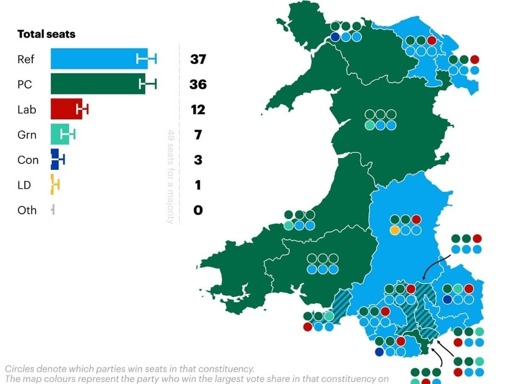

The latest projections from YouGov, published on 22 April, put Welsh nationalist party Plaid Cymru and far-right populists Reform UK neck-and-neck for control of the Senedd. What’s more, the pollster also predicts massive losses for both Labour and the Conservatives.
The new data represent only the second YouGov multi-level regression and post-stratification (MRP) model for the 2026 Senedd election. Between 6 and 15 April, 3,000 adults in Wales contributed to the dataset.
Some of the data is compared to notional results for 2021, because the Senedd electoral system has recently undergone massive changes.
Compared to the first MRP from March 2026, Reform has gained an extra seven seats. Conversely, Plaid Cymru has lost the same number.
Meanwhile, the Greens are also set to make significant gains. Although the left-wing environmentalist party has never had a Senedd MP, YouGov now predicts that the left-wing party will win seven seats.
Reform set to gain, Labour set to lose
The Tories would have held a notional 26 seats in 2021. However, YouGov’s central projection has them on just 3 seats this year. The pollster pointed out that:
This would leave the party short of the five seats needed to form a political group in the Senedd, barring them from chairing committees and limiting their ability to question ministers.
However, the Tories’ predicted losses pale in comparison to Labour’s:
Last time Labour lost a general election in Wales:
Attlee is still in the army; Bevan is 21 & about to go to study in London.
Conan Doyle still writing Sherlock Holmes; Monet still painting water lilies.
Civil war in Russia; a wounded Hitler has just returned to Munich. https://t.co/839LbVE7mj— Joe Allen (@Joe___Allen) April 22, 2026
YouGov explained that the Labour Party was:
set to fall to just 12 seats in the Senedd, a notional loss of 32, ending their century of dominance of Welsh politics and leaving them with no representation in a huge swathe of the country stretching from Llanelli to Llandudno.
As such, many social media users speculated as to the… efficacy of voting Labour:
Voting Labour under these circumstances is madness. https://t.co/uH4P9voF3G
— Zoe Gardner (@ZoeJardiniere) April 22, 2026
Some even characterised a vote for Labour as a vote for Reform, in the circumstances:
it’s clear in Wales it’s now vote Labour and get Reform
or vote Plaid and get Plaid #localelections26 https://t.co/dBcvM3CkIE— neil merriman (@NeilMerriman) April 22, 2026
Coalition on the cards
However, as with a great deal of parliamentary politics, the reality isn’t quite that simple. Rather, YouGov speculated at length about the possibility of a coalition government within the Senedd.
This was largely because both Plaid Cymru and Reform are predicted to take 40 seats at the outside. Even that best case scenario for either party is far short of the 49 required for a majority.
Rhun ap Iorwerth, the Plaid Cymru leader, has voiced a preference for his party to form a minority government. However, this would involve trying to get the Greens or Labour on-side in order to pass any motion, which is somewhat impractical.
Nevertheless, some social media users have speculated that Plaid Cymru would be a welcome change:
For what its worth, I think it’d be good for Wales if it took a break from being led by Labour – same as it was for Scotland.
If Wales puts Plaid Cymru in power, they will get a chance to see what they have to offer & what they can achieve.Voting Reform or Tory won’t help Wales https://t.co/k7eZr9eyq5
— Bryan Smith #RejoinEU same handle on BlueSky (@BpsmithUk) April 22, 2026
In practice, the Welsh parliament would likely only be able to function with some level of alliance between two or more parties. In that scenario:
the balance tips decisively towards the likelihood of a Plaid Cymru-led government, as Reform UK and the Conservatives win a collective right-of-centre majority in a mere 3% of our model’s simulations, suggesting Dan Thomas’s route to being first minister is limited. […]
Although they fall just short in our headline estimates, Plaid Cymru and Labour hold a majority between them in 47% of our simulations, while Plaid Cymru and the Greens do so in 5%. The three parties hold a combined majority in 96% of our mid-campaign model’s simulations.
The possibility of a Plaid-led coalition beating out Reform will likely come as a relief to a good deal of Welsh residents. Many posters expressed their distaste at the prospect of “English nationalist” Reform controlling Wales:
Wales doesn’t have power over immigration, only Westminster does. Don’t let an English nationalist racist party take over Wales, change our history to British in museums, and make life much harder for the vulnerable.
Owain Glyndŵr fought against this.Vote @Plaid_Cymru 7th May https://t.co/2gQIEsLJnx pic.twitter.com/M9CbQoXeDp
— Sharon

(@K4rmaRules) April 22, 2026


And again:
All that Reform blue in Wales is disgusting. It seems like Wales wants to continue to be controlled by right wing English people. https://t.co/nVGjGV2r0W
— Tom_Owain (@TOwainlfc) April 22, 2026
Meanwhile, others were more bothered by Reform’s clear vendetta against working-class people:
#wales #cymru People of Port Talbot, Swansea and South Wales. Please DOn’t vote REform, YOu are voting against working people, losing jobs in the council and Reform want to frack particularly in the Swansea Bay area. .They will take your employment rights https://t.co/jD3Ro8A1LN
— Al Bopper (@Alanbopper) April 22, 2026
Whilst YouGov currently predicts an incredibly tight race between Reform and Plaid Cymru, the prospect of a coalition being necessary means that practically any of the major parties may find themselves with a share of the leadership of the Senedd.
As such, 7 May’s voting will be more crucial than ever — and will bring greater change to Welsh politics than we’ve seen for decades, for better or for worse.
Featured image via Twitter
From Canary via This RSS Feed.