

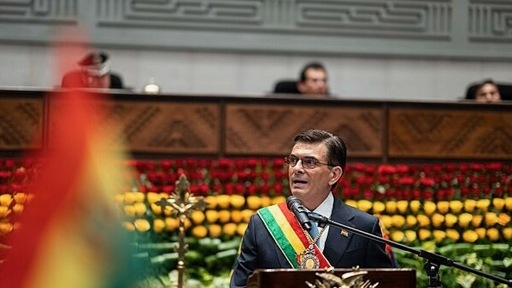
The recent regional elections in Bolivia have dealt a severe blow to the right-wing government of Rodrigo Paz. The president, who has positioned himself as a key ally of the Trump administration in the United States, has been in office for less than six months and already suffered a major electoral setback.
Paz, who stated that he would prioritize neoliberal policies, faced a massive mobilization of workers last January when he attempted to eliminate fuel subsidies. The country’s most powerful unions and various left-wing movements joined a national mobilization that, after days of intense clashes with law enforcement, forced the neoliberal government to back down. This measure, along with others promoted by the IMF, has apparently caused social unrest that has come at a high cost to the Paz administration.
A clear electoral setback
The election of several governors had to be decided in a runoff, as in several departments, no candidate reached the 50% of votes needed to win in the first round or obtained 40% of the votes plus a 10% margin over their closest rival. In both cases, the law mandates a runoff between the top two candidates.
Paz decided to support nine candidates in the elections, many of whom did not belong to his party but were allies. For now, as the vote counts progress, it appears that Paz’s candidates have won in only two of the nine governorates (in La Paz and in Beni, where Tito Egüez won), which has been interpreted by several experts as a severe blow to the government’s legitimacy.
Moreover, the victory of the alliance led by the president has been questioned by the opposition as illegitimate, since the winner in La Paz, Luis Revilla, was declared by the Electoral Tribunal despite protests from René Yahuasi, who asserts that Revilla’s 20.02% of the vote renders him a governor without legitimacy.
The remaining seven winners belong to parties that were not endorsed by Paz and thus represent political ideologies (left, center, and right) that differ from those of the ruling party. In Santa Cruz, the most populous and wealthiest department, Juan Pablo Velasco of the right-wing Alianza Libre won; the party is linked to former President Jorge Quiroga, who has been reluctant to support Paz.
The Movement Toward Socialism (MAS), which governed Bolivia for 19 years during the progressive administrations of Evo Morales (2006–2019) and Luis Arce (2020–2025), won only the governorship of Cochabamba, the country’s third-most populous department. Leonardo Loza, a close ally of Morales, will assume the governorship.
Probably the hardest and most surprising defeat for Paz came in Tarija (the region where the country’s president is from), where María René Soruco, the candidate for Camino Democrático al Cambio, swept the vote with more than 70% of the votes against Paz’s candidate. Meanwhile, Edgar Sánchez of Alianza Jach’a and Luis Ayllón of Gente Nueva were declared winners in Oruro and Chuquisaca, respectively.
Furthermore, Paz suffered a resounding defeat in Bolivia’s mayoral elections. Of the nine regional capitals, his PATRIA alliance secured victory only in Trinidad, where Mauricio Barba will serve as the new mayor.
Political fragmentation and scandals
In addition to unpopular measures, a series of scandals has eroded the executive branch’s credibility. Several media outlets reported that approximately 32 suitcases containing USD 100 million were smuggled into the country, although the recipient of the money remains unknown. Furthermore, the government approved the importation of fuel that, according to some users, has caused damage to thousands of engines, which is why the scandal has been dubbed the “junk fuel” scandal.
Paz, for the time being, has called for a reform of the electoral law, a move viewed by several analysts as an attempt to evade responsibility for the results. However, Paz also asked the winners for their cooperation in moving his political project forward: “The era of the single-party system is behind us. Today marks the beginning of a Bolivia with new leadership, new projects, and a clear commitment: to work together.”
However, it is clear that political division in Bolivia has led to a crisis of legitimacy. The right wing itself – of which Paz is a part – has been unable to unite its efforts due to the economic and political interests it represents, which often conflict with one another. For its part, the left, which entered the 2025 presidential elections deeply fractured, has yet to recover from its crushing defeat in the last elections.
The post Paz suffers a stinging defeat in Bolivia’s regional elections appeared first on Peoples Dispatch.
From Peoples Dispatch via This RSS Feed.