

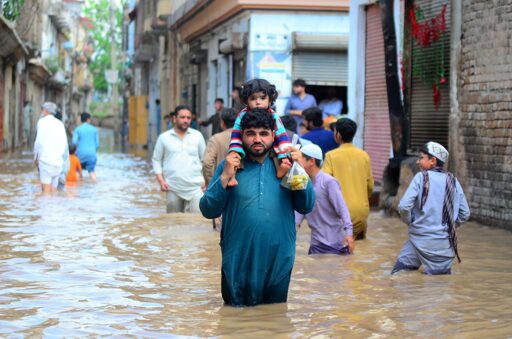
Just decades from now, millions of people all over the world will be forced to move because of climate change. In his new book, Shelter from the Storm: How Climate Change Is Creating a New Era of Migration, acclaimed journalist and migration researcher Julian Hattem reports from the front lines of the environmental apocalypse, taking readers on a journey from the South Pacific to the Indian subcontinent, to the Mediterranean. TRNN Editor-in-Chief Maximillian Alvarez speaks with Hattem about his new book and about the massive human displacement that is already being caused by climate change today.
This podcast was recorded on April 4, 2026, at “End Papers: A mini-book fest on capitalism and the climate crisis,”hosted by Red Emma’s Cooperative Bookstore and Coffeehouse in Baltimore, Maryland.
Guests:
- Julian Hattem is the editor of Migration Information Source, the online magazine of the Migration Policy Institute, and founder and host of the podcast Changing Climate, Changing Migration. He has been on staff with the Associated Press and The Hill, and written for outlets including the Washington Post, The Guardian, NPR, and The Atlantic. The author of Shelter from the Storm: How Climate Change Is Creating a New Era of Migration (The New Press), he lives in Washington, DC.
Credits:
- Audio Post-Production: Alina Nehlich
Transcript
The following is a rushed transcript and may contain errors. A proofread version will be made available as soon as possible.
Maximillian Alvarez:
Welcome back to The Real News Network. I’m Maximillian Alvarez. Just decades from now, millions of people all over the world will be forced to move because of climate change. Entire islands will disappear into the sea. Once in a century, hurricanes will occur on a regular basis, decimating cities and wiping out people’s homes. Wildfires fed by prolonged drought will rage through communities. No one will be immune. In countries rich and poor, climate change will usher in a new era of migration. In his new book, Shelter From the Storm: How Climate Change is Creating a New Era of Migration. A claimed journalist and migration researcher, Julian Hadam, reports from the front lines of the environmental apocalypse. Hadam takes readers on a journey from the South Pacific to the Indian subcontinent to the Mediterranean, offering a frankly shocking glimpse into the massive human displacement that is already being caused by climate change today.
And I recently had the chance to speak with Julian Hadam about his book in front of a live audience at Red Emma’s Cooperative Bookstore and Coffeehouse here in Baltimore. The event was actually part of Endpapers, a mini book fest on capitalism and the climate crisis organized by the good folks at Red Emma’s. And it was honestly just such a vital, energetic and important event that brought together, I mean, scholars, organizers, and Baltimore residents to talk about the climate crisis, how it’s impacting our world, and what the hell we can do about it. And I was really grateful to be asked to participate in this event. And I’m so grateful to Red Emma’s for playing such a continued essential role in bringing folks together to share knowledge and build power. And of course, I am also grateful to Julian Hadam for writing this important book, which you all got to go check out.
So here without further ado is my conversation with Hadam about his new book, Shelter From the Storm: How Climate Change is creating a new era of migration.
All right. Well, thank you so much, Meg, and a huge, huge thank you to Red Emma’s Cooperative Bookstore and Cafe. Coffeehouse, let’s give it up for Red Emma’s. Let’s give it up to Meg for hosting and organizing this incredible conference. Thank you all so, so much for being here. I’m Maximilian Alvarez, and I’m genuinely honored to be here with all of you and to be in conversation with Julian Hadam about his vital new book, Shelter From the Storm: How Climate Change is Creating a New Era of Migration, which seems pretty goddamn relevant right about now. And I’m sure even all things considered, Julian couldn’t have foretold all the ways that it would become so relevant when he embarked on this book. And so I want to talk to you, Julian, in a second, about how you embarked on the book, how it came together over the course of these raucous couple years.
But to just set the stage for everybody, I wanted to read a couple of passages from Julian’s book. So Julian writes, quote, “The impacts of climate change are widespread and in some cases irreversible according to the United Nations intergovernmental panel on climate change, creating tremendous strain on our health, economies, infrastructure, and food and water.” From 2000 to 2019, climate change was responsible for global losses of nearly $2.9 trillion, about $16 million every hour. By the end of this century, the planet could get on average as much as 4.4 degrees Celsius warmer than the pre-industrial levels of the 1800s, according to the IPCC. In even a best case scenario, the planet will continue to heat up until the 2050s, leading to more severe weather occurring more regularly. Not every single natural disaster is the result of climate change. Hurricanes, floods, fires, and droughts have been occurring for as long as the planet has been around.
The science is resoundingly clear that humankind’s release of greenhouse gases has made extreme events more common, more intense, and more widespread. The consequences are disastrous for animal species all across our planet. Global warming of two degrees centigrade could put as much as 18% of species at very high risk of extinction. Mass die offs could transform the crucial web of life that has allowed ecosystems to thrive for millennia. For humans, the future looks hardly less severe. As many as 3.6 billion people, just under half the entire planet live in places considered highly vulnerable to climate change, meaning that they are under threat from rising rivers, encroaching drought, and other impacts according to the IPCC. About a billion people live on or near the coast, which face rising sea levels, severe storms and floods. Warmer weather means more people will die in heatways while diseases such as dengue will spread to new areas, putting billions at risk of infections.
Long periods of drought will create parched farmland that refuses to yield crops. In temperate climates in much of North America and Europe, roads, bridges, railways, and other infrastructure weren’t built to withstand temperatures that regularly exceed a hundred degrees Fahrenheit. Untreated asphalt can soften. Concrete can buckle and cracks can expand to jeopardize the integrity of bolts and fixings. When these things happen, millions will leave their homes and never return. The World Bank projects that by 2050, climate change will force as many as 216 million people to move within their own countries, more than the current population of all but the world’s six largest nations. This is the future, but it is also the present. Already small island states in the Pacific are regularly inundated with water and actively planning for the likelihood that rising sea levels will wipe their homelands off the map. Croplands are going dry and farmers are being forced to abandon their fields in search of new livelihoods somewhere else.
Hurricanes routinely batter fragile rural villages, destroying homes in entire communities and scattering their residents. Worldwide natural disasters drive people out of their homes more than twice as often as war and other conflict. Even in the wealthiest country on earth, wildfires can tear through the neighborhoods and floods can drown city blocks, forcing people away and preventing them from ever returning. The era of climate migration is already here. We’re just finally starting to realize it. Julian, tell us where this book came from and how it came together and talk about what it’s like releasing that book into the world that we’re in today.
Julian Hattem:
First, thank you so much for coming on. I really appreciate it. So it is incredibly clear. Obviously, that climate change is having a profound impact on human society in a very transformative way. It’s changing what we eat, how we live, where we work, and I think also where we live, clearly. And I really wanted to tell a story that both shone a light on that as not a future projection, but as a current reality, and make clear that that was a global reality. And global means in every country around the world, but also here in our country, in my story and people’s stories in this room, and that those kind of two twin elements were really important to me to tell. And so I am a journalist, this is a work of journalism, and I wanted to tell that story from the ground up by finding people, talking to people, and getting them to tell me the ways in which climate change was impacting their lives and making them move, or in some cases, preventing them from moving, which is also a really important element of this story as well.
And so it grew from there. But also, I think it’s also important to make very clear that some of what you just described is some of what you read is catastrophic and the climate crisis is a catastrophe in many ways, but migrating in response to crisis is not necessarily a bad thing. It’s good to get out of a wildfire. When there’s a hurricane coming, you want to be able to escape to freedom or to safety. But also historically, humans beings are an incredibly migratory species and we have always migrated for better futures, for literally better pastures, for better lands, for better realities for ourselves, for our children, and that bet has historically paid off. And so especially in the climate change era, the migration can often be a bad thing. It can be a sign of desperation and forcing people from their homes, but it can also be a form of adaptation.
Climate migration can in the right circumstances be good. You don’t want to force people to live in dying crumbling lands. And I think that was kind of the story I wanted to tell. So in the book, I go to a couple different regions, talk to a couple different people to try and bring that story out, but those were kind of the guiding elements of that. And as for what it means now, yeah, I wish it were in a relevant book. I wish that this were an irrelevant topic, but I think that both the issues of climate change and migration are increasingly politicized and have become increasingly political, in some ways positively, in many ways negatively, and I think it continues to be resonant in a lot of ways.
Maximillian Alvarez:
Right. And like you said, both good and bad. And if anything, the sort of, let’s just take the past year or maybe the past chunk of years, I think that the roiling horrific times that we find ourselves in are both showing us part of the horrifying reality of climate change and a 21st century in which climate concerns are driving a lot of the war and aggression and so on and so forth. So we’re seeing some of it there, but we’re also seeing the apotheosis, the apex of the kind of contradiction between the modern concepts, the nation state conception of immigration and the human history of migration. And that’s, of course, the title of your first chapter is that we’ve always been climate migrants. So can you unpack that for us?
Julian Hattem:
Yeah, sure. I mean, I’m not going to speak to everyone in this room. Many people in the world are themselves migrants, or if not from international, from internal within their own country, they’ve moved from point A to point B. But historically, we have always moved around as a species and the environment has, for a long time, been a part of that. Cities are where they are because there are rivers there, because it’s not too cold. It’s very cold in Antarctica. A lot of people don’t live there. It’s very hot in the Sahara. Not that many people live there, but the environmental factors have always kind of been a driver of where and how people move. And even in the relatively more recent history, the climate has changed, not in any way to the degree at which it’s currently changing now due to human cause climate change, but there have been what’s called the Little Ice Age or the medieval ice age was a period in the medieval times when parts of Europe got exceptionally cold and it created some movement patterns within Europe.
There was some Viking. There was a point at which much of the North Sea was frozen. So some troops could march literally from Denmark across to the Scandinavia. There were times at which things were warmer. So there were grapes growing very up high into England, so you could grow wine. Vineyards were very popular across England at the time.
Maximillian Alvarez:
I was quite fascinated to learn that there used to be wineries in the Midlands of England.
Julian Hattem:
Could be, again, if things keep going, right? But even in this country, a lot of people think about the dustbowl migration, which I think is for a lot of us, a great example of how climate factors can add on top of underlying issues to really compel movement. And so these are not strange stories. People are aware of the dust bowl. Many of us read grapes of wrath in high school. And so climate issues are inextricably interwoven in a lot of our economic lives, a lot of our social lives. It’s relatively recent that human beings have been majority urban dwellers until the last 10 or 20 years. A majority of the world did not live in cities. Now we do, but historically we lived in rural areas, and especially if you were connected to the land in pre-industrial eras, when there were variations in rainfall, when there were droughts, which there have always been to some degree, although more now, when there were hurricanes, which there have always been to some degree, although more and more extreme now, those impacted where and how you lived.
And I guess the point is that climate events and environmental events have always been interwoven into all of the other factors that affect where and how people move. And often it’s … I think when we think about climate migration, quote unquote, now, people tend to think of fleeing a wildfire, like running away from a drought. And it’s a very clear binary of climate event happens. I don’t want to be there, therefore I run and go someplace else. Sometimes it’s like that, but most often it’s much more complicated. It’s much more nebulous. So the book, I went to Guatemala, did some reporting in Guatemala, and there’s a long history of migration from Guatemala to the US. And one of the things that’s very clear is that climate change is very real in many places, including in Guatemala, including with farmers that I talked to who were affected by seasonal rainfall variation and hurricanes and mudslides.
But that was just one element. And there was all of these other things sacked on top of each other. And now there’s the history of migration, there’s global economic inequality and the urbanization and the legacy in Guatemala in particular of civil conflict, the genocide against the Mayan. You add all these elements together and now you add climate change on top. And it’s not just climate change itself, it’s climate change makes it harder to be a farmer. And maybe that would be okay, except that you’re in a relatively disadvantaged part of the country because you are indigenous and because of the civil conflict in that country that has pushed you to disadvantageous lands and you add all these things up together. And now this little extra push that comes from climate change can be the precipitant, I guess, to move, to leave. And then that can take effect in many ways.
In the US, I think many of us might feel that we are often protected against climate change unless we suffer through an intense hurricane or wildfire. But for a lot of us, insurance is a real thing, right? If you own a home or a property and climate change is impacting the deductible and the premiums of your home insurance, that is a factor that can make you think about whether or not to go someplace else. And for many people it has. I mean, research is still kind of evolving on this, but there is a very clear trend that climate crisis is creating more or higher insurance costs, or in some cases, the lack of availability of insurance. And that has an impact on some people being pushed out of their homes and going other places, but also at the same time, some people not being able to, not being able to afford to leave, and then they’re stuck in a place where they’re either paying a higher cost or have no insurance.
So if a crisis does come, they lose everything.
Maximillian Alvarez:
Oh, and I think that’s very well put. And it hits so close to home for me because I not only come from Southern California where those fires that you write about were, and I’ve been dealing … Ever since I left home in 2005, I’ve been dealing with more and more of my home state burning every year. I remember calling my mom one year and she was just talking to me like normal, and then I noticed she’s doing stuff in the background. I was like, ” Mom, what are you doing? “She’s like, ” Oh, nothing. We’re just being evacuated. “I was like, ” What are you doing on the phone? “But that’s kind of where my mom is and I love her, but that’s just been kind of getting worse. We’ve had our mega drought out there. But from there to the residents of Asheville, North Carolina, who I’ve interviewed in the wake of the massive hurricane a year and a half ago that went so far inland that it destroyed a lot of Ashland, North Carolina for Christ’s sake.
And so the point being is that I was interviewing people there because I’ve been looking at what are so- called sacrifice zones across the country, like areas where the conditions for … People are left to live in conditions that threaten life itself, including industrial pollution, but also being directly in the path of manmade climate change. And when I was reading your book, I was just like, ” Jesus, you can sort of draw a red circle around these insurance company designated sacrifice zones where they’re like, “If you’re rich enough, move, if not, good luck.” Yeah.
Julian Hattem:
And so there’s a term called blue lining, which is something like that. And it has a legacy and in some ways there’s an evolution or an update on the historical race-based discrimination of redlining, right? And the idea is yes, that certain areas have been sacrificed, condemned that they are uninsurable. And there is a push and pull to that, because you don’t want to artificially incentivize people to live in dangerous areas. If there is a very climate vulnerable area, it’s good to have some sort of economists talk about price signals, right? It’s good to talk about some sort of mechanism to tell people that this is a dangerous area, but for the people living there right now, they’re getting screwed. They’re getting screwed. It’s either they’re getting more costs or no insurance, which can lead, especially in high income countries to a pattern called climate gentrification, which is kind of what it sounds like.
Lower income folks either get pushed out of their areas as higher income people move into traditionally more climate protected areas and it creates a series of bad patterns.
Maximillian Alvarez:
Well, let’s talk about the proverbial people who live there and the people you spoke with. And I really appreciate the human journalistic work that went into this book. And obviously one of the most difficult things to navigate when we’re talking about and reporting on the climate crisis is the fact that we as finite human beings can’t really comprehend the scale of the crisis that is happening until we’re actually feeling it and experiencing it ourselves firsthand. And when you add on top of that, that so much of the world is invisible to us, especially those of us here in North America, we become kind of the horrifying apex of the adage out of sight, out of mind. But you’ve reported from four continents, you’ve gotten to see the realities that we’re reading about up close and in person. So what did you see and what have you found that you are and are not able to convey in the form of a book?
Julian Hattem:
I think in some ways it’s the pervasiveness of climate change and kind of the all- consuming nature or no stone is unturned, no area is untouched and that manifests itself in a lot of different ways. And I think in high income countries like the US, there are lots of ways to enure ourselves. We have air conditioning, we have good infrastructure, we have seawalls, some places you can put your houses on stilts, whatever. That’s not always the case. And so I did some reporting in Bangladesh, and one of the things that often happens there is that there’s a lot of, especially in some of the river deltas in the southwest of the country, there’s tense amounts of erosion as hurricane typhoons come through and erode the river banks and people’s houses fall into the river, and then maybe they have to rebuild the next year. And then another typhoon comes two years later and they have to rebuild.
And it’s this continual notion of having to recover and get back up. And as soon as you’re back on your feet, everything comes apart again. And there have been increasing efforts to try and protect against that, to build seawalls and things like that, but it’s expensive. And I mean, there’s something profoundly unfair about that, especially because the vast majority of the people worst impacted by climate change are not the ones responsible for it. There’s a basically inverse relationship by who’s paying the cost and who’s reaping the benefits. But also at the same time, in the US, maybe you’ve experienced this, the phrase climate change to some people can be, I don’t want to use the word triggering, but can be very kind of loaded. And so sometimes I’ll talk about insurance being high or floods happening or wildfires, but I won’t use the phrase climate change that in many parts of the world, that’s not the case.
Climate change is like, yeah, obviously it’s climate change, but at the same time, the notion that someone is a climate migrant does not always translate. So there’s, I think I talked about it in the book. There was a guy I talked to in Bangladesh who, his house was eroded or fell into the water because of erosion. He was a fisherpolk, he’s a fisherman, and then he had to move to another place, but that was far from the river and he couldn’t earn a living there. So then he had to move, I think once or twice more. And so I had a translator and a fixer and I asked him, asked the translator, can we ask him if he considers himself a climate refugee, a climate migrant? And the translator just shook his head and was like, those words literally do not translate because he’s just like a guy who has kids and wants to help his son get a plot of land and be able to marry and have a good life.
And that the climate change is real, but the notion that climate change is the driver of migration is, because that connection is much more indirect and complex, that concept is not always as sticky as it might be in a place like the US especially because that’s a useful shorthand here, but it’s not always in other parts of the world, especially where migration has a, not tangible quality, but is occurring at a very different scale and is occurring at a very different pace. In Bangladesh, there’s something like 2,000 people moving every day to DACA, the capital, a lot of them from the countryside because of climate impacts. Bangladesh is incredibly dense, very climate vulnerable. And the notion of climate migrant isn’t really relevant. It doesn’t really capture because everyone’s got that. We’re all dealing with this. And so I’m just looking for my kids and that’s what I’m doing here, not necessarily climate migrant.
Maximillian Alvarez:
No, I really appreciate that and really appreciated it when I was reading it in the book, is that I think one of the many things that you offer with this book is a perspective shift on what we’re already looking at, which is like, yeah, no one really ever moves for just one thing. Maybe in movies when we’re moving for the love of our life, sure, that happens, but often it’s a combination of things, pushes and pulls and conditions to do so and yada, yada, yada. And so I think it’s both instructive for understanding the topic of your book, what’s the relationship between climate and migration today, but it’s also instructive for how we talk about that subject, how we talk about the climate, both in historical analysis. You have a great little aside about how the Black Death and the Bubonic plague is, there’s a climate component to that story, but it’s not just a climate story.
But I love, it gave me, I think, more storytelling tools as a person in the media for including that analysis without triggering people, like you said, because it does happen. I’ve been trying to get, I made my name in the labor reporting world and I’ve been trying to get unions and labor folks to give a shit about climate stuff and it ain’t always easy, but it’s also in other ways easier than a lot of people online think it would be. But anyway, the point being is I want to kind of turn this into a geopolitical question, right? Because
As you write about, the vast majority of climate related migration happens within the borders of existing nation states. It’s not the hordes of people coming from the global south that everyone in all the fascists in Europe and here make it sound like it is. But at the same time, the specter of rising global international immigration is like one of the most central issues of our day, and it is fueling this global rise of fascist, neofascist, techno fascist, ethnonationalists, right. So can you talk more about how climate migration is sort of forcing states to adapt to the internal migration, but also how climate migration is sort of changing the whole geopolitical terrain right now?
Julian Hattem:
Yeah. So I want to go back very briefly to the definitional question about climate migrants as a definitional concept. As you know, so I sometimes think of it like cell phones, right? Before the smartphone era, people migrated obviously, but smartphones have clearly facilitated and made some of that migration easier in ways that you can … There’s WhatsApp groups and like TikToks. And because that exists, that’s just like an added pressure and there’s an added element of ongoing migration to some of the political questions. Yeah. So this is like a problem I really reckoned with or thought a lot about because there is a real concern that catastrophizing catastrophic language and kind of sensationalizing backfires. And the fascist right has been very, very eager to latch on, and some countries have been very leaguer to latch onto the notion of like climate migration as a reason to prevent migration.
Okay, if climate change is going to happen and that’s going to create a lot of climate refugees, we should have no migration. There’s a ear market here. There’s a telling quote by Jordan Bardella, who’s the head of the Ross On Blonde National, the National Rally, the far right group in France. It’s quote, “Borders are the environment’s greatest ally. It is through them that we will save the planet.” And so sometimes referred like ecofascism we’ve talked about before briefly, this notion … And there is also a long history of the conservationist movement, particularly in the US, but also generally embracing anti- anti-immigration tropes. And a lot of that’s connected to long histories and like discourses of colonialism. The Sierra Club famously for a long time was very skeptical of immigration and generally kind of wanted to reduce population sizes, largely through by preventing immigration. And there is a real concern that if you inflate the scale, the magnitude of climate migration of the number of people and the ways that people are moving because of climate change, what you do is you stoke the fire of the far, right?
And you play into this narrative that like a dangerous number of, let’s face it, like black and brown people in their narrative are coming here and they’re going to tear us apart and leach our resources because they’ve, in their narrative, they’ve ruined their country and they’re going to come and take our good things. And so we’ve got to put up walls and put up barbed wire fences and prevent them coming out. And I very obviously want to avoid that. And there is, because there also is a desire, an understandable desire by both the immigrant rights and by the climate activist movement to accelerate and talk up these two issues, to talk about human faces of climate change as climate migrants quote unquote, but research shows that that can often backlash and that you can play into the very tropes that you’re trying to avoid. So in a lot of ways, yes, climate migration can and has played up some of the far right concerns about migration, which is something I’ve been very conscious about, but also it has created real tensions between countries to some extent too.
There has never been an international conflict or international state based war, state against state war because of climate change, but there have certainly been lower level skirmishes and conflicts because of the intersection of climate change and migration. People talk about Darfur and Western Sudan as one example of this. There’s histories of violence between farmers and herders, pastoralists and parts of Sub-Saharan Africa, the Lake Chad region, some parts of East Africa. And often what’s happened in these cases is that people of … And often the climate and migration is laid on top of underlying economic and ethnic divisions, but people from group A and group B are now often competing over the same resources. So goes the common narrative, whether that’s fertile pasture land or a lake or whatever, and that then something happens and then the shit hits the fan and then they start fighting each other.
And so there is a concern that those kinds of conflicts and tensions could spill into broader interstate war at the worst, but …
Maximillian Alvarez:
Yeah, no, no, no. I mean, we could be here for another two hours tracing all the other ancillary ways that this is rippling out and affecting the lives that we live today. But I do want to kind of bring us around the final turn and two things. I I wanted to ask first, just to rhetorically empower those of us here and those of us listening, what is the kind of quibble with the … Or the rejection of the term climate refugee?
Julian Hattem:
Yeah. A common phrase, legally it’s not a thing. So refugee law is a very defined, very circumscribed, very prescribed refugee law, legal system, the grants refugee status on five elements, race, religion, nationality, membership of a particular social group and political opinion, that’s based on the 1951 refugee convention. Climate, environmental change is not in there. There’s been some updates, but basically no country will give you refugee status or give you legal protection because you’re fleeing a climate event. And so part of the reason to avoid that term is that it might suggest that people are getting that protection when they’re not, which can be misleading in some ways. But also my concern is that … I mean, we started at the talk at the top talking about the extent to which everyone is a climate migrant or we are all affected by climate change. And I think that a term like climate refugee, I fear can exaggerate the us versus us and them.
Those are climate refugees desperate in climbing up the wall and anxious to come in. And it just got too hot in Phoenix and now I want to live in Montana. And I think that they’re the same. It’s pieces of the same story, but drawing that division is dangerous. And also, I think most equally importantly, individuals themselves don’t want to be called climate refugees, partly because refugee has been a label that has been looked down upon. It’s been kind of marginalized. And a lot of people think of refugees as being the victims, right? And people don’t like to victimize themself. And they like to talk about migrating with dignity instead instead of being forced to migrate. But there is this instinct to use this term climate refugee. And the idea is that deservingness, the notion of deservingness has a lot to go into. And the notion that if you’re forced from your home, you might be deserving of protection where if you’re just migrating to get a job, you’re less deserving.
But I mean, people don’t want to be called refugees, which it’s very meaningful to me. Listen to what people want to be called as well.
Maximillian Alvarez:
No. Well, I think that’s a great answer. And I guess it always feels cheap to end on this question when it’s the biggest one and the one we need to spend more time on. But really, I think what we should take away from that is that the answer needs to come outside of this event, but what do we do? What is to be done? What can this book and all the work that you did to put it together, how can it help empower us to confront the realities that you’re writing about in the book itself?
Julian Hattem:
Yeah. So I kind of wish I had a better answer. A lot of it’s stuff you already know. We should stop burning fossil fuels. We should halt climate change. We should get the earth back to a net zero future on the one hand. On the other hand, we should have an immigration migration system that treats people with dignity and compassion and a welcoming nature. I think those are kind of the big obvious ones, which are in some ways it’s reassuring that we know what to do. We just got to do it. In some ways it’s disheartening that we know what to do and haven’t done it. But there are some other things. So there’s a lot of climate folks will often talk about adaptation. So you want to help people stay in their homes as well. So even if you turned off flip the switch, we got to net zero tomorrow.
I mean, as you read in the beginning, at some point, some of the climate shit has already hit the fan. We are already past, if not a point of no return, like a point of only limited return. Some impacts of climate change are not going to be erased. And so there are mechanisms to help people stay in their home, adaptation, build seawalls, invest. And some of this stuff is not that technically complicated, like irrigation techniques and crop rotation things, but if you’re a very poor farmer in Central America or whatever, that those are expensive and difficult to ascertain. So the UN’s adaptation fund aims to get at some of that and there’s other mechanisms to help people stay in their homes because ultimately while human beings are intensely migratory species, we also like our homes. Home is a very powerful concept and people want to be able to migrate to earn money, help themselves, help their families, but they also want to be able to want to keep their community and their homes, other places where their ancestors are buried and where their religious institution is and all of these things and people want to be able to stay there.
And so the ideal policy solution is to help people stay in their homes if they want to, and if and when they want to migrate for whatever reason, help them do so voluntarily, safely, and with dignity.
Maximillian Alvarez:
Thank you for listening to this episode of The Real News Network Podcast. And thank you to journalist Julian Hadam for this great and lively discussion about his new book, Shelter From the Storm: How Climate Change is Creating a New Era of Migration. And thank you to Red Emma’s Cooperative Bookstore and Coffeehouse for organizing this great event. If you want to get more coverage and hear more important conversations just like this, then we need you to become a supporter of The Real News Now. Share this podcast with people in your circles, your friends, your family, your coworkers. Sign up for the Real News Newsletter so you never miss a story and go to therealnews.com/donate and become a supporter today. I promise you guys, it really makes a difference. For the Real News Network, this Maximillian Alvarez signing off from Baltimore, take care of yourselves and take care of each other.
From The Real News Network via This RSS Feed.