

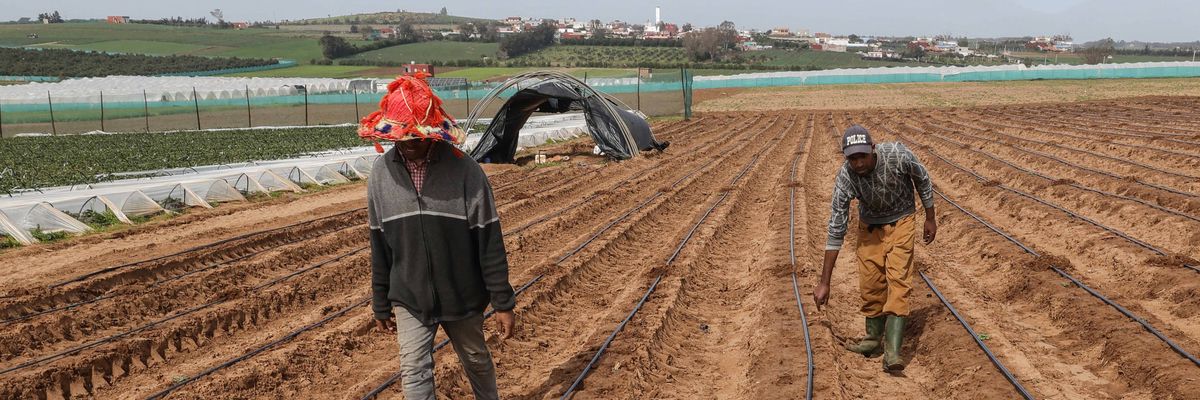
Just a month after a sweeping World Meteorological Organization report led United Nations Secretary-General António Guterres to declare that “every key climate indicator is flashing red,” WMO and another UN agency marked Earth Day on Wednesday by releasing an analysis focused on “how extreme heat is reshaping food production and food security.”
Simply titled “Extreme Heat and Agriculture,” the WMO and Food and Agriculture Organization (FAO) report lays out how extreme heat “is influenced by multiple interlinked drivers,” including the trends and inertia of human-induced climate change, natural climate variability, and meteorological phenomena such as droughts and atmospheric and marine heatwaves. Then, it gets into what that means for agriculture.
“Extreme heat is increasingly defining the conditions under which agrifood systems operate,” WMO Secretary-General Celeste Saulo and FAO Director-General Qu Dongyu stressed in the foreword of the report. “Rising temperatures and heatwaves, occurring with greater frequency, duration, and intensity, are often accompanied by prolonged drought and other climate extremes.”
“Higher temperatures parch soils, reduce harvests, strain livestock, disrupt fisheries, and increase wildfire risk. When combined with water scarcity, the consequences intensify, cutting production, lowering incomes, and tightening food supplies,” the pair wrote. “These impacts extend far beyond the farm gate. They represent a systemic risk to global food security and to the livelihoods of more than 1.23 billion people who rely on agriculture.”
For example, yields of staple crops such as maize and wheat have already declined by 7.5% and 6%, respectively, with 1ºC of global temperature rise beyond preindustrial levels. The publication points out that yields “are projected to decline by up to an additional 10% for every 1ºC of warming in the future.”
It also notes that “under high-emission scenarios, nearly half the world’s cattle could be exposed to dangerous heat by 2100,” resulting in annual losses nearing $40 billion. Under a low-emission scenario, the report adds, “impacts from livestock exposure to extreme heat are reduced by nearly two-thirds.”
The report details vulnerabilities, observed impacts, and projections for not only crops and livestock but also fisheries and aquaculture; forests, plantations, and orchards; and agricultural workers.
Saulo and Qu highlighted that “agricultural workers are already experiencing effects on their health, productivity, and income. As climate variability intensifies, hard-won progress in reducing hunger and poverty comes under strain, with shocks rippling through economies and households and disproportionately affecting the most vulnerable.”
The report outlines the existing “range of technical agricultural adaptation options and other broader nontechnical risk management strategies” for responding to extreme heat, as well as barriers to implementing them. It also offers a case study: the extreme heat event that hit Brazil in 2023-24.
That period in the South American country “serves as a stark example of the breadth and severity of compound impacts that can be triggered by a primary extreme heat event,” the report states. “On top of a warmer baseline shaped by climate change and amplified by El Niño, the heatwave simultaneously impacted crops, livestock, forests, fisheries, and human health.”
“The interconnected failures highlight the profound vulnerability of the entire agricultural sector and the grave implications such events have for the livelihoods and food security of the millions who depend on it,” the report continues, emphasizing that “building systemic resilience through adaptation and dedicated risk reduction is imperative.”
“While this report outlines a path toward enhanced resilience, solutions and opportunities are not infinite,” the publication adds. “Alongside robust adaptation and risk reduction strategies, the only durable solution to the escalating threat of extreme heat lies in ambitious, multilateral climate change mitigation.”
🌡️ Extreme heat is already affecting crops, livestock, forests, fisheries & the people who produce our food.New @fao.org-@wmo-global.bsky.social report on #ExtremeHeat & Agriculture shows the impacts & #ClimateAction needed to respond to this growing threat.🔗 https://bit.ly/4cXmmOe#EarthDay
[image or embed]
— Food and Agriculture Organization of the United Nations (@fao.org) April 22, 2026 at 4:15 AM
After the most recent UN Climate Change Conference, COP30, concluded in Brazil late last year, critics called it “another failed climate summit.” The United States is the world’s largest historical climate polluter, yet President Donald Trump didn’t even attend, and has spent his second term not only repealing climate policies but also serving the planet-wrecking fossil fuel industry whose campaign cash helped him return to power.
Trump has also started a new illegal war in the Middle East, partnering with Israel to target Iran. That assault has underscored how armed conflict negatively impacts agriculture and food systems around the world. The Iranian government has restricted traffic through the Strait of Hormuz—a key trade route, including for fertilizer and fossil fuels—which has prompted mounting alarm about a global food crisis.
Earlier this month, ahead of the current fragile ceasefire, the FAO’s chief economist, Máximo Torero, warned that farmers would soon “have to choose: Farm the same with fewer inputs, plant less, or switch to less intensive fertilizer crops.”
Jorge Moreira da Silva, executive director of the UN Office for Project Services, said Tuesday that “the planting season has already started, and in most countries in Africa it will end in May. So, if we don’t get some solution immediately, the crisis will be very significant and severe, particularly for the poorest countries and for the poorest citizens.”
From Common Dreams via This RSS Feed.