

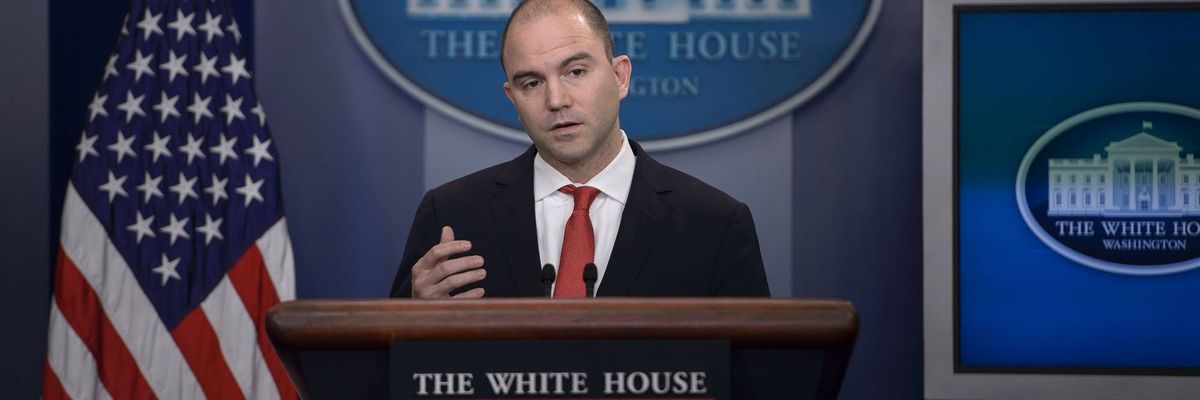
Ben Rhodes, who served deputy national security advisor under former US President Barack Obama from 2009 to 2017, has done a fair number of mea culpas in the years since he left government service. But a New York Times op-ed published Wednesday punctuates with a fresh admission: “We like to frame our wars as virtuous, but they are not.”
Rhodes comes to this statement circuitously as he writes about recent time spent with Graham Platner, the US Army and Marine veteran who served tours in both the Iraq and Afghanistan wars as an infantryman who is now running as a Democrat for the US Senate in Maine to unseat Republican Sen. Susan Collins.
Platner, who has recently opened up a double-digit lead against his primary rival, two-time Maine Gov. Janet Mills, has been an outspoken anti-war voice since putting his hat in the ring for elected office and Rhodes, who cut his teeth defending the forever wars during the Obama years, says Democratic Party leaders—and voters wherever they are—would be wise to listen to what he has to say.
“The forever war has been destroying America from within, like an organism that must keep growing to survive, filling us with fear of outsiders and contempt for one another,” writes Rhodes.
Most Democrats, observes Rhodes, don’t talk about war the way Platner does, and that’s not just a feature of his wartime experience compared to those in positions of power or paid to pontificate for think tanks or on the corporate news networks.
After traveling around with Platner on the campaign trail in Maine, Rhodes concludes that “Americans must change their relationship to war itself.”
“One reason we have a hard time reckoning with the forever war is that it undermines our own story,” he continues. “We like to think of America as a force for good, acting out of enlightened self-interest, our military fighting for freedom around the globe. Is that really what’s been happening?”
In their conversation, Platner explained that “most people get it,” suggesting those who live and work in the real world, outside of DC or within media echo chambers, understand the costs of the nation’s endless wars. “Do you think this country should spend more on schools and hospitals and less on bombs?" asked Platner rhetorically. "A lot of people are like, yeah, that’s pretty obvious.”
When Platner had his epiphany that the wars he fought in Iraq and Afghanistan were a mistake, Rhodes said he, still working for the White House in those years, was exactly the kind of person the soldier was thinking of when he said that the “people running the war didn’t even seem to know the point of the war,” calling it “a self-licking ice cream cone” that could not admit its failures.
“Listening to [Platner] talk, I knew intuitively what he was saying,” writes Rhodes. “I would have been one of those people back in 2011, believing that what we were doing was helping Afghans.”
For someone so enmeshed in the politics of US war-making and defending the foreign policy of past US governments from criticism, Rhodes confesses the pitfalls of American exceptionalism and where it can lead. And again, he quotes Platner:
We are so broken emotionally when it comes to our politics that we’ve literally created this story that it’s inherent in being a competent political leader to kill civilians. If you’re not willing to do some hard things and drop some bombs, then you’re not up to the task of power. I think it’s the opposite. You’re not up to the task of being in power if you do not think about the cost of violence. If that’s not at the front of your mind, then I don’t think you are morally in the right place to be in positions of power.
Such an argument directly implicates not just past presidents, but certainly US President Donald Trump, currently waging a new war of choice against Iran, as well as his Defense Secretary Pete Hegseth, who openly celebrates the killing prowess (“lethality”) of the US military while characterizing the laws of war as impediments.
Contextualizing why he has come to conclude that contemporary US wars lack virtue, Rhodes writes that the conflicts we have been waging abroad for most of this century have also done tremendous and lasting damage here at home. “They resemble,” writes Rhodes, “a declining empire sowing chaos along its periphery as a matter of strategy: Economic and political elites profit while the Americans who fight suffer along with the places they attack.”
As Platner told Rhodes, such admissions must be spoken about publicly in order for them to lead to meaningful change in the country. And voices like Platner’s, argues Rhodes, must be listened to because the “visceral and moral reckoning he advocates is the only way to truly dismantle the forever war, change our priorities and detoxify our country.”
“To save ourselves, we must stop this cycle of violence,” Rhodes concludes. “We must find meaning not in our capacity to kill or control others, but in each other.”
From Common Dreams via This RSS Feed.