


Drop Site is reader-funded — no corporate owners, no outside influence. Your support is what keeps this journalism independent and free. Please consider making a tax-deductible donation to support our work.
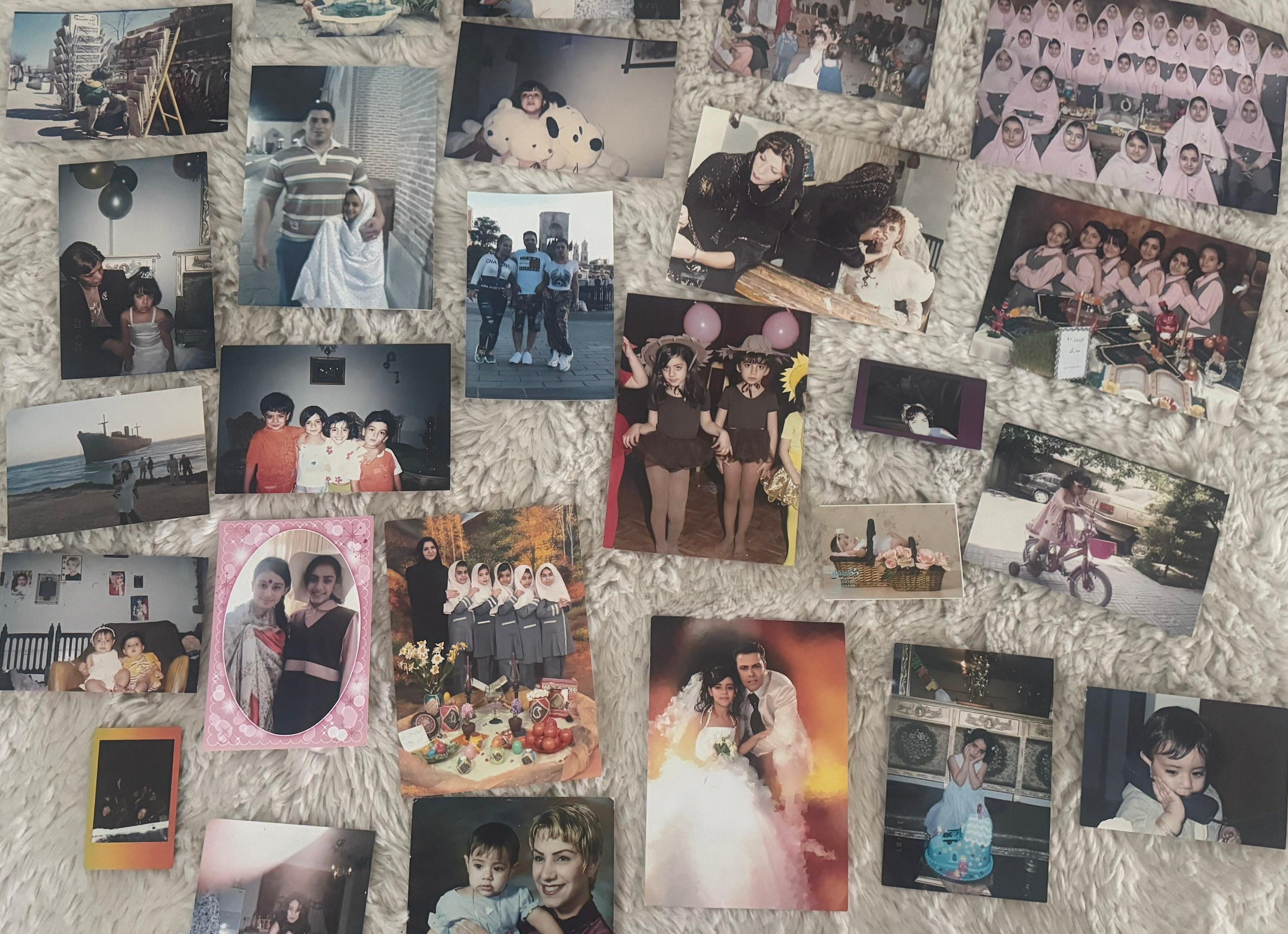
Family photos of Sarina Hosseiny and her mother, Hamideh Soleimani Afshar.
Two Iranian women remain in immigration detention, arrested earlier this month on accusations of being the niece and grandniece of Qasem Soleimani, despite no connection to the late Iranian military commander. Drop Site reviewed Iranian birth records, identification papers, a family will, and other personal documents and found no connection whatsoever to him or his extended family. One of the women is now seriously ill in a Texas facility, her chronic blood condition left effectively untreated.
On March 8, right-wing activist Laura Loomer posted on X calling for the deportation of a woman she claimed was Soleimani’s niece. The commander of the Quds Force of Iran’s Islamic Revolutionary Guard Corps, Maj. Gen. Soleimani was assassinated by a U.S. drone strike, ordered by U.S. President Donald Trump, in Baghdad on January 3, 2020. The day after Loomer’s original post, she tagged Secretary of State Marco Rubio on X, claiming to have reported the woman to the Department of Homeland Security (DHS) for “posting content sympathetic to the Iranian regime and Ayatollah.”
On April 3, Hamideh Soleimani Afshar and her daughter, Sarina Hosseiny, were taken into custody by Immigration and Customs Enforcement (ICE) at their home outside Los Angeles. Rubio issued a statement headlined, “Secretary Rubio Revokes Green Cards of Foreign Nationals with Ties to Iranian Terror Regime,” identifying them as “the niece and grand niece of deceased Islamic Revolutionary Guard Corps Major General Qasem Soleimani” and describing them as “green card holders living lavishly in the United States.”
The claims made headline news in the U.S., while triggering immediate denials from Soleimani’s family that the two women were relatives of the military commander. The Trump administration has gone largely quiet about the women’s cases since their arrest, as they remain in ICE detention pending deportation to Iran.
As attention has faded, the situation for the women has turned dire at the South Texas ICE Processing Center in San Antonio, particularly for Hamideh, 47, who lives with autoimmune hemolytic anemia, which requires regular treatment and blood transfusions she isn’t getting.
As a student in the late 1990s and early 2000s, Hamideh was active in protest movements in Iran, and, she says, even spent a week in prison after getting arrested at one demonstration. Sarina, in a phone interview from the ICE facility where they are being held, said that her mother—not one to hold back her opinions—was most looking forward to having “freedom of speech” when she moved here to the United States. She remains opposed to the son of the former Shah, Reza Pahlavi, as well as Trump’s current war. “She’s kind of a passionate person overall, and she thought that she was going to come here and be able to talk freely when she’s been threatened and imprisoned in Iran for speaking about politics, and now she’s again in prison for speaking out about politics,” she told Drop Site.
They were forced to leave Iran under duress after Sarina took part in a dance performance on vacation in Turkey at the age of 12. The dance competition was filmed and later aired by the satellite channel “TV Persia” and her dance went viral. (Two of her performances are still viewable on YouTube.) The channel is illegal in Iran but many residents have access to it. She said she was expelled from her public school, only to enroll in a private school and later to be expelled from that one, too, when the scandal recirculated. Some of her more conservative family members, who had connections to the government, beat and threatened her mother, Hosseiny said, and the situation became increasingly unbearable. At 14, she came to the United States on a student visa and the two of them applied for asylum.
In terms of its alignment with how the United States professes to see its place in the world, and the claims it makes about Iran’s treatment of women and girls, it’s hard to think of an asylum claim that would more neatly fit into the American agenda.

Sarina Hosseiny.
Sarina translated for her mother, who added that she doesn’t know where to turn if the U.S. isn’t safe either. “We came to America to seek calm and to feel safe and protected from that regime,” Hamideh said, according to her daughter’s translation. “And now we’re being treated almost the same—even worse than there. We’ve been here for three weeks now. I don’t know where to go from here.”
Sarina, 25, has also spoken with friends outside the detention facility, conveying that her mother has been denied the treatment she needs, is regularly in and out of consciousness, with dangerously low hemoglobin levels. Her mother recently passed out and was left unconscious on the floor for over ten minutes, Sarina reported to her friend Shawna Ruhland.
“She’s basically just trapped in there watching her mom die,” Ruhland said of Sarina. Ruhland, who served for eight years in the U.S. military, has set up a GoFundMe to help cover the family’s legal bill, which Drop Site verified is legitimate.
The South Texas ICE Processing Center, where the women are being held, declined to provide information on them other than to confirm they were in custody; their attorney, Sam Faragalla, did not respond to requests for comment.
Both were legal permanent residents until Rubio revoked their legal status. A State Department spokesperson, in an odd statement, said the government stood by its determination. “While we do not comment on matters of classified intelligence, we remain certain of the Secretary’s determination,” said Assistant Secretary Dylan Johnson. “If ‘Drop Site News’ is aware of anti-American green card holders with ties to terrorists presently in the United States, we would gladly investigate those individuals for possible termination of legal status and deportation.”
A review of personal documentation undercuts the allegation of a personal connection to Soleimani. Birth certificates from Iran, collected by the family, lay out a documented family tree spanning multiple generations with no connection to Qassem Soleimani, or even to relatives of the late general. Drop Site also reviewed other personal identification documents, including passports, family photographs, and work documentation from both Iran and the U.S. that strongly contradict the allegations that the two women were connected to the late Iranian military commander, or living lavishly from any connection to the Iranian government.
In order for Qasem Soleimani to be Hamideh’s uncle, based on her last name, he would need to be the brother of Hamideh’s father, Ali Soleimani-Afshar, who was born in Tehran in 1947. Yet according to the documents, Soleimani-Afshar had no brothers at all and his father died in the early 50s. Gen. Soleimani was born years later—in 1957—in a small village in the southern province of Kerman. Ali Soleimani-Afshar’s parents died in his childhood. Historical passport documents also show that Soleimani-Afshar’s family origins go back generations to the city of Yazd in central Iran, a province away from the roots of Gen. Soleimani.
The late general is also known to have two brothers, Sohrab and Hossein, who have previously given interviews about their upbringing in rural Kerman that identify themselves as his only brothers and make no mention of a connection to Ali Soleimani-Afshar.
Qassem Soleimani’s own family in Iran issued numerous strident denials that they had any relation to the late general. Soleimani’s youngest daughter, Zeinab Soleimani, a well-known political figure inside Iran, said in Iranian media that the State Department’s allegations were “false” and that “the individuals arrested in the United States have no connection whatsoever to our family.” Another daughter, Narjes Soleimani, went further in a separate statement, adding that, “To this day, no member of the Soleimani family, nor any relative of General Soleimani, has resided in the United States.”
To be clear, even if the women were in fact distantly related to Soleimani, such a link would not, under any version of justice, make them guilty of anything. While the U.S. says spouses and children of alleged terrorists can be detained, the law deems arresting other relatives inadmissible. The U.S. recently took immigration action against leading Emory University cancer researcher Dr. Fatemeh Ardeshir-Larijani, simply for being the daughter of Ali Larijani, a top Iranian official and Kantian scholar assassinated by the U.S. and Israel in March, along with his son. She was out of the country at the time her legal permanent resident status was stripped and barred from re-entering. Emory fired her.
In the wake of their detention, the State Department said that the asylum claim filed by the two Los Angeles women was undercut by the fact that they had visited Iran in subsequent years.
In general, a grant of asylum is indeed called into question if the asylum seeker travels back to the country where they have claimed they are unsafe, immigration lawyers say. Hosseiny said that because they are not political dissidents wanted by the government, but rather a girl and her mother who had pushed the boundaries of gender politics in a repressive environment, they deemed the trips home safe enough. She said that she had informed the government about the trip and there was no objection until they were arrested years later. “They’re about to lose everything that they’ve built here, because no one’s willing to help,” said Demi Uredi, a friend of Sarina, who is figuring out how to pay the mortgage for their house or sell it entirely.
Patrick Taurel, an immigration attorney at Grossman Young & Hammond, questioned the merits of the arrest. “Based on what I have seen firsthand as an immigration lawyer… I would not be surprised if the recent targeting of Iranians is based on shoddy and unreliable evidence,” he said. “That was true in the Mahmoud Khalil case and the cases of the other Palestinian dissidents; that was true with my client, Reginald Boulos; and that could well be true here. Congress must rein in this power.”
Sarina’s friends also disputed characterizations by the State Department that the family had been living lavishly in the United States, pointing out that they had been behind on mortgage payments and that they had been relying on the support of friends to pay for legal support in ICE detention. The jewelry and handbags flaunted on Instagram and highlighted by the U.S. government were, like much else in North Hollywood, entirely fake, her friends said.
“They’re not blood money, like regime trust fund kids, none of this is true whatsoever,” said Uredi.
In the meantime, Sarina’s mother is at severe risk. “The only thing that they can do is a blood transfusion with a match, because she has a severe anemia,” said Uredi. “And Sarina might be a match, but they’re like, we don’t even have the equipment here to do this for you. And that was two weeks ago, and now this week, they’re like, Yeah, we still don’t have the equipment. They just put her on antibiotics. That’s not going to save her life.”
Loomer, reached for comment, was unmoved, insisting the women were indeed related, but that it didn’t matter either way. “I want all Islamic immigrants deported. I don’t support any of their asylum claims,” she said.
Areeba Fatima contributed reporting.
From Drop Site News via This RSS Feed.
Removed by mod
Removed by mod
Removed by mod
Removed by mod
Removed by mod