

The trial of Renea Gamble had been underway for almost two hours when Marcus McDowell, the city attorney of Fairhope, Alabama, called a surprise witness.
“I call the gentleman in the red shirt,” he said, pointing toward a long-haired man in the second row. It took a moment to realize that he was referring to Gamble’s husband, 63-year-old Larry Fletcher.
Gamble’s defense attorney objected. He’d received no advance notice. But Fletcher shrugged and made his way forward.
Fletcher was with his wife when she was arrested at a No Kings protest in October 2025. She was wearing a 7-foot-tall inflatable penis costume and holding a sign that read “No Dick Tator.” Video of the incident went viral, turning Gamble into a minor celebrity and local free speech icon. Most people assumed the city would eventually drop the misdemeanor charges filed against her. Instead, McDowell added more, including giving a false name to law enforcement for identifying herself as “Aunt Tifa.”
Fletcher wore black Levi’s and a collared shirt with a Ferrari logo – a nod to his work rebuilding fuel injection systems for high-end cars. Sitting in the front row, Gamble looked a bit stricken watching the man she’d known since her childhood in Baton Rouge. “I know what she was thinking,” Fletcher later said. “She’s like, ‘Oh man, this could go out of control real easy.’”
McDowell asked Fletcher if he’d gone to bail his wife out of jail after her arrest. Yes, Fletcher said.
Did he make any statements to any of the jailers? Fletcher wasn’t sure. McDowell motioned toward one of the many law enforcement officers standing on the side of the room and asked if he looked familiar. Fletcher said he’d seen him around.
McDowell cut to the chase: Did Fletcher remember telling this man that he had gone to get bail money the day before the protest?
His objective was suddenly clear: The city attorney was suggesting that Gamble had gotten arrested on purpose.
If this was meant as a gotcha, things didn’t go as intended.
“I always make sure I have bail money!” Fletcher replied emphatically, as if this should be the most obvious thing in the world.
Did he have bail money on him now?
“Yeah!” Fletcher exclaimed, then gestured broadly. “With this many cops around? Come on.”
The room erupted with laughter. Moments later, Fletcher was back in his seat. Gamble reached back and held his hand.
“If we don’t have free speech, what do we have?”
The trial took place at the Fairhope Civic Center, home to the city council chamber and — on the first and third Wednesday of every month — municipal court. Outside the building, dozens of people gathered to support Gamble, while a small army of cops stood watch from inside. One woman wore a huge purple eggplant costume. Another held a sign featuring a banana and the words “Free speech shouldn’t be hard to swallow.”
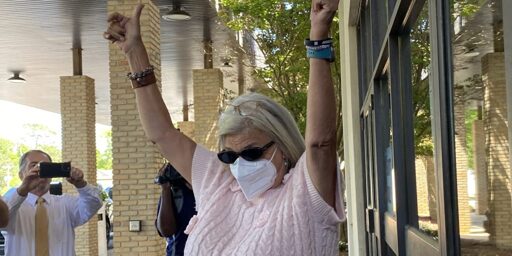
Gamble, 62, had arrived wearing pearls, a soft pink cable-knit sweater, and a matching tulle skirt adorned with delicate butterflies. Her face was concealed behind sunglasses and a white KN95 mask. After a smattering of chants of “Free speech!,” Gamble spoke briefly before going inside. “I’m not on trial,” she said. “What’s on trial is the First Amendment.”
“It was abuse, too!” one woman yelled. “They abused you. We saw it.”
[
Related
Grandmother Faces Trial in Alabama for Wearing Penis Costume to No Kings Protest](https://theintercept.com/2026/04/03/penis-costume-no-kings-protest-alabama-censorship/)
Indeed, for all the slapstick comedy of the scene — body camera footage showed three different cops wrestling with a giant penis — her arrest was also shocking. Gamble was turning to walk away when the arresting officer grabbed her costume from behind, pulling her backward onto the ground. While officers tried to stuff her into their car, causing the handcuffs to dig into her wrists, she screamed in pain.
But Gamble said she wasn’t speaking as a victim. “I’m standing on the foundation of our democracy. If we don’t have free speech, what do we have?”
Fairhope is a picturesque town on Alabama’s Gulf Coast, 20 miles from Mobile. Its entrance is lined with live oaks and a procession of American flags, while its historic downtown is brimming with galleries and upscale boutiques. Around the corner from a Christmas store, clapboard signs advertised espresso martinis and peanut butter pie.
Fairhope has long been a top destination for retirees from across the country, with its rapid growth an enduring source of anxiety. Although the No Kings rally was organized by Indivisible Baldwin County, whose founder was born and raised in the area, local critics adopted a familiar line: The protesters were outside agitators. Never mind that Fairhope itself was originally founded by outsiders as a “single-tax” utopia, “built by and for artists, writers and other ne’er do-wells,” in the words of local political cartoonist JD Crowe, who attended Gamble’s trial with his sketchpad. Today, some describe Fairhope as “California with a Southern accent” — a compliment or an insult, depending on who you ask.
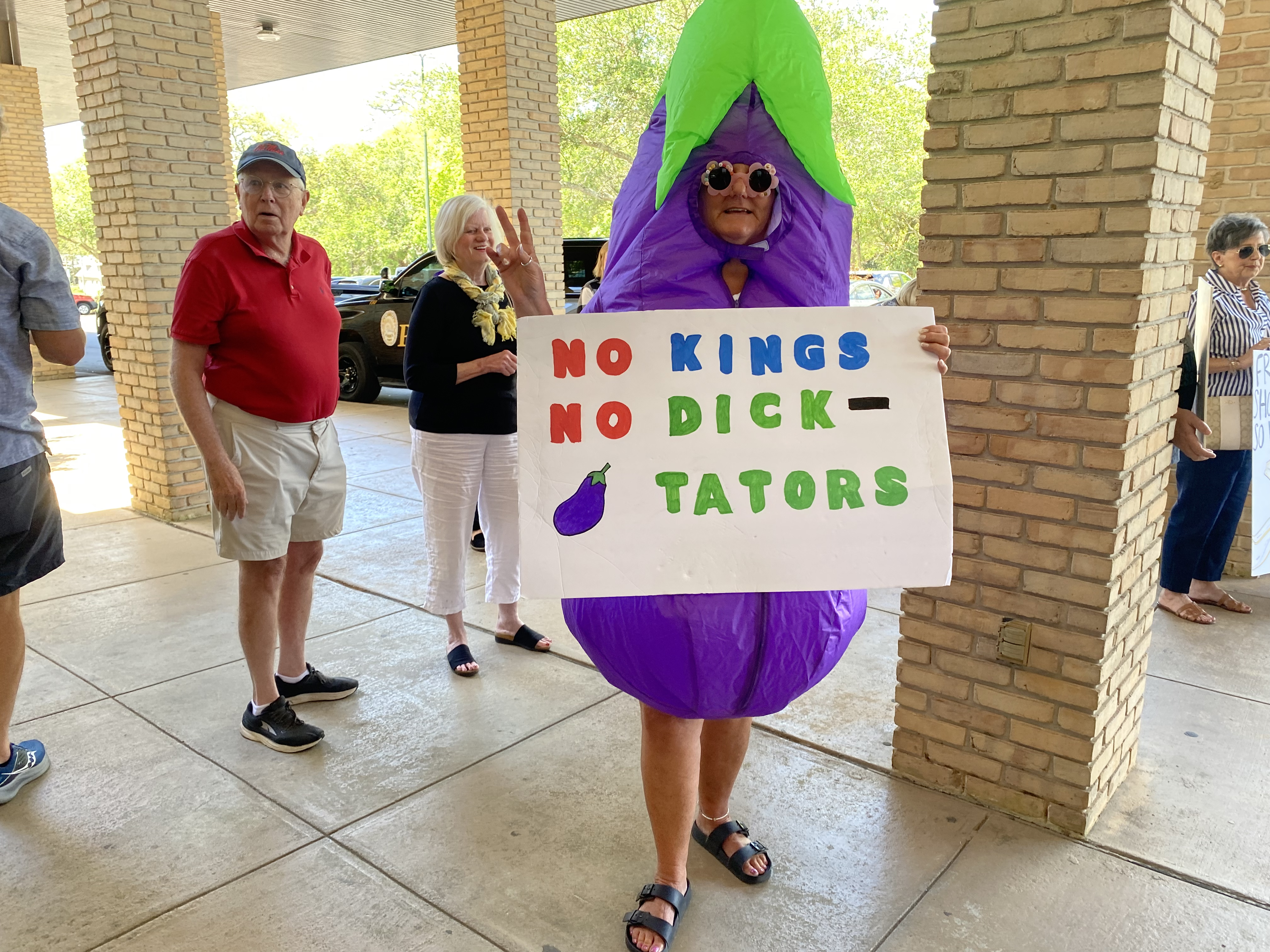
A supporter of Renea Gamble dressed as an eggplant at the Fairhope Civic Center in Fairhope, Ala., on April 15, 2026. Photo: Liliana Segura/The Intercept
Gamble’s case struck a nerve in part because of an ongoing free speech battle that made national news. Right-wing activists had targeted Fairhope’s beloved public library, convincing the state to pull funding over books they deemed obscene. Among the people gathered outside the civic center, several said they could not understand why city officials, including the mayor, stood up for the library only to express support for Gamble’s arrest.
Others were driven by national politics. A man dressed in a taco suit was a member of Mobile’s Indivisible chapter. “This is all about Trump,” he said. The fact that people were protesting in this part of the state spoke volumes about the destruction Trump has wrought, he said. “This is deep-red Alabama — as red as it can get.”
Presiding over the trial was Magistrate Judge Haymes Snedeker, best known as the older brother of champion pro golfer Brandt Snedeker and a noted amateur golfer himself. Snedeker sought to defuse the tension in the room, reassuring attendees at the start that, while Gamble technically faced the possibility of six months in prison, “that’s not gonna happen.”
It was the city’s burden to prove its case beyond a reasonable doubt, Snedeker went on. “I’m just an umpire calling balls and strikes.” He had just asked people to silence their cellphones when a ringtone broke out, apparently from one of the police officers lining the room.
“Bad start for the city,” Snedeker quipped.
If Snedeker was trying to keep things light, McDowell, the city attorney, was not in a joking mood. It was no secret that Gamble was considering suing the city — and any potential lawsuit would be on him to defend. The threat of legal action helped explain why McDowell might have refused to drop the charges. If Gamble was convicted, after all, she would have no grounds to sue.
McDowell insisted that, while there is no constitutional right to dress as a giant “erect penis,” this case had nothing to do with the First Amendment. Gamble’s case was about public safety.
“I’m trying to preserve a town that has values.”
He called the man who arrested Gamble: Fairhope Police Cpl. Andrew Babb. A 15-year veteran of the force, he testified that he’d been called to the scene due to reports of a disturbance at the busy intersection. When he pulled up, he spotted a “7-foot inflatable penis.” It was impossible to tell the identity of the person inside the costume, Babb said. He assumed it must be a teenager.
Did you know it was an old woman?” McDowell asked him.
“She’s not that old,” someone muttered in the audience.
“No,” Babb said.
Babb said he ordered Gamble to remove the penis suit. When she refused to comply, “she was put to the ground.”
Babb denied that he’d been personally offended by Gamble’s costume. Rather, he was concerned that Gamble, who could neither see nor walk very well while wearing it, posed a risk to herself and others. “You saw her as an obstruction and a safety risk?” McDowell asked. Yes, Babb said.
This was laughable. In his body camera footage, Babb repeatedly scolds Gamble for the costume, demanding to know how she would explain it to his kids. “I’m not trying to violate your freedom of speech,” he says as he unzips the penis suit. “I’m trying to preserve a town that has values.” Now McDowell was conjuring an alternate reality in which Gamble had teetered precariously at the edge of the road, endangering motorists, while the protest itself was veering close to a riot.
“It was a brushfire,” Babb claimed at one point. “We were trying to stop it from spreading.”
Gamble was represented by David Gespass, a veteran civil rights attorney who wore a Constitution-themed tie reading “We the People.” He asked Babb why he’d zeroed in on Gamble if his concern was traffic safety.
“She was a distraction,” Babb said. “A distraction can be a hazard.” Gespass pointed out that Babb’s incident report invoked the legal definitions of obscenity: Why did he write that the penis costume was devoid of any “artistic value”? Babb replied that the protest took place at noon on a Saturday, in the midst of Little League baseball season, and on the same day as a funeral for a former mayor. “In that setting, it would be obscene,” he said.
Much of Babb’s testimony was easily refuted by the body camera footage. Babb claimed that Gamble resisted arrest, and that he only called for backup once she was on the ground. In reality, he called for backup almost immediately. Babb claimed that he told Gamble she was “not free to go.” In fact, she repeatedly asked, “Am I being detained?” but he ignored her, continuing to scold her instead. When Gespass asked why Babb grabbed his client from behind, Babb claimed that he would not have been able to get in front of her — there were too many people in the way.
But perhaps most preposterous was the claim that Babb’s actions were necessary to contain a situation that threatened to spiral out of control. “He made a clear professional effort to deescalate,” McDowell said. “She decided to escalate,” he said, “poking and prodding” in a deliberate attempt to get arrested.
Listening to this, Gamble seemed to have a hard time containing her emotions. Even in her face mask, she looked stunned, indignant, and increasingly agitated. Her bright blue eyes widened. Her eyebrows raised upward. Once or twice, she threw her arms up in exasperation and disbelief. On her wrist, a warning flashed across the screen of her Snoopy-themed smartwatch: Her heart rate was spiking.
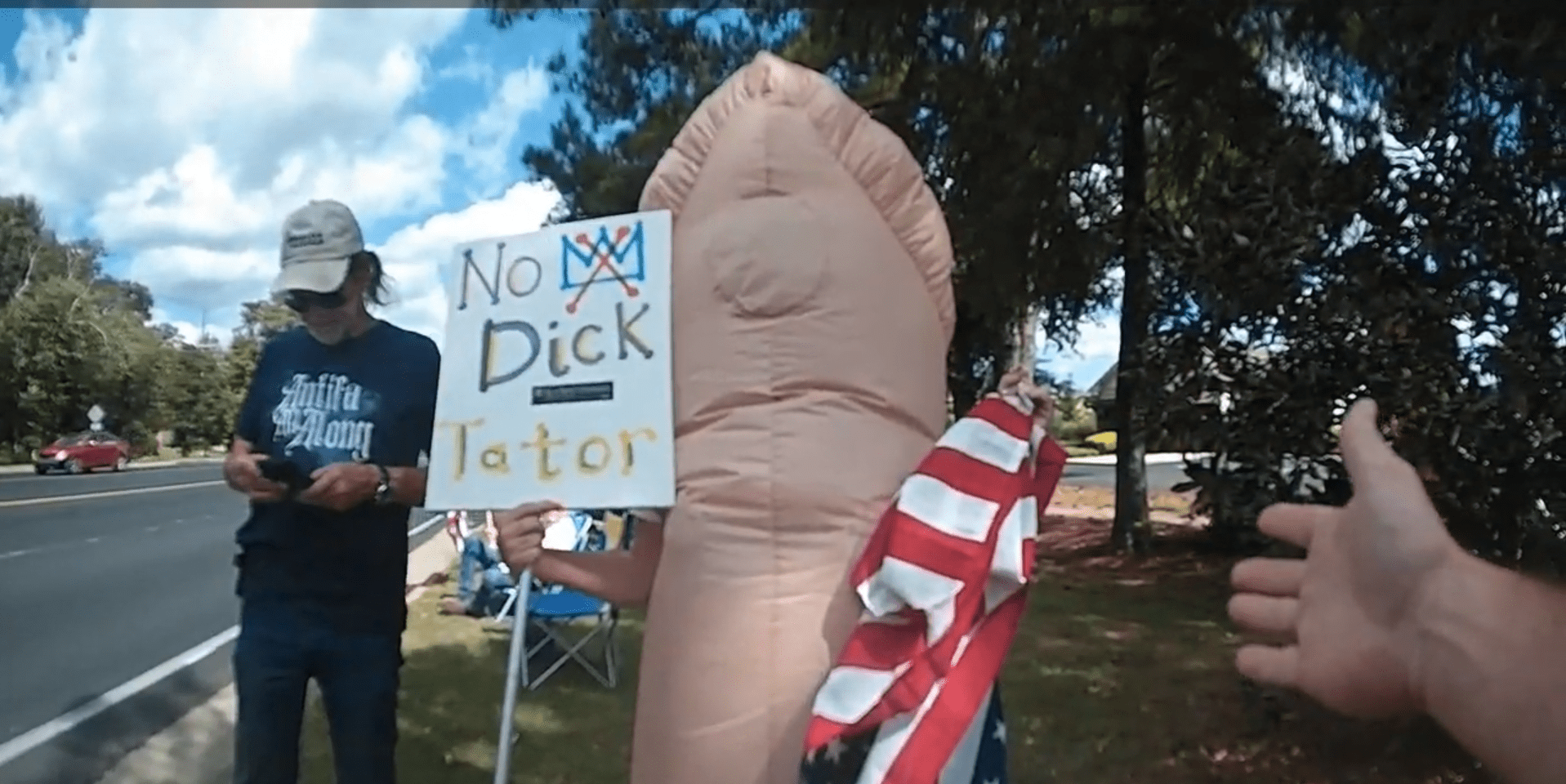
A still from police body camera footage of Renea Gamble at a No Kings protest being approached by Fairhope Police Cpl. Andrew Babb in Fairhope, Ala., on Oct. 18, 2025. Still: The Intercept
For all the hilarity surrounding Fairhope’s “penis lady,” the arrest and its aftermath had taken a toll. Gamble’s adult daughter Adeana sat behind her mother at the trial, reading a library book during breaks in the testimony and occasionally communicating with her in sign language. She told me that Gamble had hit the back of her head when she fell to the ground, which was hard to see in the tape, and raised concerns about a possible concussion. She also worried about injury to Gamble’s wrists, especially because Gamble has long lived with rheumatoid arthritis. As a longtime ASL interpreter, “she’s always protected her hands,” Adeana explained.
But the real cost had been psychological. For about two months, Adeana said, Gamble was afraid to leave the house. When threatening mail arrived at the family’s home, Adeana suggested calling the police. “And she said, ‘What police?’” How could she expect law enforcement to protect her?
The story behind the penis suit further undermined the case against Gamble. According to Adeana, Gamble purchased it at the last minute as a backup. “She had ordered a sea turtle costume,” Adeana said. She’d planned to wear it while holding a sign that said “I love the Gulf of Mexico.” But the costume didn’t arrive on time. “So she had to scramble to find another one and a message to go with it.”
[
Related
A Redditor Criticized ICE. Trump Is Trying to Unmask Them by Dragging the Company to a Secret Grand Jury.](https://theintercept.com/2026/04/10/reddit-ice-protest-grand-jury/)
This context didn’t make it into the trial. Instead, Gespass called a slew of defense witnesses who attended the No Kings protest. One after another, they reiterated what was already clear: The rally had been peaceful. There was no threat to anyone’s safety. The only escalation came from the police.
It was after 5 p.m. when Snedeker made clear he’d seen enough. He had already tossed the charge of providing a false name to police. Now he was ready to rule on the rest.
Snedeker said that while he believed that police had probable cause to arrest Gamble, the city’s evidence was not strong enough to convict; Gamble was not guilty. The room broke into applause.
Snedeker tried to put a positive spin on things, speculating that some good might come of the episode. For instance, police now knew to place barricades between the streets and a protest — a common-sense precaution. But the judge’s no-harm, no-foul sentiments fell flat. Fairhope police had made the town a laughingstock. Now the city was about to be sued.
In fact, much of the trial seemed aimed at inoculating the city from a lawsuit. McDowell repeatedly emphasized that Babb’s actions were “reasonable” given the circumstances — the legal standard that judges use when dismissing claims of police abuse. Gespass also revealed that McDowell had offered a hasty plea deal just moments before the trial began. Gamble rejected it.
“As Alabamians, we dare defend our rights, and this fight is not over,” she announced after her acquittal. On Friday, she served notice of a lawsuit with the city clerk.
Whatever comes next, Adeana made clear that her mother was luckier than most. “What would have happened if she was a young Black man?” she asked. “What would have happened if she was a middle-aged Latina woman?” In Baldwin County, where Indivisible activists are focused on supporting immigrants targeted by U.S. Immigration and Customs Enforcement, Gamble’s prosecution has been a lesson unto itself. “If we don’t stand up and support our neighbors, who will?”
Adeana understood why Gamble was so widely described as a “grandmother” in the headlines following her arrest. But the label didn’t capture the full picture. “If anything, we’re getting more explosive in our older age,” Adeana said. “Because we’re tired of being pushed down.”
The post The Short and Ridiculous Trial of a Protester Arrested in an Inflatable Penis Costume appeared first on The Intercept.
From The Intercept via This RSS Feed.