

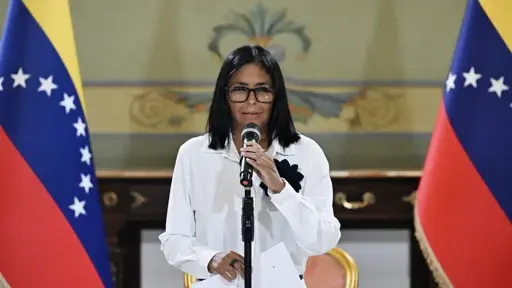
In recent months workers in many Latin American countries have taken to the streets to protest the impositions of the International Monetary Fund. Meanwhile, in Venezuela, the country’s acting president, Delcy Rodríguez, has brokered a reengagement with the IMF, a step she has described as “a triumph of diplomacy.” In doing so, she has tried to hide the move’s true nature: the resubordination of Venezuela to international creditors. Indeed, the country’s reengagement with the IMF and the World Bank marks the reinstatement of direct imperial control over Venezuela.
“We are opening our doors to the world,” declared Rodríguez on April 19, symbolizing her complete sellout after 100 days in office. Ironically, she made this declaration on the anniversary of the start of Venezuela’s War of Independence in 1810. What she presented as “opening to the world” and “financial normalization” is, in fact, the “reintegration” of Venezuela into the imperialist-dominated financial system, in a context marked by political changes after the U.S. military offensive on January 3 and the reconfiguration of state power under a neocolonial protectorate regime. In other words, the return to the IMF and the World Bank signifies the financial component of this national surrender.
“The Resumption of What Should Never Have Been Prevented”
“The resumption of what should never have been prevented has been imposed,” Rodríguez emphasized on Thursday, celebrating the return of an organization with a tragic history in Venezuela. The Caracazo uprising of 1989 was preceded by the IMF’s prescriptions: at the request of a letter of intent, the government of Carlos Andrés Pérez committed to implementing austerity measures in exchange for a loan — in other words, indebtedness. The country was experiencing immense social inequality, typical of capitalism, and a severely crippled economy, as was the case in Venezuela in the late 1980s. Human rights organizations estimate that 3,000 people died during the brutal repression against those who rose up against the austerity measures.
In Venezuela the return of the IMF takes on particular significance because it follows years of official “anti-imperialist” rhetoric. Although Venezuela never formally left the organization, the political distancing from the IMF that began during the Chavista era effectively meant withdrawing from its monitoring and financing mechanisms. Venezuela broke relations with the IMF in April 2007 under Hugo Chávez’s government, ceasing to submit its economic policy to the IMF’s reviews and rejecting direct intervention, but not before paying off all the external debt (which was, incidentally, illegal) owed to the IMF and the World Bank, the architects of the privatizations of the 1990s. Yet for Rodríguez, it “should never have been prevented,” and now “good has prevailed” with the arrival of the IMF, while people across Latin America reject it in the streets.
The IMF’s return is a response to a realignment imposed by the new political conditions that emerged after the U.S. imperialist offensive and the new alignment of the government led by Rodríguez with Washington. On April 16 the IMF and the World Bank announced the formal resumption of relations with the Rodríguez government. Hours earlier, the Treasury Department’s Office of Foreign Assets Control (OFAC) had issued General Licenses 56 and 57, easing sanctions imposed on the Central Bank of Venezuela (BCV) and state-owned banks.
OFAC’s partial lifting of sanctions — which allows the BCV and local public banks to operate internationally — paves the way for the country’s “reintegration” into international financial circuits under new conditions of dependency and always under the supervision of international capital. It is the necessary lubrication for the country to once again incur debt and for the IMF to oversee the implementation of a severe adjustment plan. Therefore, the arrival of the IMF should be interpreted as part of the Rodríguez government’s renewed alignment with Washington.
For decades, the IMF and the World Bank have played a central role in the “economic reorganization” of Latin America according to the needs of transnational capital, generating dependency and increasing social inequality. From the debt crisis of the 1980s to contemporary “stabilization” programs, these institutions have operated as instruments to guarantee the repayment of external debt, facilitate plunder, promote market liberalization, and discipline working classes through structural adjustment programs and repression.
We Don’t Need to Predict the Future
IMF-affiliated programs entail cuts to public spending, the elimination of subsidies, the deregulation of the labor market, and increases to the cost of living. Wherever they are implemented, cycles of social protest inevitably emerge. From the Argentinean mobilizations against austerity measures to the Chilean, Ecuadorian, and Peruvian uprisings, it is clear that the working majority and the people ultimately confront governments that implement policies dictated by international finance capital.
The Argentinean experience under Javier Milei’s government starkly illustrates this dynamic: the government’s “chainsaw” austerity program has decimated wages, laid off thousands of public sector workers, and driven poverty to historic levels under the pretext of achieving a zero deficit, all under the IMF’s watchful eye. Milei’s agreement with the IMF has justified implementing a shock policy based on eroding wages, dismantling rights, privatizing public companies, and transferring income to financial capital. Under the guise of “macroeconomic stability,” the IMF conceals a regressive redistribution process, shifting the burden of the crisis onto workers, retirees, and the poor.
In Ecuador the government of Daniel Noboa is moving in a similar direction. There, subordination to international financial institutions is combined with fiscal austerity policies, regressive labor reforms, and increasing internal militarization. Social protests express popular rejection of a model that turns external debt into a tool of political and social control.
The same pattern is repeated in Chile, where decades of economic policies shaped by neoliberal orthodoxy — consolidated under the supervision of international organizations — produced profoundly unequal growth that erupted in the social rebellion of 2019. There, it was revealed that the country’s so-called economic miracle masked extreme levels of indebtedness, privatization of social rights, and structural labor precarity. Peru offers another example of this same logic: successive political crises cannot be separated from the economic model imposed after the neoliberal reforms of the 1990s, sustained by unrestricted access to international capital and fiscal policies aligned with IMF criteria.
Whenever the majority questions this economic order, the state’s response combines repression, criminalization of protest, and a reaffirmation of commitments to international markets. This is the norm. But Rodríguez, in addition to thanking IMF managing director Kristalina Georgieva, directly thanked President Donald Trump and Secretary of State Marco Rubio for facilitating the IMF’s return. “I applaud the decision to resume relations with Venezuela,” Georgieva declared.
The IMF Doesn’t Arrive Alone: It Brings Austerity, Debt, and Further Subordination
Venezuela’s return to the IMF has generated great enthusiasm in the business community and among neoliberal analysts. They are already talking about indebtedness: according to Luis Vicente León of Datanalisis, “Rejoining the institution enables the option of coordinating emergency financing with the IMF that could exceed $8 billion.” And the representative of Conindustria, Tito López, enthusiastically asserts, “In the next six months, we will have a completely different Venezuela.”
But the IMF will not provide financial aid. It will wrap a chain around Venezuela, binding future generations to the mandates of Washington and the financial institutions. For international capital, Venezuela’s reintegration represents the reopening of one of the planet’s largest energy and mineral reserves under predictable rules for foreign investment. The partial lifting of sanctions and the financial opening serve as incentives to consolidate this transformation while business sectors seek to adapt to the new scenario, legitimizing U.S. tutelage.
The recent legal reforms in hydrocarbons and mining, approved under the Rodríguez government, follow a logic of liberalization and privatization. Presented as mechanisms to attract capital and rebuild the economy, they constitute steps toward the transfer of strategic resources to transnational capital, reproducing the historical pattern of extractive dependency that has characterized Latin America since the 19th century. Historical experience shows us where countries under adjustment programs supervised by international financial institutions end up, and that is where Venezuela is headed.
The consolidation of this governmental course establishes the fundamental axes of a neocolonial regime. Key economic decisions are conditioned by international financial institutions, energy agreements, and geopolitical commitments defined outside the country. Clearly, the government of Rodríguez does not exercise sovereignty; it administers the will of Washington.
The IMF Is a Historical Enemy of the Working Class and Must Be Rejected
Venezuela’s return to the IMF and the World Bank does not signal a gradual exit from the crisis but rather a plan to reorganize the country under a new pact of international subordination. In light of this situation, the challenge is to confront a model that seeks to “stabilize” the economy by surrendering sovereignty and to build, from the ground up, the capacity to oppose a new phase of imperialist domination.
The decisive question is how the working class and the popular sectors will respond. The only progressive way forward lies in rejecting the tutelage of the IMF and the World Bank, defending natural resources under workers’ control, rejecting external debt, and building an independent workers’ politics with an anti-imperialist and anti-capitalist program.
Faced with the neocolonial regime and the protectorate, the working class must raise the banner of class struggle against the war declared on us. In the face of national surrender, only the mobilization and self-organization of the workers can offer a way out other than total submission to international finance capital. Yankee imperialism out of Venezuela! No to the IMF! Down with Delcy Rodríguez’s surrender!
This article was first published in Spanish at La Izquierda Diario on April 20.
The post Delcy Rodríguez Advances U.S. Control over Venezuela by Welcoming the IMF appeared first on Left Voice.
From Left Voice via This RSS Feed.
Fucking hell.
Next to the IDF, the IMF is the worst three letter abbreviation that start with I and end with F.