


By David Swanson, World BEYOND War, April 22, 2026
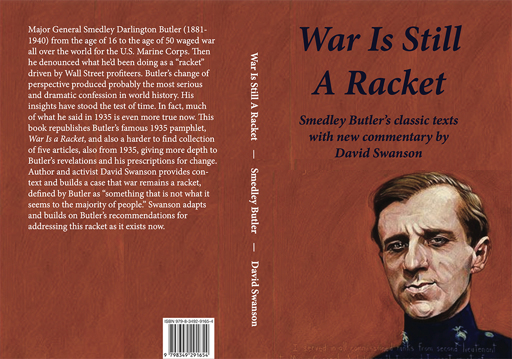
This is excerpted and adapted from Swanson’s new book, War Is Still A Racket.
In the peace movement in the United States—or at least in any antiwar circles that involve Veterans For Peace or other veterans groups, or that take an interest in the financial corruption that surrounds wars—Major General Smedley Darlington Butler (1881-1940) is a mythical and heroic figure and has been for almost a century. He is best known for the text contained in Part I of my new book, a passionate rejection of war penned in 1935 called War Is a Racket. Published as a small pamphlet, War Is a Racket took up the theme of speeches Butler was giving around the country, with the text worked on by newspaper editor E. Z. Dimitman.
It’s not hard to see why the text of War Is a Racket was and remains powerful. In it, Butler makes what is probably the most serious and dramatic confession in world history. Certainly Saint Augustine’s is not even in the running. Butler was a famous and high-level insider blurting out secret truths, and with a blunt emphasis on the question of immorality. In War Is a Racket, Butler puts a focus on those profiting from war, but not as part of a cynical strategy to turn people against war who are economically selfish and uninterested in the moral question of mass slaughter. On the contrary, Butler never goes long without placing a spotlight on the killing, in order to contrast the price paid by some with the profits gained by others—those investigated for war profiteering by the 1934-1936 Nye Committee in Congress and referred to in popular speech in the 1930s as the merchants of death. Butler’s idea is not that war is made evil by profiteering, but that the evil of war is driven by profiteering and not by anything else that might be imagined to justify it.
The sense we get from Butler’s words that shame about war was still possible in the United States of the 1930s is, I think, an appealing feature to us in an age of widespread shamelessness—and in the case of Donald Trump a warmaker who could not possibly confess years later to piratical motives since he openly trumpets them from the start, stating publicly that wars on Venezuela and Iran are about oil and profits, things traditionally denied by U.S. officials about their wars no matter how implausibly.
Butler’s words suggest not only the possibility of shame, but also the possibility of changing behavior. Butler tells us that war has always been a racket, but not that it will always be with us. In fact, he gives us his prescription for war’s speedy abolition. Some of his recommendations—such as no profits from wars, no wars without a vote by those who would do the fighting, and no U.S. troops ever more than 200 miles from the United States—were either rhetorical flourishes or proposals for a world with no U.S. wars in it, barring an invasion of the United States by another country—something Butler argued could never happen.
In contrast to peace activists, your average member of the U.S. public has never heard of Smedley Butler, does not know what a celebrity Butler was in his lifetime, is not familiar with the fantastic stories from his years of racketeering for Wall Street, hasn’t heard that Butler took over and ruled the nation of Haiti, has no idea that he was the most decorated member of the U.S. military of his day and the highest ranking member of the U.S. Marines, has never read that he was himself imprisoned on the U.S. Marine base at Quantico as punishment for speaking badly about an important U.S. ally named Benito Mussolini, might not believe you if you told them that Butler likely prevented the execution of a well-developed coup plot to overthrow President Franklin Roosevelt, and decidedly has no notion of the contents of War Is a Racket.
As few in the United States know much about the centuries of U.S.-backed coups and malign influence in Latin America, even fewer know of Butler’s role in killing and destroying to prevent freedom or sovereignty in places like Nicaragua, Panama, Honduras, Haiti, the Dominican Republic, and Mexico. Within the U.S. Marine Corps, Butler is remembered as a courageous hero. In Haiti, he is remembered as the leader of an occupation that lasted 20 years and as a man who brought slavery back to that nation. He was also an early militarizer of police forces in the United States and Latin America. But for millions of people in the United States he, and some of the events and trends he was a part of, are not remembered at all.
I suspect that some of the reasons Butler is absent from school textbooks are also reasons for his intense popularity among those who have discovered him. Butler lays blame on major corporations and banks. And he names their names. He believes that he committed mass murder on their behalf for decades; he’s not about to shy away from naming them. He also states the obvious—points out the emperor’s nudity—even when popular consensus holds a statement to be unspeakable. War departments —then not yet renamed “defense” departments—build and train and prepare for wars, he reminds us, and those wars consist of numerous instances of something normally forbidden and condemned: murder.
Butler uses sarcasm, which tends to be either loved or hated, and uses it to point to patriotism as central to the phony propaganda advanced to hoodwink the public and military recruits / conscripts on behalf of war profiteers. That alone sets Smedley Butler outside the realm of topics that can be mentioned in a school textbook.
Butler was writing against the mad buildup to another war following World War I. No gatekeepers of acceptable culture mind that fact at all. But where Butler commits major heresy is in writing against the mad buildup to war preceding World War II. To many, such an action must be either foolish or traitorous. Never mind that Butler was exposing fascist plots, not engaging in them. Butler also warned against the major build-up for the coming war against Japan. This was at a time when the U.S. and Japanese governments were inching their way toward war, and some wise people in both countries were protesting. Peace activists were marching through New York City against that threatened war years before it finally started. But none of that is supposed to have ever happened. In U.S. mythology, right up through 1941 the entire United States and its government was minding its own business, peacefully farming or inventing plastic or something, when the Japanese attacked out of a clear blue sky. Reading Butler doesn’t fit into that imaginary history.
Yet those who opposed slavery centuries before its general abolition have eventually become thought of as having been right, and even as having had something to teach those who finally succeeded. Who are we to say that advocates for peace in the 1930s have nothing from which the 2030s could benefit? I think the benefit becomes rapidly apparent simply by reading Smedley Butler.
My book is available at https://davidswanson.org/racket
I’ll send you a signed copy if you sign up for a 4-session, online book club (there is a fee).
Or you can join me for free for one session to discuss the book online here.
The post Listen to Smedley Butler appeared first on World BEYOND War.
From World BEYOND War via This RSS Feed.