

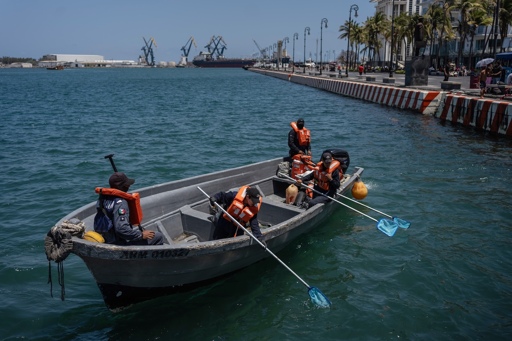
MEXICO CITY — In Nautla, a municipality on the coast of the Mexican state of Veracruz, soft folds of sand await sea turtles as their annual nesting season begins between April and June. But instead of the miniature olive-green turtles — the Kemp’s ridley turtles (Lepidochelys kempii) that show up here are the world’s smallest species of their kind — sticky black discs the size of coins dot the coastline. Along a 1-meter (3-foot) section of beach, Nautla resident Ricardo Yepez Gerón, director-general of the Yepez Foundation, an NGO focused on sea turtle conservation, said he could count approximately 100 of these spots. “To remove the oil that has [washed up] on these beaches … let’s be honest, the coastline is too long,” Yepez Gerón told Mongabay in a video interview. “You need one person for every 10 meters [33 ft].” Similar reports of tar stains on the beaches of Veracruz, Tabasco and Campeche, along the southern arc of the Gulf of Mexico, have cropped up since early March. According to a late March report from the Coral Reef Network of the Gulf of Mexico, what appeared to be an oil spill had impacted 933 kilometers (about 580 miles) of shoreline — and at least seven of nine natural protected areas, ANPs by their Spanish acronym, in the Tabasco, Veracruz and Tamaulipas states, according to Alicia Bárcena Ibarra, Mexico’s secretary of environment and natural resources. For 67 days, the government denied any wrongdoing as various scenarios circulated regarding the source…This article was originally published on Mongabay
From Conservation news via This RSS Feed.