

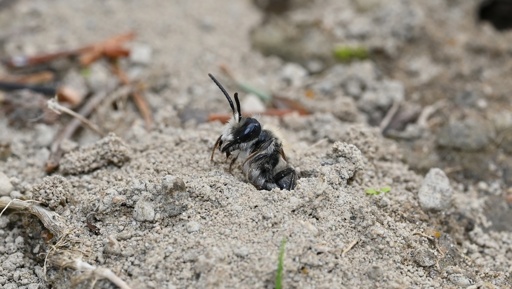
A miner haunts the East Lawn Cemetery in Ithaca, New York. It’s not the spirit of an interred workman, but Andrena regularis, also known as the regular miner bee. It’s black and tan and fuzzy, sometimes sporting patches of yellow as it collects pollen. The critter is at once peculiar to humans and highly regular in the natural world: We might expect it to form huge colonies like honey bees, but in fact it’s among the 90 percent of bee species that’s solitary. Instead of building bustling nests in trees, it digs tunnels into the ground, hence the moniker.
Scientists at nearby Cornell University have discovered that this seemingly sterilized habitat — lots of tombstones and cropped lawn — doesn’t just support this wonderful insect. It hosts one of the biggest and oldest known communities of ground-nesting bees anywhere in the world.
Great for the miner bee, to be sure. But the findings also add to a growing body of evidence that cemeteries, of all places, provide essential habitats for all kinds of wildlife, from insects to mammals. Bees are already under significant threat due to habitat loss and insecticide use, so thoughtfully managing these final resting places can protect the pollinators we need to fertilize crops amid rising temperatures and increasingly chaotic weather. “It’s exciting to see that things like this are being discovered, where you find biodiversity in unexpected places,” said Christopher Grinter, collection manager of entomology at the California Academy of Sciences, who wasn’t involved in the research. “It’s kind of this key, or this ‘aha’ moment, where it’s like: ‘Wait, not only is this happening without us noticing, we should now encourage and foster this biodiversity.’”
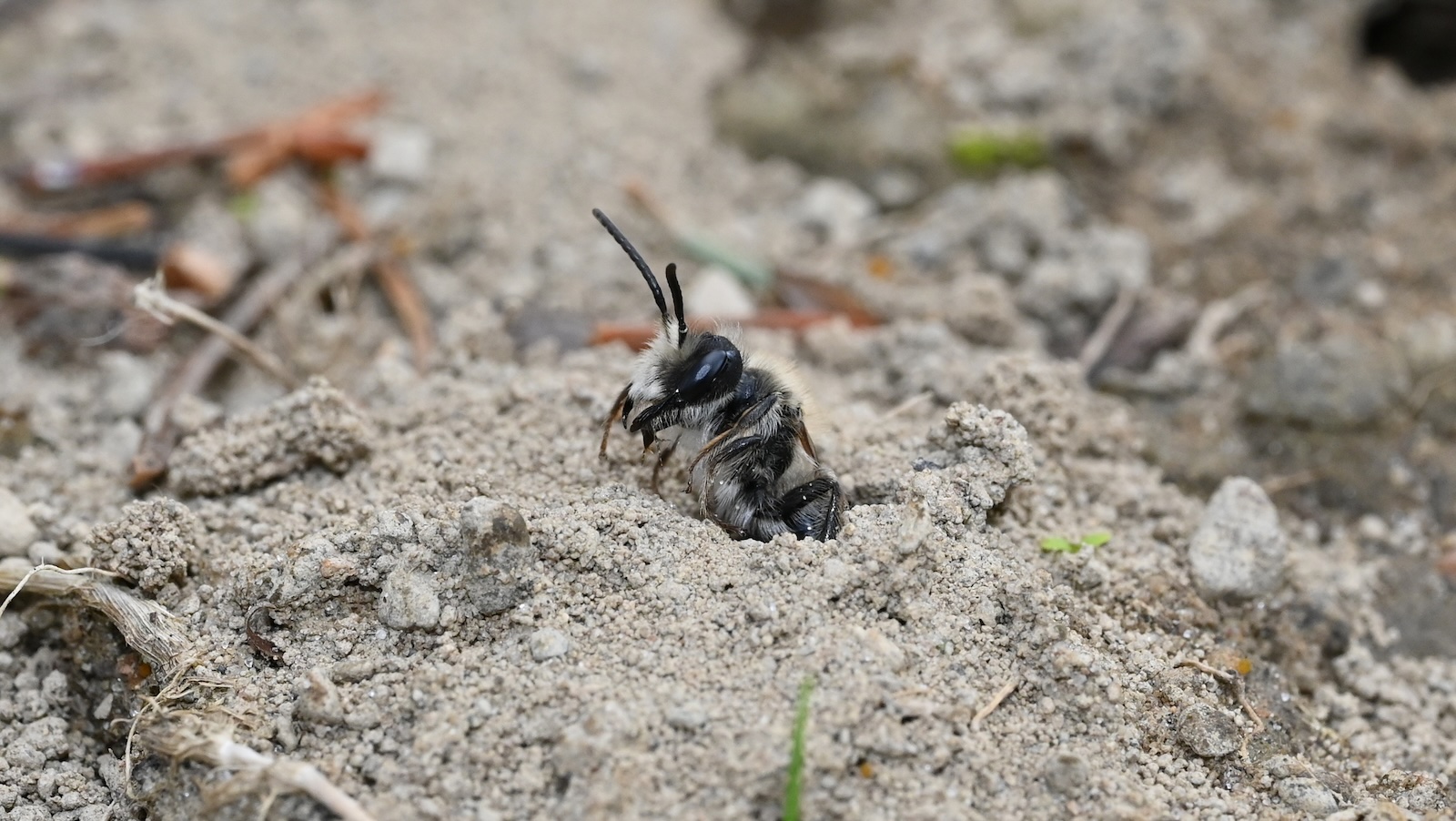
Unlike social bees that amass in large nests, the regular miner bee is a solitary species that digs tunnels underground. Courtesy Bryan N. Danforth
It’s not your fault, but you might have the wrong idea about bees. We’re taught that bees live in colonies with a queen and lots of workers that produce honey. These are such essential flower-visiting pollinators that farmers rent hives to work their crops.
As honey bees swarm farms, though, their less visible colleagues are also hard at work. The vast majority of them are solitary, making their homes underground or in natural cavities like trees. The regular miner bee, for instance, digs cavities under the East Lawn Cemetery, where it lays eggs that hatch into larvae and emerge as adults the following spring. Those adults go on to become critical pollinators for local plants, including New York’s apple trees, a highly valuable crop.
Weirdly enough, a cemetery might tick many of the boxes for a ground-dwelling buzzer in the market for a home. If this is a good spot for humans to bury their dead, it’s also a good spot for the regular miner bee. “Places that don’t flood, and places that are easy to dig and don’t collapse when you dig them,” said Jordan Kueneman, a community ecologist at Cornell University and coauthor of a new paper describing the findings. “So we think the bees in this area are drawn towards some of those same characteristics.”
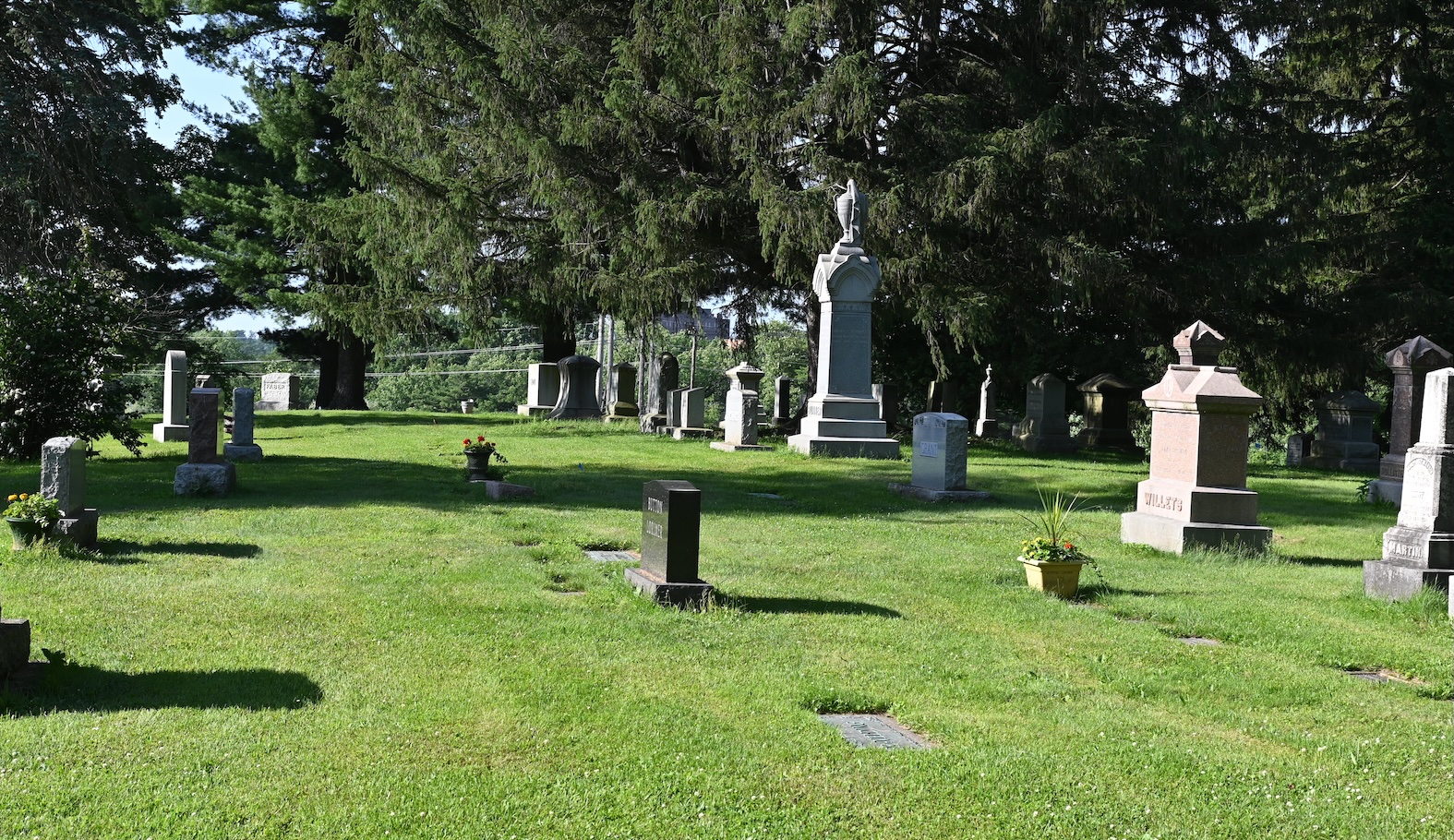
The East Lawn Cemetery is a seemingly sterilized landscape that in fact teems with life. Courtesy Bryan N. Danforth
But if a lawn mower grazed your house, wouldn’t you think about moving? Well, this might not be too big of a deal for the regular miner bee. In fact, by cutting the grass close, groundskeepers could be doing the insects a favor. “They do like to often have the ground exposed,” Kueneman said. “That helps the ground warm up quicker, allows them to become more active more quickly in the day. It allows them to get in and out of their nests easily.”
The researchers discovered that this population of miner bees is absolutely booming. By collecting individuals and scaling that count up across the grounds, they estimate that the East Lawn Cemetery hosts between 3 million and 8 million bees, including species other than the miner. “It was an extraordinary size, and a lot of that has to do with extraordinary density,” Kueneman said. “In some locations, we were measuring thousands of individuals emerging in a square meter.” (Still, Kueneman added, gardening crews could help the bees out even more by mowing earlier in the morning, before the insects emerge for the day.)
The researchers could also determine that this is a healthy population because of how many females were flying around. Male regular miner bees are smaller than they are, so when a mother lays eggs, she has to put fewer resources into making male offspring. If a population has a healthy proportion of females, then, it suggests that it’s thriving, and indeed that’s what the scientists found in the cemetery.
Enter the miner bee’s mortal enemy, Nomada imbricata, a variety of cuckoo bee. Just as cuckoo birds lay their eggs in other species’ nests, this opportunist invades the miner bee’s burrows and lays its eggs. This saves it the trouble of digging its own home, and its offspring hatch with plenty of food. “The parasitic bee develops and often has these large mandibles that they use to devour everything in their path, including the host bee,” Kueneman said. “They’ll sometimes decapitate them.” Not great for the miner bee, obviously, but the cuckoo’s presence at the cemetery provides more evidence that it has a healthy population to parasitize.
The bees are not alone in their success in this unlikely habitat. Other scientists are finding that many species across the tree of life — bats, migrating geese, owls, coyotes, rare types of plants — are using cemeteries as refuges in an increasingly urbanized world. “It has a lot of the things you want,” said Seth Magle, senior director of the Urban Wildlife Institute at the Lincoln Park Zoo in Chicago, who wasn’t involved in the new research. “It’s got trees, it’s got grass, it’s potentially got prey species for you, and resources. And then it largely lacks a couple of things you don’t like about parks, which are probably people and dogs.” Also absent from cemeteries are speeding cars, which in the United States hit hundreds of millions of birds and large animals, not to mention untold numbers of insects, each year.
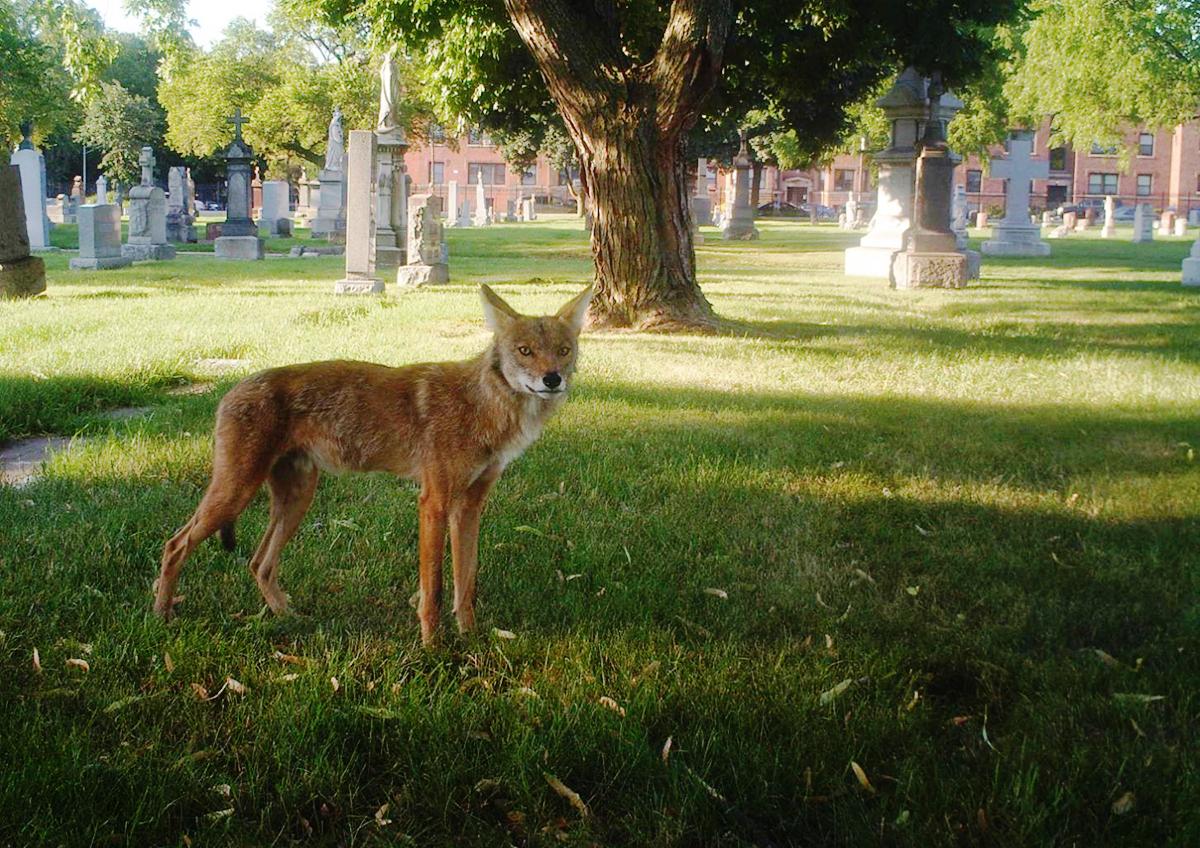
Wildlife cameras in cemeteries, like here in Illinois, have captured mammals and birds looking for food. Courtesy Lincoln Park Zoo
While cemeteries already shelter hoards of regular miner bees and other species, groundskeepers can do even more to support wildlife. Reducing the use of rodenticides protects birds of prey, which die when they consume poisoned rats and mice. Adding native plants provides food and shelter for native pollinators, which go on to help humans adapt to a changing climate. These species fertilize greenery across a city, for instance, significantly reducing urban temperatures, and help farmers to propagate their crops. “In order to have flowers, in order to have a beautiful ecosystem, or any biodiversity, we have to have pollinators that are fueling the reproduction of those plants,” Grinter said.
While cities have been historically cast as destroyers of biodiversity, conservationists now take a more nuanced view, Magle said. Yes, clearing forests to build metropolises is terrible for nature. But there are also ways to foster the natural world deep within cities. As places for the dead, ironically enough cemeteries can teem with the living. “What would it look like to create a world where we continue to urbanize,” Magle said, “but we do it in a way that leaves the space for some of these species?”
This story was originally published by Grist with the headline Why millions of adorable bees are emerging from this cemetery on Apr 22, 2026.
From Grist via This RSS Feed.