

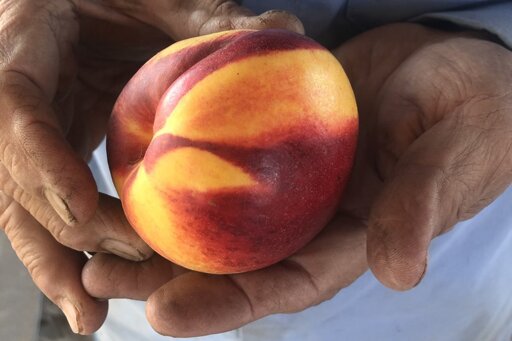
For more than two decades, our small family fruit farm in the heart of California’s Central Valley has hosted a beloved program that we call “Adopt-A-Tree.”
On two weekends in the summer, teams of people arrive from throughout California (in some years even from Oregon or Hawaii). We welcome them to the dusty fields of our farm to harvest “their” tree brimming with plump peaches or nectarines. They pick the jewels from the branches, pack their fruit into boxes in the fields, and leave with the smells of the day wafting through their cars: sweat, ripe stone fruit, and the fresh soil.
The Adopt-A-Tree harvest days are remarkably joyous. As farmers, we get to witness mainly suburban- and urban-dwelling neighbors sink into the sensory abundance of a farm. We hear exuberant giggles; we see the familiar trails of sweat on dust-covered foreheads and cheeks; we sense that core food memories are forming. This ritual is the culmination of each stone-fruit season on our farm. Watching the teams in the fields replenishes my spirit; I get to witness first-hand the pleasure of the eaters in the fields, gleefully biting into tree-ripened fruit that explodes with juice and flavor.
While the harvest days are in many ways a perfect example of celebrating the earth, as a farmer, the more important part to me is the setting of intentions.
“Farming in the age of the Anthropocene requires two resolutions (among others). The first is to pay attention.”
For our small farm program, teams must apply to Adopt-A-Tree. The application requires writing. We ask each team questions about how they will plan for and enjoy 250 to 300 pounds of fruit, and we invite reflections on questions like: What are you harvesting from this season of life? Or, What’s your favorite way to engage with the soil? Or, What have you learned from plants?
While it pains us to turn people away, every year some teams don’t make the cut. The applications are due during winter, when harvest seems so very far away, and we use them to discern if the team has earnestly committed to the program. Even for veteran teams who have been coming for more than 20 years, we still ask them to apply.
For me, the application process is the most important moment because it’s when I question myself as well. Can I give deep attention to this season and make the life cycle of the trees a central organizer of my time?

Author Nikiko Masumoto with her daughter and volunteer James Comes at a packing-supplies booth during an Adopt-A-Tree harvest. (Photo credit: Nichola DeNatale)
As a farmer, in many ways I was married to the land before my wife and I tied the knot. Even in my short tenure (brief especially compared with the stewarding of the land by the Indigenous peoples of California), I have come to realize that my original promise to live in relationship with our farm has almost no meaning unless I re-make the commitment year by year, season by season.
Farming in the age of the Anthropocene requires two resolutions (among others). The first is to pay attention. This sounds so simple. I have found it increasingly difficult in a world where our attention is easily and intentionally manipulated by digital technologies—and where the noise we humans make (both literally and figuratively) can distract us from being here, now, IRL. Farming among rapidly changing weather patterns requires our constant observation. How are the trees responding to warmer winters? What might we do to support their well-being?
The second commitment, to center life cycles of plants, I believe requires dancing between grief and stoking unrelenting hope. Just this year, one of the most beautiful few weeks on our farm was cut short: blossom time.
The orchards in bloom offer breathtaking beauty. On our small farm, 25 acres of stone fruit probably amount to over 1 million blossoms. Soft pink hues for as far as you can see. In a typical year, the blooming ends with a stage we call “petal fall,” when the teardrop-shaped petals float to the earth. But this year, most of the varieties on our farm skipped this stage. I believe because of the unprecedented 90-degree days at the end of February and early March (right at peak blossom), many of the petals dried on the branch, surrounding the pin-sized baby fruit.
Weeks later, we began to see what that skipped step of petal fall meant for our harvest.

This year, soaring temperatures dried the blossoms right on the fruit, causing fungus spores to form underneath as well as scars from rot. (Photo credit: Nikiko Masumoto)
When the fruit is about the size of a lychee or ping-pong ball and still very green, we go through a process called “thinning.” Removing some fruit from the branches gives room for the remaining young crop to grow big and juicy. If we don’t thin, the branch can break with the weight of the fruit and each fruit is very small.
This year, on the first day of thinning our apricots, to my dismay we found many fruits that were scarred near the tip. After an hour or so we pieced patterns together: Some of the fruit still had dried blossom petals clinging to the tip, and underneath those shriveled petals were fungus spores and scars from rot. We have never seen this before in the 60-plus years we’ve been growing stone fruit.
We think the dried petals of the blossoms acted as a perfect micro-habitat for morning dew and an ideal hideout and home for fungus. Instead of returning to the earth in petal fall, the blossoms became unlikely partners for destroying the very fruit they created. I estimated that 30 percent of some trees fruit had mold injuries or scars. They all had to be thinned off. I think we have enough remaining fruit that we’ll still have a decent crop, but what we witnessed frightened me to my core.
It is startling to see with my own eyes one manifestation of the global imbalance of climactic cycles and the spikes and valleys of extreme weather. Who could have predicted that something as seemingly unimportant as whether a petal dries on the stem or falls to the ground could have such drastic consequences for a year’s harvest? What if next year this happens again, and it isn’t 30 percent that is scarred, but 60 percent, or 90? What if I am the last generation to be able to grow stone fruit on this land?
The withering blossoms (re)opened some of my deepest fears about climate change and our ability to adapt and survive, but it also reminded me of how deeply I care. The unprecedented changes in weather and their acute expression in scarred fruit thrust me into grief, sudden and unexpected, the same quickening sadness I felt upon seeing the handwriting of my baachan (grandmother) on a bag of preserved peaches in the freezer months after she passed.

Audra LajNtxiag Yang-Johnson, an Adopt-A-Tree team member, rests near an Elberta peach tree at Masumoto Family Farm. (Photo credit: Geri Yang)
Farming today, I find my ability to move through loss and fear of future loss to be as essential as knowing how to drive a tractor. When I started farming, both of my grandparents were still living on the farm. Now, their legacies live on in the stories we share about them and the trees and vines that still grow here. My child can learn to know them through the stories, artifacts, and the plants that are part of her living inheritance. I still feeling the pangs of missing my grandparents in my daily work. Grief is a root to what we once (and still) love; grief can remind us how deeply connected we are and were.
Sitting with grief and reimagining it as an expression of love, I ask: What can I do now? What if I have no right to give up? What if a cold day in winter is the perfect time to re-commit to dreams of ripe stone fruit? What if the act of recommitting is the most important act of a farmer in the 21st century? When the joy of sweet, juicy peaches is very far away, that is my most sacred Earth Day, when the fruits of my labor are far in the distant horizon and the obstacles are plentiful.
One of my all-time favorite poems is by Li-Young Lee. It’s called “From Blossoms” and beautifully describes the moment of biting into a lush and succulent peach. Lee writes, “O, to take what we love inside, to carry within us an orchard.” What a profound way to think about the moment of a bite—the mouth becomes a portal of welcoming the outer living world so that we may literally be nourished and then carry the very place, inside ourselves, where the food is grown.
Because I know what it is like to eat this way, I don’t think I will ever tire of recommitting to the farm. I want to be present with the earth, to make my home in an intimate dance with the seasons, to sing a song at the funeral of a blossom, to embrace this gift of feeling heartbreak as well as love, acknowledging my fears and choosing to dream of harvests to come.
The post Op-ed: Farming With ‘Unrelenting Hope’ in the Age of Climate Change appeared first on Civil Eats.
From Civil Eats via This RSS Feed.