
Bullets:
Private Equity companies have rolled up manufacturers of ambulances, fire trucks, and other first responder equipment tools.
As a result, a small handful of companies control supply and pricing, and have aggressively raised costs and increased order backlogs.
Equipment in the North American market are ten times more expensive than for comparable tools from China, and wait times are three years or longer.
Inside China / Business is a reader-supported publication. To receive new posts and support my work, consider becoming a free or paid subscriber.
Report:
Good morning. Last week our team was in Hubei province, with a large factory group that builds vehicles for the specialized trucking segment. They have a manufacturing division for emergency vehicles and disaster response. The company is one of the top makers of ambulances.
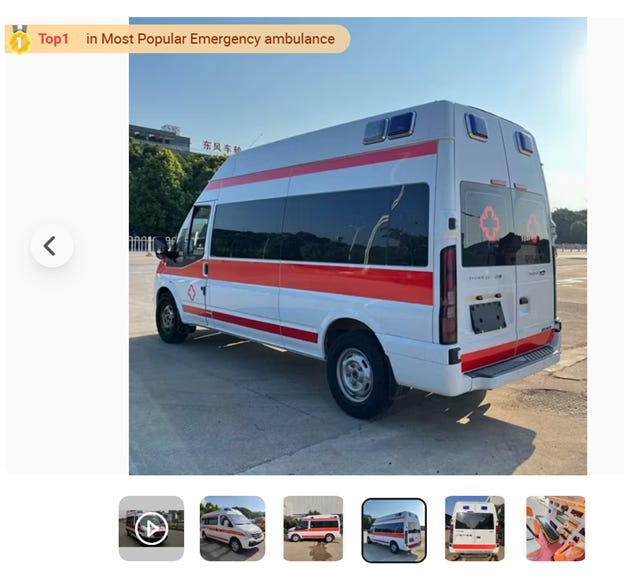
The company is ChengLi, or CLW, and this is one of their top sellers, an ambulance on a Mercedes chassis, for about $30,000 if you’re buying just one.
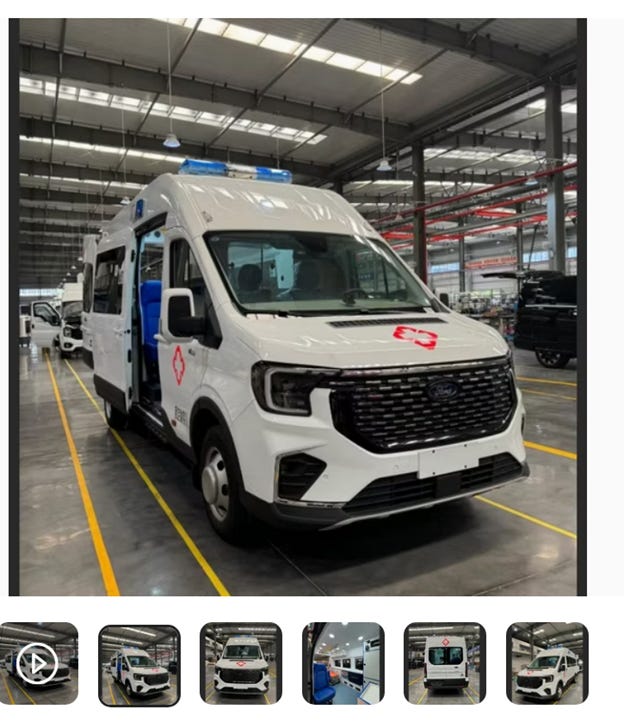
This is one on a Ford chassis for under $60,000. When you open the product pages we can read the specifications, and details about the factory itself. So this model can run on diesel or regular gasoline, and the company can build 5,000 of them per year.
Delivery times run 90 days, on average, and these companies have no problem sourcing chassis from Ford, or Benz, or a dozen other manufacturers. All the major Western and Japanese brands have production centers here in China that keep the markets well-supplied with chassis and other parts.
So now we know where ambulances come from, how much they cost, and how long it takes, for all the buyers of ambulances who are allowed to buy from China. Unfortunately that is exclusive of buyers in North America, who cannot do so. And that fact is now a crisis for local governments across the United States, who are paying more than ten times the prices, compared to buyers of Chinese equipment, and are waiting for three years instead of three months.
This is one of the best Substacks around, and it’s the same guys who did a deep dive into why Southern California caught fire and the richest communities in the United States couldn’t put it out:
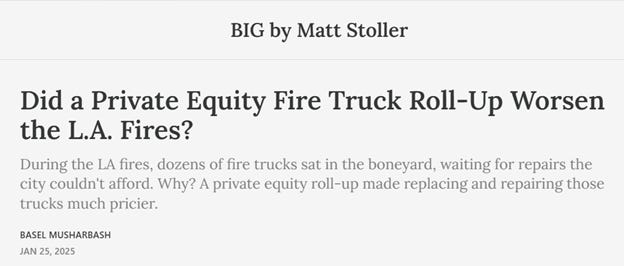
It’s true that a major issue in that story was the dysfunction and incompetence that’s more the rule than the exception these days in American big cities. But even the best-run local governments can’t buy new fire trucks, and can’t buy replacement parts to keep their old ones running.
That is a feature – not a bug – of our economic system, and that report on Substack eventually led to Congressional hearings that featured the original author of that piece, and some fire chiefs from across the country, and the CEO’s of the emergency equipment manufacturing companies. We should expect nothing whatsoever to come of that investigation; these are usually just photo ops so Congressmen can pretend to care about a problem.
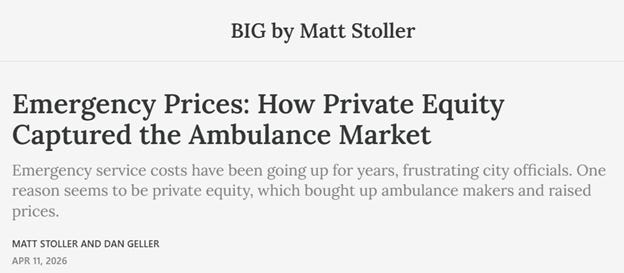
Here though is that Substack again with a new expose of North American ambulance makers, which dropped at almost exactly the same time we arrived at the big Chinese factory group that builds a hundred ambulances a day. Business travel doesn’t leave me much free time, and I might have missed the Substack piece were it not for a friend of mine who forwarded the link to me, knowing it would set me off.
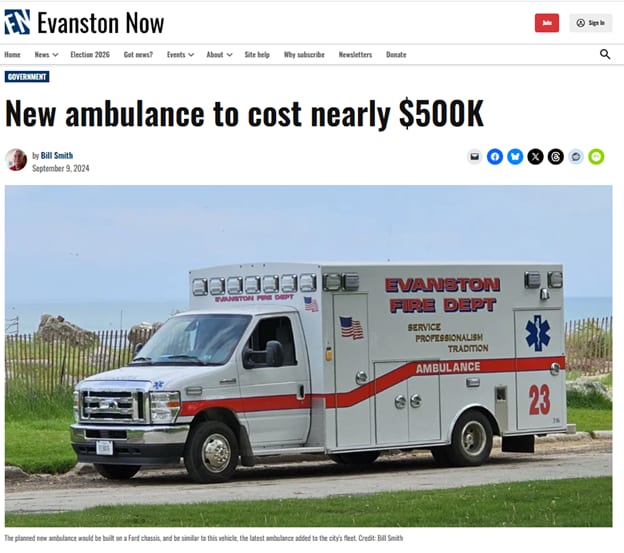
Evanston is a suburb of Chicago, Illinois, and is home to Northwestern University. Their city council just approved the purchase a new ambulance, on a Ford chassis, for $498,000. It’s a 2026 model, but won’t be delivered for at least two years because of production backlogs. The city is trying to switch to electric vehicles, but “there are no electric versions that are comparable.” This is also true in the American market, though not here. Evanston bought their previous ambulance13 years ago, kept it well maintained, and finally decided to buy a new one. And that price, half a million dollars, let’s call it, is over 4 times more than the one it’s replacing. The overall inflation rate during that time was 40%, while the cost for ambulances grew about 300% faster.
North Olmstead is in Cleveland, in Ohio. They just ordered a new ambulance from Horton, which is in Columbus. That also is on a Ford chassis. $495,000. Fire chief said that they have “had good luck with Horton, they are reliable” and local. In 2021, the fire department paid $353,000, so the new model is far more expensive, and will come in 925 to 950 days.
That puts the ETA sometime in 2028, which doesn’t sound especially lucky, or reliable. But “the days are gone when you could just call up a manufacturer” and get one by the end of the year. “That doesn’t happen anymore.”
Respectfully, but yes, it does. Ambulances in China are out the factory door in under 90 days. They could arrive at the Port of Long Beach in mid-August and be on the job in Cleveland or Chicago by Labor Day. The rest of the world does not deal with this problem. In every single country not named the United States or Canada, the problem doesn’t exist.
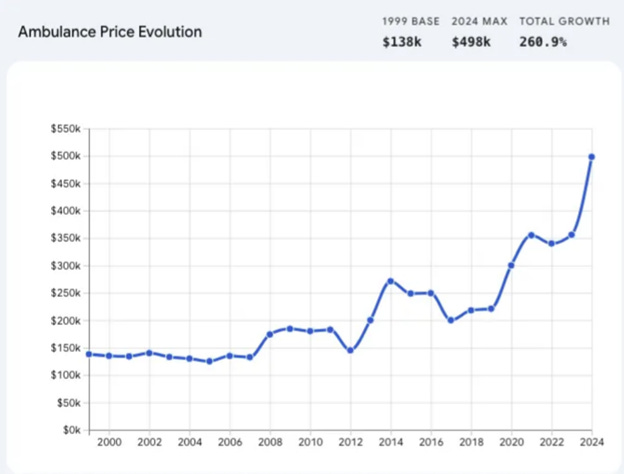
These price moves also do not exist. From 2000 through 2012, ambulance prices held steady, at between $140,000 to $180,000. Now the vehicles cost half a million dollars per, and the lines have gone vertical just in the past three years. At Horton, they increased prices by $68,000 in just one month. The Big Substack guys were curious why, and were told to call the local Horton dealer, who then suggested they call the spokesman for the REV Group. REV is the big Private Equity rollup that owns Horton and 13 other brands. A company spokesman is supposed to speak for the company, but never called back.
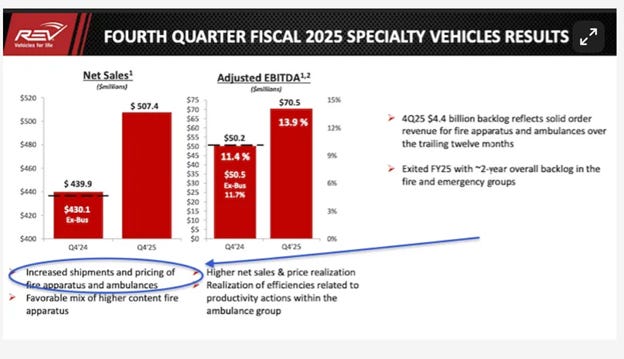
But the questions answer themselves. Private Equity groups have taken over this industry, and now run effective monopolies economy-wide. They move the prices up, and their profits follow:
That is the only rational conclusion. An ambulance is not any more complex to build than in the past. This is a reddit group of emergency workers, with 93,000 visitors a week, and this redditor points out that ambulance designs are the same since the turn of the century:
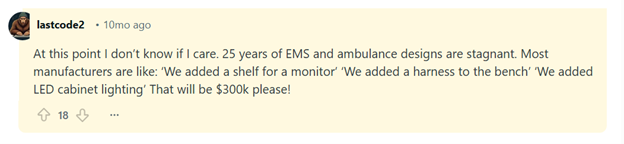
Companies perform a slight improvement, pretend it’s a new model, and jerk up the price. It’s true that an ambulance costs more than a truck on that same Ford or Benz chassis, because they need it to go faster and carry a bunch of medical gear, but that has always been true, and that is also true of ambulances built by Chinese factories for a tenth the cost and time.
Guilford County is in North Carolina, and they’re trying to explain here why their new ambulance set them back $600,000. Orders for ambulances are rising, and that is purportedly straining the supply chain for them. Delivery time used to be 4 months or less, now it’s two or three years. And the main driver of the cost increases and backlogs is not supply chain, it’s a function of how Private Equity companies make money, and emergency services is now a Private Equity industry. American Industrial Partners started scooping up ambulance companies, starting in 2006. Ten years later it had a portfolio of companies which they rolled into REV group, which they took to a public offering. In 2024, the company estimated they had about 70% of the manufacturing market share in the United States.
Up in Canada, another PE group, DBCM, got busy, rolling up manufacturers in the US and Canada. And after a decade of consolidating whatever companies REV didn’t get their hands on, today those two groups—REV and DBCM—control at least three fourths of the market in North America. They eliminated competition by buying them out, and closing manufacturing lines.
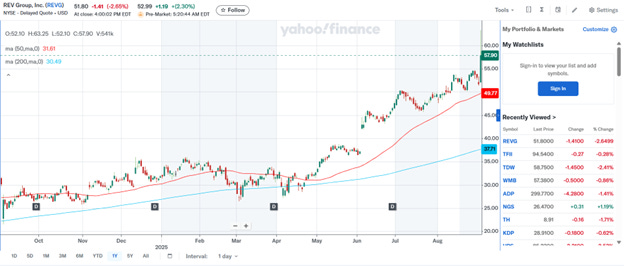
That strategy pays off. Backlogs are more profitable, and “investors love them.” Last year REV had over $4 billion in backlog orders for fire trucks and ambulances. The CEO even said on a conference call that the company loves order backlogs, because they turbo-charge profits. Earnings there increased 149% in 2024 from the previous year, and jumped another 65% in 2025. The stock price more than doubled, which far outgained the overall market:
All that consolidation — the industrial concentration — does not exist here. On made-in-China.com we looked for for ambulance models, direct from the factory manufacturer. Over 28,000 results were returned. I stopped counting when I got up to 40 different manufacturers, nationwide. In Hubei province alone, there are at least 15 companies, building over seven thousand various models and types.
The consolidation of his industry in the US has resulted in a duopoly; two companies that control pricing for the whole market. But this is their next trick, and the other big difference, which is that these companies’ dealer networks control everything from the procurement process to the cost of replacement parts. Local dealers have territories and can set their own prices, with big markups. That, again, is the crucial difference.
Chinese factories are direct to their buyers, and mechanics who need a new muffler can have one put on a plane tonight. A new motor can go on a ship the day after tomorrow. No middlemen are in the way. The reason that Private Equity groups operate this way, is that they can. They can afford to raise prices, then tell their buyers you can’t have a new ambulance before 2028. The reason Chinese factories do not operate that way, is that they cannot. They cannot afford to raise prices, and neither can they afford to tell their buyers the vehicle won’t arrive after a few months. Because there are dozens of other factories who can do it for a fair price, and faster.
I grew up with what I thought was a solid understanding of capitalism. Of the virtues of competition, which drives companies to build superior products for a fair price, for customers who have a lot of choices in the market. That’s not what we have anymore, in the United States, and so only a handful of cities across the country can afford to buy a new fire truck or ambulance, and no matter how much money they’ve got, they can’t get it for three years.
Be Good.
Resources and links:
Emergency Prices: How Private Equity Captured the Ambulance Market
[ BIG by Matt Stoller
Emergency Prices: How Private Equity Captured the Ambulance Market
Dan Geller is a Staff Attorney at Antimonopoly Counsel and can be reached at dan@antimonopoly.us…
Read more
11 days ago · 245 likes · 14 comments · Matt Stoller and Dan Geller](https://www.thebignewsletter.com/p/code-red-why-your-city-cant-affordor)
What your favorite make and model of ambulance?
https://www.reddit.com/r/ems/comments/1lfvstb/comment/myvfhsf/
North Olmsted fire department set to purchase new $495,000 ambulance
https://www.cleveland.com/community/2025/10/north-olmsted-fire-department-set-to-purchase-new-495000-ambulance.html
New ambulance to cost nearly $500K
https://evanstonnow.com/new-ambulance-to-cost-nearly-500k
Did a Private Equity Fire Truck Roll-Up Worsen the L.A. Fires?
[BIG by Matt Stoller
Did a Private Equity Fire Truck Roll-Up Worsen the L.A. Fires?
Today’s piece is written by antitrust lawyer Basel Musharbash…
Read more
a year ago · 712 likes · 27 comments · Basel Musharbash](https://www.thebignewsletter.com/p/did-a-private-equity-fire-truck-roll)
Sounding the Alarm: America’s Fire Apparatus Crisis
https://www.hsgac.senate.gov/subcommittees/dmdcc/hearings/sounding-the-alarm-americas-fire-apparatus-crisis/
Inside China Business, Chinese factories build fire trucks for $400,000 in six weeks. In the US it’s $2 million in 4 years
Inside China / Business is a reader-supported publication. To receive new posts and support my work, consider becoming a free or paid subscriber.
From Inside China / Business via This RSS Feed.
Private equity firms should be illegal.
Another feels bad article where throwing a few bricks wont help this problem. Thanks for awareness.