

From May 11–12, 2026, Kenya is set to host the France–Africa Summit, officially branded the “Africa Forward Summit: Africa-France Partnerships for Innovation and Growth”. Jointly organized by the Kenyan and French governments, it is the first time such a high-level France–Africa summit is being held in a non-Francophone African country.
Framed by its organizers as a platform to strengthen partnerships in business, technology, and sustainable development, the summit is expected to bring together African heads of state, government officials, corporate leaders, and representatives from civil society.
However, beyond the rhetoric of innovation and growth, the summit has provoked political reaction from progressive movements, who view it as part of a wider geopolitical repositioning by France on the African continent.
France’s shifting strategy in Africa
The Nairobi summit comes at a moment of major transformation in France’s relationship with the African continent, particularly following its declining influence in the Sahel region. In recent years, countries such as Mali, Burkina Faso, and Niger have witnessed mass protests and political upheavals that led to the expulsion of French troops and a breakdown of long-standing military and economic arrangements.
For many in the continent, these developments signal the erosion of what has historically been a system of political, economic, and military ties through which France maintained influence in its former colonies after formal independence.
Progressives in Kenya argue that the Nairobi summit reflects an attempt by France to reposition itself, with East Africa emerging as a new strategic frontier. This interpretation has been reinforced by recent developments, including a newly signed defense cooperation agreement between Kenya and France, which establishes a framework for the presence and legal status of French troops in the country. Reports indicate that approximately 800 French soldiers have already arrived in Kenya ahead of the agreement’s ratification.
Read more: East Africa rallies with the anti-imperialist struggle in the Sahel
Counter-summit: “Pan-Africanism Against Imperialism”
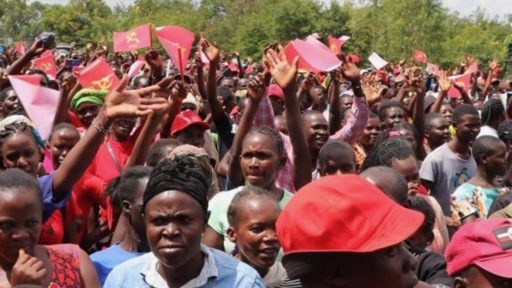
In response, a coalition of progressive organizations has announced a counter-mobilization under the banner of the Pan-Africanism Summit Against Imperialism (PASAI). Scheduled to coincide with the official summit, the counter-summit aims to challenge what organizers describe as “the imperialist nature” of France–Africa relations.
In a press statement released on April 17, organizers framed the Nairobi summit as “a rebranded offensive of imperialist recolonization disguised behind the mask of environmental diplomacy and financial reform.” They argue that the sectors highlighted in the official summit, such as climate finance, green energy, and digital infrastructure, are not neutral development priorities, but rather strategic areas through which foreign capital seeks to extract “superprofits” from African economies.
The statement further contends that while such partnerships “will bring bounties to the local big comprador capitalists, big landlords, and bureaucrat capitalists, in the form of business partnerships and new sources of corruption, it will bring only misery, poverty, and hardship to the African masses. They point to the state of West African countries, who after decades of French colonial and neocolonial rule, are the poorest countries in Africa.”
The critique has also been articulated more explicitly by the secretary-general of the Communist Party Marxist–Kenya, Booker Omole, who described the summit to Peoples Dispatch as “a war council of imperialism convened under the mask of diplomacy.”
According to this perspective, France’s historical and contemporary role in Africa is characterized by resource extraction, monetary control, particularly through mechanisms like the CFA franc in West and Central Africa, and military intervention. The Nairobi summit, in this view, represents continuity rather than change.
“France has never been a partner to Africa. France has been a plunderer. It has looted our wealth, dictated our currencies, stationed troops on our soil, and installed regimes that serve foreign interests while our people endure poverty and indignity. This is not history. This is the present reality the summit seeks to preserve.
Read more: The Alliance of Sahel States launches unified military force and strengthens regional security
“Let it be said without hesitation and without apology. The African masses reject Françafrique in all its forms, old and new. No amount of polished language, no summit declaration, no staged handshake can conceal the truth. Imperialism remains imperialism, whether it speaks softly or carries a gun.”
He situates the current moment within a broader continental shift, pointing to rising political consciousness among youth, workers, and rural communities as a driving force behind recent anti-imperialist movements. “The era of fear is collapsing. The era of defiance is being born,” he says.
Thus, the counter-summit is framed not just as a protest, but as part of a wider campaign aimed at dismantling structures of foreign domination.
France’s maneuvering in East Africa is likely to continue generating questions, given its historical legacy of imperialism and the recent experiences of West African states, which demand the need for vigilance. This is especially so in a context where questions of sovereignty and self-determination have become increasingly central to political debates across the continent.
“Any African leader who participates in this summit against the will of the people stands on the wrong side of history, aligned not with liberation but with oppression. The people will remember. The people will judge,” Booker said.
“Africa shall not be negotiated away in conference halls. Africa shall be reclaimed through struggle. Through unity. Through organized revolutionary force,” he added.
The post “The African masses reject Françafrique in all its forms”: Kenyan left mobilizes against France-Africa summit appeared first on Peoples Dispatch.
From Peoples Dispatch via This RSS Feed.