

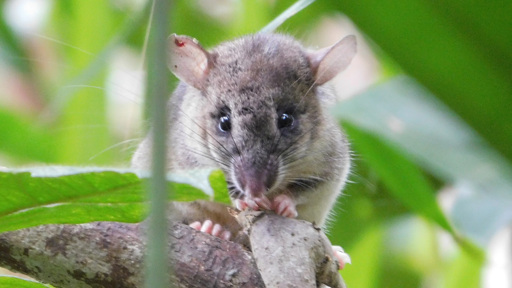
In a lowland forest in southeastern Madagascar, what was missing proved as telling as what was found. Researchers trapping small mammals in the Manombo Special Reserve caught tuft-tailed rats in the intact interior forest. In the nearby littoral forest, despite repeated efforts, they found none. The traps held black rats instead. The observation appears in a recent paper describing the first complete mitochondrial genomes for two endemic species, Eliurus webbi and Eliurus minor. The study, published in Mitochondrial DNA Part B by Elise Paietta and an international team of researchers, itself is technical. It assembles genetic sequences, places them within a sparse phylogeny, and notes gaps in what is known about these animals. Yet the fieldwork offers an important ecological finding: native rodents were confined to intact forest; degraded habitat was occupied by an introduced species. The pattern is not unusual. In many tropical systems, disturbance tends to favor generalists. Species with narrower ecological requirements recede as habitat fragments or is altered. What is less often spelled out is what this shift means beyond the change in species lists. The Malagasy study offers a way to examine that more closely. Eliurus tanala rat in Ranomafana… Photo by Nina Finley / Health in Harmony Its immediate contribution is genetic. Until now, no complete mitochondrial genomes existed for the Nesomyinae, a subfamily of rodents found only in Madagascar. Earlier work relied on shorter sequences, often from a single gene. These can indicate broad relationships but leave much unresolved. Whole mitochondrial genomes offer greater…This article was originally published on Mongabay
From Conservation news via This RSS Feed.