

Ecuadorian President Daniel Noboa further ignited tensions between his country and its northern neighbor. In an interview with right-wing Colombian magazine Semana, Noboa blamed Petro for the tensions, said he would work much better with right-wing presidential candidate Paloma Valencia, and insinuated that the Colombian incumbent had run in circles with drug traffickers while visiting Ecuador.
Noboa alleged: “[Petro] met with members of the Citizen Revolution party, and some of those members have ties to Fito. Whether he met with Fito face-to-face, I couldn’t say at this time. But let’s just say he was with the same group and in the same area.”
The Citizen Revolution party is the main opposition party in the country and Fito is the infamous leader of one of the country’s most powerful drug trafficking groups, Los Choneros.
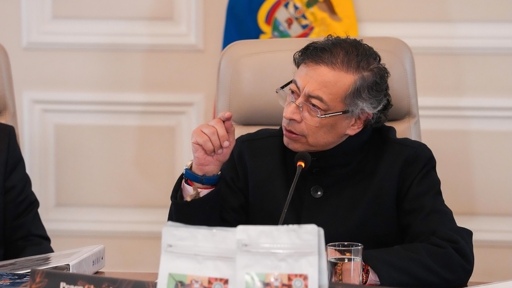
Petro’s response was immediate: “I have decided to file criminal charges against President Noboa for his slander. Noboa himself gave the order, as he should have, for the Ecuadorian army to guard me at all times, day and night, in Manta, where I went on the day of his inauguration, which I attended, and where he treated me with disdain simply because I asked for the release of political prisoner Jorge Glas, a Colombian citizen and former vice president of the Republic of Ecuador. Jorge Glas is being held in conditions of extreme malnutrition, and I have asked Noboa to hand him over to Colombia.”
Furthermore, the Colombian president clarified at the summit of progressive presidents held in Spain: “Not only did the Ecuadorian army accompany me to Manta, but also my escort from the Colombian security forces, who can testify under oath, and in addition to them, there are other witnesses at the place where I stayed while finishing my book. I don’t know if going anywhere in Ecuador implies suspicion of shady dealings. Manta is a beautiful place worth visiting. The Colombian press went to the place where I was staying and found neither luxury nor extravagance, nor a bizarre condominium – just a wooden cabin that was a nice place to look out at the sea.”
A crisis that seems to have no end
The conflict between Bogotá and Quito is nothing new. Last month, a tariff dispute broke out between the two countries. Noboa imposed a tariff on Colombian products that quickly rose to 100%. The Ecuadorian government justified its decision by claiming that the Colombian government is not taking the necessary steps to curb the flow of cocaine into Ecuador.
Read more: Tensions escalate between Colombia and Ecuador
Petro’s response initially included raising tariffs on Ecuadorian products and asserting that it is not true that Colombia is not taking action against drug trafficking. Furthermore, he accused Noboa of “handing over the border to the mafia,” which exacerbated a situation driven, among other things, by Colombia’s repeated request for the release of former Ecuadorian Vice President Jorge Glas (RC), convicted of corruption, whom Petro considers a “political prisoner”.
Noboa denied that Glas was a political prisoner and told the press that it would be very difficult to resolve the crisis – which escalated to the point of both countries recalling their ambassadors – with Petro’s government, and that he would therefore wait for a new administration to take office to normalize relations.
For its part, Bogotá suggested that behind the recent crisis lies former Colombian President Álvaro Uribe, a far-right politician, who, according to the Colombian Foreign Ministry, had visited Ecuador just as the 100% tariff increase on Colombian products took effect: “He was there last Wednesday as well, and the very next day they imposed the 100% (tariffs). I think these are very strange coincidences that I wanted to bring to your attention,” said the Colombian ambassador to Ecuador, María Antonia Velasco.
Thus, the dispute appears to be intensifying amid a serious security crisis affecting Ecuador, whose northern border is bearing the brunt of a tariff conflict that has caused enormous losses for Ecuadorian and Colombian merchants.
For his part, Petro is facing this crisis in a presidential election year, in which his potential successor, Iván Cepeda, hopes to continue the current government’s reformist and progressive path. However, the opposition, especially those close to the Democratic Center (the party led by Uribe), has tried to capitalize on the crisis with Ecuador: its presidential candidate, Paloma Valencia, stated that on her first day in office, she will call Daniel Noboa to resolve the crisis.
The post Petro says he plans to press charges against his Ecuadorian counterpart Daniel Noboa appeared first on Peoples Dispatch.
From Peoples Dispatch via This RSS Feed.