

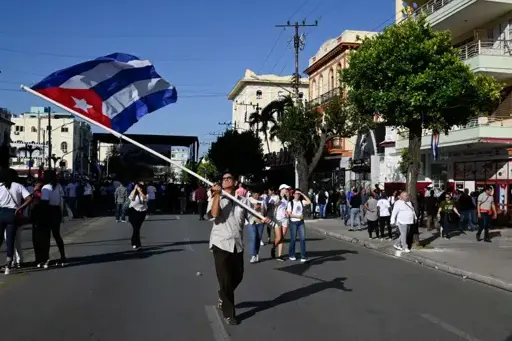
With all eyes on the war on Iran, the Trump administration is also continuing another front in U.S. imperialist aggression: the economic strangulation of Cuba. Trump’s escalation of the decades-long blockade through an oil embargo has deepened the misery of the Cuban people.
Left Voice interviewed Diego Dalai, an editor at our sister site, La Izquierda Diario, who has studied the history of the Cuban Revolution and closely follows developments in the country. He elaborated on how the blockade is impacting Cuban workers and broader sectors and how it ties into the bipartisan effort to restore imperialist control over Cuba. Dalai also explains the risks of capitalist restoration in Cuba if revolutionary socialists look to “diplomacy” or the leadership of Cuba’s ruling bureaucracy rather than the leadership of the Cuban working class and workers across the Americas.
*
How is Trump’s oil embargo affecting Cuba?
The social impact is enormous. Like in any country, the economy and daily life in Cuba rely on energy from fossil fuels. All transportation, both of people and goods, relies on fuels such as diesel or gasoline; most of the electricity (around 90 percent) is generated from diesel; agricultural production requires fuel for tractors; and industrial production requires fuel or electricity. Cuba has oil and refineries, but it is very heavy oil, more difficult to refine, and can only cover 40 percent of the needs for electricity generation.
That is why there have been major blackouts across the country — some even occurring simultaneously throughout the entire territory — lasting many hours, day after day, which causes very serious hardships for the population. It’s not just about being without power at night. Being without power for 20 hours means perishable food spoils; it means water tanks stop working to supply neighborhoods where water doesn’t reach by gravity. Hospitals, for example, remain only partially operational using electric generators that are far less efficient than the general power grid. In fact, thousands of scheduled surgeries have had to be canceled, including for children.
Patients who rely on medical devices have had to be supplied with an electric generator or solar panels in their homes. Universities have switched to online classes, affecting the entire academic year; in fact, there have been protests by students who realize they will fail the year. Every aspect of daily life is affected.
The economic paralysis, caused by the lack of fuel, also means that many people who had to seek work in the private sector are now left without jobs because businesses are closing. That is why we have been denouncing that this blockade imposed by Donald Trump is criminal and violates international law itself.
How does this compare to the broader blockade the United States has maintained for decades?
It is part of the same strategy. Since the revolution, the U.S. political regime has followed a very clear line that, with few exceptions, all administrations have adhered to. The strategy has always been to influence the Cuban economy and the lives of the Cuban people as much as possible, with the aim of imposing the White House’s will on the country.
And what is the will of all the administrations — Republican and Democratic — that have passed through the White House? That the Cuban people renounce the social gains they achieved starting in 1959 and return to subordination under U.S. imperialism.
The blockade was imposed by Democratic President Kennedy in 1962, but sanctions had already begun during the Eisenhower presidency (also responsible for the Bay of Pigs invasion) — for example, with the reduction of sugar purchases in July 1960. This was a sector that accounted for 80 percent of the foreign exchange earned by the island. The U.S. blockade against Cuba is the longest in history and has caused economic losses equivalent to some $170 billion since 1962. Since then, it has affected all trade with the U.S. and with other countries allied with or subordinate to the United States.
Cuba had to rely on trade and aid from the Soviet Union and later from Venezuela, among other countries, to sustain itself. And when these countries reduced or outright cut off that aid, the island entered into severe crises, like in the first half of the 1990s, when, following the collapse of the Soviet Union, Cuba’s GDP plummeted at a rate of 10 percent annually.
Consider how criminal the imperialist policy is: taking advantage of that situation, in 1992 the U.S. enacted the Torricelli Act and in 1996 the Helms-Burton Act. The first essentially extended the ban on trade with Cuba to subsidiaries in third countries and closed U.S. ports to ships that had called at Cuban ports. Among the prohibited products were food and medicine.
The second law was even worse, because it consolidated all previous sanctions and transformed them into a federal law that cannot be lifted by executive orders, and it establishes a full political roadmap — basically regime change in Cuba — for the blockade to be lifted. Furthermore, in Title 3 of the law, it internationalized the sanctions by allowing lawsuits to be filed against companies in third countries that trade with Cuba. It’s worth noting that Democrat Bill Clinton was president at the time.
Over all these decades, there have only been very brief periods of some easing of the blockade under certain Democratic presidencies. One was between 1977 and 1980 during the Carter administration, when, quite simply, restrictions on travel to the island were lifted, remittances were allowed, and the Cuban fishing industry was facilitated in geographically shared waters. Another was under Clinton himself, who suspended the harmful and illegal Title III of the Helms-Burton Act on several occasions, and toward the end of his second term, following Pope John Paul II’s visit to Cuba, authorized the sale of food to private Cuban entities (NGOs, churches), as well as travel and remittances. The last of these brief moments occurred during the final part of Obama’s second term. Between 2015 and 2017, travel and remittances were permitted without limits, and certain commercial activities were authorized, such as the sale of food, telecommunications, and construction materials, tools, and agricultural supplies. The opening of bank accounts and the use of credit cards were also permitted.
However, the sanctions — and the blockade itself — were never lifted. Cuba was always prevented from trading freely with other countries and had to constantly maneuver and pay in advance to obtain the goods it needed to import. The Democratic Party may argue that, since it is a federal law, the president cannot lift the blockade, but the truth is that they have many legal tools to ease it, and only those three presidents (out of six since the 1960s) did so — in a very limited way — and, with the exception of Carter, they did so at the end of their terms, so that their successor could quickly revoke the measures. In fact, Trump reversed everything Obama did as soon as he took office, and then, in 2019, he reinforced the blockade with more sanctions, which shows that the blockade is always there. It is a matter of state policy that the Democrats are unwilling to confront.
The Cuban government has confirmed that it is negotiating with the United States. How should we interpret these negotiations from a socialist perspective? What do they mean for the possibility of a capitalist restoration in Cuba?
The Trump administration is going into these negotiations with the objective we mentioned earlier: for Cuba to return to capitalism and become economically and politically subordinate to the United States. And it is not going to negotiate on equal terms. Before sitting down at the table, the Trump administration staged the coup in Venezuela and imposed the fuel blockade, putting Cuba on the ropes. The talks with Marco Rubio, who has always been a representative of the most reactionary sector of the Cuban diaspora in Miami, are more about extortion than negotiation.
On the Cuban side, there is a bureaucracy that decided many years ago to move toward capitalism, and they have imposed numerous pro-market and neoliberal economic adjustment reforms on the people — including cuts and the elimination of subsidies, increases in public utility rates, layoffs and closures of supposedly unviable companies, inflationary shocks, and so on. In fact, images of the 2021 social uprising went viral around the world; in other words, we all know what those measures led to: more hardship for the working masses. And since then, there have been constant social protests — on a smaller scale, but they continue to this day.
The ruling bureaucracy blames all evils on the blockade, which, as we discussed earlier, is entirely true. But they themselves are also largely responsible for people going hungry and facing endless hardship. They always shift the burden of crises onto the workers instead of seeking revolutionary solutions — like promoting organization and mobilization inside and outside Cuba to defeat imperialism and its allies.
Instead, they prohibit people from organizing independently in Cuba and abroad; they call for trusting supposedly progressive governments like Lula’s in Brazil or Sheinbaum’s in Mexico instead of betting on the revolutionary struggle of those peoples. They remain silent about the internal policies of those governments that use progressive rhetoric but at every turn guarantee stability, capitalist business interests, and subordination to imperialism.
In short, from the negotiations between the Trump administration and the restorationist bureaucracy, we can only expect further erosion of the revolution’s gains and greater hardship for the masses. And I say this even though an agreement with the United States might allow Cuba to escape the critical situation it faces today — since, of course, the U.S. itself is largely responsible for it through its fuel embargo.
But a return to capitalism and subordination to the United States will have disastrous consequences for the people. It will lead Cuba to become a country like its Caribbean and Central American neighbors, where poverty, hunger, unemployment, capitalist exploitation, and imperialist plunder proliferate. Cuba is not very different from countries like Jamaica or Haiti; it is a much larger island, but nothing more. There are no major industries, no major mineral deposits, except for nickel. If Cuba managed to achieve the highest socio-cultural standards in the region, it was because it truly gained independence from the United States, expropriated the large landowners, and reorganized the entire economy with the aim of meeting social needs rather than capitalist profits — though it did so bureaucratically, with endless problems.
The solution remains socialism, not capitalism. The serious problem we face is that the bureaucracy is moving toward capitalism in the name of socialism and, moreover, imposing a highly repressive one-party regime. Consequently, the masses come to see socialism as the problem and even begin to doubt that the blockade is the primary cause. In fact, Raúl Castro himself said in several speeches while in power that one could not place all the blame on the blockade. Consequently, some sectors, particularly the youth, end up calling for a shift toward capitalism.
That is why we always say that the masses must overcome this bureaucracy, oust it, and put an end to the entire one-party regime, and establish a government truly of the workers and the people. Because that is the only way to truly move toward socialism, and always, of course, with an eye toward advancing the revolution in the rest of Latin America and especially in the United States. It would be utopian to imagine a socialist Cuba if it is not part of a Federation of Socialist Republics of the continent.
The strangulation of Cuba has intensified as a result of Trump’s “Donroe Doctrine.” How does the advance of U.S. imperialism in Venezuela influence this? Why aren’t the “progressive” governments of Colombia, Brazil, and Mexico sending oil, and what is the impact of their complacency?
Well, the military coup on January 3 in Caracas, where, in a completely illegal manner and in violation of Venezuelan sovereignty, Maduro and his wife were kidnapped, was the starting point for implementing a rather old imperialist strategy: using its military power to compensate for the decline as a hegemonic power that it has been experiencing for decades. U.S. imperialism wanted to regain control over Venezuelan oil, which it had lost since Chávez arrived at the Miraflores Palace. Even though the Maduro regime was completely reactionary and in total decline, imperialism still lacked control over this strategic fuel.
Furthermore, the U.S. wanted unrestricted access to Venezuela’s other mineral wealth. All of this was stated brazenly by Trump in front of the press. And in Venezuela, it worked out very well for him. They got what they wanted and, in the process, were able to cut off oil supplies to Cuba. But why did it work out so well? It’s because the regime’s leadership negotiated with imperialism, betrayed and handed over Maduro, in exchange for Trump and Rubio letting them continue to govern.
More generally, the entire offensive the White House is waging against Latin America is possible because there are a dozen countries in the region governed by right-wing and far-right leaders who love to subordinate themselves to the United States. And it is also possible because the governments that call themselves progressive — Lula’s in Brazil, Sheinbaum’s in Mexico, Petro’s in Colombia — do nothing concrete to resist. They make “sovereignist” speeches, but they also subordinate themselves to the Trump administration.
Let me give you a very concrete example. When the total fuel blockade against Cuba was announced at the end of January, these countries could have broken the blockade quickly. In fact, Mexico was Cuba’s second-largest supplier, and in early January it had sent a ship that was the last one to arrive. Sheinbaum did exactly what Trump demanded.
These countries are major oil producers and exporters; with just a fraction of their production, they could cover all of Cuba’s needs. What was Trump going to do? Was he going to dare to seize an oil tanker from Pemex or Petrobras? At the very least, it would have made things much harder for him. But if he threatens you and you do what he demands, well, you’ve already lost the fight from the start.
And the fact is, in Mexico’s case, it will soon have to renegotiate economic agreements with the United States and Canada, so the “progressives” are betting on “good relations” rather than confrontation. But this only benefits Trump and further weakens the position of Mexico, Brazil, and Colombia. “Progressivism” ends up serving arrogance and imperialist expansion. It is this disastrous policy of “friendly” governments that allowed the fuel blockade to take effect, not U.S. military power. And of course, it put Cuba on the ropes.
Two important international events have recently taken place. One is that Trump, while insisting he maintains the blockade, allowed a Russian oil tanker to reach Cuba. The second is that, regardless of how the war against Iran unfolds, it has laid bare the weaknesses of U.S. imperialism. How do dynamics such as U.S. imperialism’s relationship with Russia and the crisis in the Middle East influence the position of U.S. imperialism in the Caribbean and Latin America?
Indeed, what happens in the Middle East, the relationship with Russia, and other geopolitical factors — such as the relationship with China, for example — are key to what happens in the Americas. Or rather, they are key to determining the strength with which U.S. imperialism can impose its will on Latin America and on its own people within the United States.
Regarding the Russian oil tanker they let through, both local and geopolitical factors were at play. First, Trump had gotten himself into a quagmire by declaring war on Iran, which led Iran to close the strategic Strait of Hormuz, causing oil prices to skyrocket to around $120 a barrel. He needed to increase demand to contain that spike and lifted sanctions on Russia so it could sell oil to various countries.
At the same time, in Cuba the situation was reaching a breaking point, and, paradoxically, Trump risked an uncontrolled collapse of the regime. I say “paradoxically” because Washington has always sought the implosion of the Cuban regime, hence the blockade. But they need something to replace the ruling bureaucracy, and they don’t have that. They don’t want to risk social and political chaos, especially in a country as politically symbolic as Cuba, with a very strong revolutionary tradition and decades of resistance against imperialist aggression. It’s a scenario where you simply can’t predict how it might end.
That’s why they’d love to do what they did in Venezuela: oust Díaz-Canel — who is just as discredited as Maduro was — and have the rest of the bureaucracy submit, as Delcy Rodríguez, Padrino López, and Diosdado Cabello did. But Cuba is much more complex in that regard. First, because of its history. Second, because the regime, although it is deeply discredited and also has internal divisions, is very different from Venezuela’s; its origins lie in a socialist revolution, quite unlike a bourgeois nationalist project such as Chavismo.
Third, because there are imperialist sectors — first and foremost the Miami diaspora — that do not accept the Castro family remaining at the helm of the regime, or the Communist Party continuing to rule, but at the same time, they have no politician or political organization capable of replacing the bureaucracy. In Cuba, there is no right-wing current that enjoys support among the population, beyond the fact that political parties are banned.
So, to avoid a potential uncontrolled collapse with unpredictable consequences, they let this ship pass — which, let’s be clear, covers 10 or 12 days’ worth of needs and must first be transported, refined, and then transported again to the thermal power plants. In other words, it was a drop in the bucket; it solved nothing.
On the other hand, since late February, as part of Rubio’s negotiations with Castro’s grandson — whom some call “Raulito” — the United States began allowing its companies to sell fuel to the Cuban private sector. And there is information that there have been several shipments, although all are of moderate quantities — tanks of 20,000 or 25,000 liters that can supply a fleet of tourist taxis for a few days, to give an example.
The fact is, there was a major contradiction: the blockade was harming the very sector they want to promote: medium-sized businesses pushing for deeper and deeper capitalist measures and economic liberalization. In other words, they are the quintessential social base of capitalist restoration. And many of these companies and businesses were closing or drastically scaling back their operations due to a lack of fuel and/or electricity. That is why I want to highlight this point: Trump and Rubio seem to be taking the world by storm, but they are full of contradictions and weaknesses. That is why the condescending politics of progressivism we discussed earlier is so tragic.
Many members of the pacifist Left in the United States suggest that the country should return to Obama’s approach and, in general, view diplomacy as a positive alternative to war. Why is it wrong for revolutionary socialists to defend this diplomacy as a form of relief for the Cuban working class?
Obama’s policy on the Cuba issue broke a decades-long paradigm (with the exception of Carter, as we’ve already mentioned) of trying to force regime change through economic and diplomatic aggression. And this coincided with the fact that Raúl Castro had taken the path of pro-capitalist reforms and never tired of saying he was willing to negotiate if it was on “equal terms” and “respecting the sovereignty” of the other side — a way of saying that the political regime should not be touched because Raúl was pursuing the “Chinese model” of capitalist restoration. Incidentally, this is quite similar to what the Díaz-Canel government is saying now.
The point is that Obama broke with an old paradigm that had failed, but with the same underlying strategy of restoring capitalism in Cuba and once again subordinating it to the United States as it was before the revolution. As we said before, this is a matter of state for the U.S. two-party regime: to defeat the Cuban revolution. Trump with the stick, Obama with dialogue, dollars, and cheap goods.
But they are two sides of the same coin. With Obama and Raúl, did the living conditions of the Cuban masses improve? You can’t answer with a simple yes or no, because there’s no doubt the economy was revitalized, but it created a growing gap between those with access to foreign currency and those without.
It was a boom time for the self-employed, and it accelerated the differences between self-employed workers who eked out a living day by day on the street trying to sell something to a tourist, and those who could run a profitable business and even have a few employees.
So, we must not be fooled by the polite manners, friendly smiles, or speeches about mutual cooperation and development. The “Obama approach,” so to speak, does not solve the problems of the Cuban people, but rather leads to capitalist restoration and subordination to the United States.
For revolutionary socialists, the only way for the Cuban people to emerge from the current crisis is through their own mobilization and organization, defeating the imperialist blockade alongside the peoples of the entire continent, ousting the restorationist bureaucracy, overthrowing the one-party regime, and establishing a government that truly belongs to the workers and the urban and rural people. In this way, through their truly democratic workers’, popular, and peasant organizations, they must take the reins of the economy, review all the market reforms carried out in the 1990s and subsequently under the Economic Guidelines, and steer the country back toward an economy in transition to socialism.
Why is the leadership of the Cuban working class necessary to resist imperialism? What role does the Cuban bureaucracy play in obstructing this anti-imperialist resistance?
Because it is the only force capable of waging a struggle of such magnitude against the greatest imperialist power, located just 180 km away. Together with the poor peasants and the militant student movement, they are the only ones who can reverse the current course of degradation caused by the blockade and the austerity measures and policies promoting capitalism.
And here, by “working class,” we do not refer only to state employees, who remain the majority (around 70 percent) and ensure the functioning of the main levers of the economy that are still in the hands of the state. For many years now — since 2011, perhaps even earlier — there has been a very significant sector. And here let me add a footnote, because many people think there is a qualitative difference between Díaz-Canel and Raúl Castro. Raúl Castro had planned to lay off 1.5 million state employees between 2010 and 2015, but during that period they were only able to lay off 500,000 (which is a lot, but far short of the plan) because there was enormous, albeit “silent,” resistance from the workers. It took them 15 years to carry out all those adjustments in the state sector in several stages so that anger wouldn’t erupt.
Today, 1.3 million people work in the private sector as self-employed workers or employees in the nearly 10,000 MSMEs (micro, small, and medium-sized enterprises). This sector of workers is fundamental to the struggle that needs to be waged. It is the most exploited sector. Although they generally earn more than state employees, 60 percent of the private sector work informally, meaning that for most, wages are unstable — you don’t know if you’ll be fired tomorrow or if the employer will be late paying your salary. I’ve read several newspaper articles quoting people complaining that they’re paid whenever the employer feels like it, or that they simply haven’t been paid at all and had to find another job. Imagine how difficult it must be to file a complaint in this regard. I believe that today it is a very precarious sector. And then, Cuba has a very large rural population, 25 percent of the national total. So in Cuba, bringing poor and small-scale farmers into the struggle is essential to defeating the blockade and reversing the current process of decline.
And regarding the role of the ruling Communist Party bureaucracy, they say it themselves in every speech: they want to negotiate with imperialism — that’s what Raúl always said, too — and ask to negotiate from a position of sovereignty. They don’t call for confrontation; at most, they call for resisting if attacked. We do not know the details, and we cannot know the pace it will take. It also depends greatly on the geopolitical context we discussed earlier, including whether the negotiations break down and the rhetoric becomes more aggressive on both sides, but the objective, the desire of the bureaucracy, is to negotiate. This, too, was the case with China, to name just one example, as when Mao Zedong negotiated with President Nixon, followed by Deng Xiaoping’s negotiations with President Carter.
Therefore, the bureaucracy is a brake on the anti-imperialist struggle, and in this sense, the struggle against imperialist aggression is necessarily linked to the struggle against the one-party regime. If the analogy holds, it’s similar to when you confront management and in that process you have to confront your union leaders because they constantly put obstacles in the way of the struggle. They want to demoralize you, and sometimes they even send the union thugs after you. Obviously it’s not the same, but it’s very similar.
What can be done to build solidarity with Cuba throughout the Americas, and particularly from the United States?
This is fundamental, especially within the United States, as you say. In the face of aggression by an imperialist power against an underdeveloped country — weaker in every sense — international solidarity is key. And the struggle within the aggressor imperialist state is even more so. Although it’s not the same because we’re not facing an invasion and a war, there’s the case of Vietnam. It wasn’t just the incredible, heroic resistance of the Vietnamese people, but the anti-war movement within the United States had a huge influence. Simply because it weakens the aggressor; it opens up an internal front, so to speak.
And you can do it. Through mobilization, you managed to drive ICE out of Minneapolis; millions mobilize in the “No King” marches; in the face of the genocide in Palestine, you built a significant movement of active and militant repudiation among students and other sectors. Solidarity with Cuba could also organize hundreds and mobilize thousands. Launch a major campaign, including humanitarian aid drives, mobilizations to demand the immediate shipment of fuel, pressuring the most active unions to take the lead, and demanding that politicians like Zohran Mamdani and progressive groups and others take real action to end this aggression of the blockade. Such a campaign, within the United States, could also help strengthen the efforts underway in Mexico — demanding that the progressive Sheinbaum — or in Brazil — demanding that Lula — stop with the rhetoric and send fuel.
The post “The Solution Remains Socialism”: A Deep Dive into Cuba’s Confrontation with U.S. Imperialism appeared first on Left Voice.
From Left Voice via This RSS Feed.