

There are growing signs that the United States may be on the verge of another major financial crisis, one that could start in the private credit market, which is already seeing significant turmoil, before spreading to other sectors.
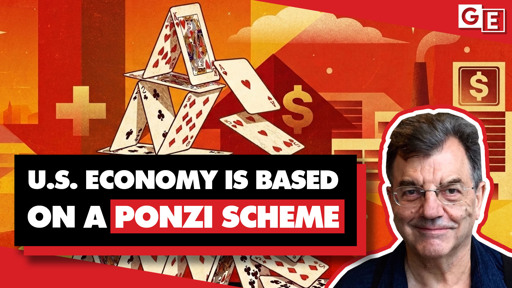
Geopolitical Economy Report editor Ben Norton interviewed economist Michael Hudson to discuss the serious problems on Wall Street. Hudson warned that the US economy is built on a Ponzi scheme that depends on continuing to pour money into a bloated, bubbly financial system based on unsustainable speculation, not industrial production.
Video
Podcast
Transcript
(Introduction)
BEN NORTON: There are more and more signs that we may be on the precipice of another major financial crisis.
The former CEO of the Wall Street bank Goldman Sachs warned in an interview on Bloomberg that he can smell another financial crisis on the horizon.
Where exactly could this crisis come from? Well, some financial analysts are worried about the private credit industry in the US.
This has exploded in recent years, because after the 2008 crash, banks were more heavily regulated. So more and more firms on Wall Street began to lend to private companies, and the private credit industry ballooned.
It is now a $3 trillion industry, yet it is not regulated. And many of these private credit firms have given bad loans to bad companies that are now defaulting.
We published a short video explaining the issue with the private credit industry and the fears of a new financial crisis. However, that video is just a brief introduction to the problem.
I thought it would be important to go into further detail explaining the very real danger here. And I thought the perfect guest to interview to help us understand this would be the economist Michael Hudson.
Michael is the author of many books, including Killing the Host: How Financial Parasites and Debt Destroy the Global Economy.
So here we’re going to play some highlights of our interview, and then we’ll go straight to the discussion.
(Highlights)
MICHAEL HUDSON: You then begin to have private capital take over companies and make money by essentially looting them.
Thames Water in England is typical how you loot a company. Hospitals, for instance, were a target of these private equity companies.
Private equity proceeded to bankrupt whole swaths of the American economy. And, new word was added to the English language: enshittification — just cutting back the quality of what companies were doing, slashing expenses, working labor harder, making them work overtime.
…
So the financial system has been turned into a predatory system. And all of this enormous growth in financial wealth since 2009 has accrued to the financial and real-estate sector, dominated by the wealthiest 10% of the population.

40% of the American population doesn’t have any savings at all. They’re living on the brink.
And now the costs are going up. They’re having to fall further and further behind on their credit-card debt, their personal debt, their automobile debt, student loans especially.
…
But as long as the credit-card companies will lend the consumers the money, the credit, to remain current on their obligations, and not have to pay penalty fees, then you’re going to be able to keep the Ponzi scheme going.
A Ponzi scheme is you need more and more money paid into it to keep the exponential growth rate growing.
(Interview)
BEN NORTON: Michael, thanks for joining us today. It’s always a pleasure having you.
Let’s talk about the real possibility of a new financial crisis. If you read financial media outlets like Bloomberg and the Financial Times, they have been warning a lot recently of the possibility of a new financial crisis.
It could potentially start in the private credit industry, which is seeing all of these problems and rising default rates. And it could spread; this could be contagion that spreads through the banking sector and other industries.
Then you also have the AI bubble, and the war in Iran, and the energy shock. There is so much we’re going to talk about today.
But let’s just start by talking about this crisis. Do you think we could be on the verge of another major financial crash?
MICHAEL HUDSON: Yes, the whole problem stems exactly from 2008 or more particularly, 2009, when President Obama took office.
His solution to the junk mortgage crisis, the bank fraud crisis, was to turn the economy into a Ponzi scheme.
He needed to bail out the banks. The banks had made so many fraudulent and bad loans, that exceeded the ability of these banks to collect on their high-interest, junk mortgages that had been given, that the major banking companies were in negative equity.
What was the solution? The solution was a zero interest-rate policy, ZIRP.
Then the Federal Reserve lowered interest rates from the high crisis levels in 2008 and 2009 way down to 0.1%, which is what banks could borrow for.

The Federal Reserve was able to create electronic money on its computers to lend to the banks at a very low interest rates and said, “Well, banks, you have as much money as you want, at 0.1%, that we are providing you to lend out to the economy, to support the price of real estate, stocks, and bonds, so that we will restore the negative equity that the reckless banking sector has created”.
Well, the result is that the banks did two things.
One, they could simply leave the 0. 1% money they borrowed with the Federal Reserve, and make a few percentage points for nothing, in their sleep, by just leaving it with the Federal Reserve, because the Federal Reserve said, “Our job is to transfer money from the private economy into the banking sector, to rescue the financial sector, because that’s what central banks do; we represent the commercial banks”.
“So we’re going to begin paying interest on the bank reserves”, which the Fed hadn’t done before. “But, all the rest of the money, we want you to lend out to the economy, to make as much interest rate margin, the increase in what you charge to borrowers over what you can borrow, the cost of your borrowing from us, which is almost nothing”.
Well, the banks weren’t set up to evaluate loans to particular companies, specifically. They the banks usually make money on collateral being pledged for their loans.
Bank credit isn’t extended, in the United States or Britain, to finance industrial capital investment. That’s the job of the stock market, if anything, or of companies to reinvest their earnings.
Banks lend money for assets, real estate, stocks, and bonds, already issued, already in existence.
So they lent money out to intermediaries, saying, “You do the job; you find the companies to take over”.
You then begin to have private capital take over companies and make money by essentially looting them.
Thames Water in England is typical of how you loot a company. Hospitals, for instance, were a target of these private equity companies.
They would go to a hospital saying, “We’ll sell off your real estate, to a separate entity. Then you agree to use the capital gain, the money that you make selling the real estate, to pay a special dividend. And now, instead of owning the real estate, you will now be paying rent on a long-term lease for the real estate. And we’ll lend you the money for this, and you’ll be paying us credit, management fees, late fee penalties”.
And the result is that a lot of hospitals went bankrupt. Private equity proceeded to bankrupt whole swaths of the American economy.
A new word was added to the English language: enshittification — just cutting back the quality of what companies were doing, slashing expenses, working labor harder, making them work overtime, cutting.
When there was an attrition of the labor force, when workers left, you let the remaining workers pick up all of the slack. Productivity went up.
So you had an extractive, predatory financial system in the United States.
Well, meanwhile, this predatory financial system was making so many gains for the companies that were financialized and using their profits not to invest in new capital formation and new factories and means of production; all of that was done abroad; it was sent to China and other Asian countries.
94%, 92-94%, of corporate cash flow profits and all the surplus they had was spent either on dividend payouts or buying their own stocks.
So you had companies creating the stock market boom by buying their own stocks back, to push up the price, so that the earnings they had would be spread over a shrinking and shrinking number of shares, making the illusion of increasing earnings per share. The earnings weren’t really earned.
When you make money in your sleep, it’s not earned; it’s economic rent, meaning unearned capital that you make in predatory ways.
So the financial system has been turned into a predatory system. And all of this enormous growth in financial wealth since 2009 has accrued to the financial and real estate sector, dominated by the wealthiest 10% of the population.

40% of the American population doesn’t have any savings at all. They’re living on the brink.
And now the costs are going up. They’re having to fall further and further behind on their credit card debt, their personal debt, their automobile debt, student loans especially. So they’re not able to pay.
And the bottom 60-80% finds itself hardly increased at all. What used to be the middle class isn’t really in the middle anymore.
It turns out the middle-class people are wage earners, just like the blue-collar earners.
They all have to pay rising costs for either for rent or for their mortgages to buy homes, whose price is inflated by the low interest rates that enable a larger and larger debt to be created on the basis of these low interest rates.
Well, now that interest rates are going up, you can imagine the cost squeeze.

There’s a huge wave of defaults happening all the way from consumers — that’s polite word for wage earners, in America — to corporations that are being squeezed.
So, this is all part of the backwash that — being a Ponzi scheme, essentially, the way that you enable the economy to keep paying its debts if you lend the debtor the money to pay the interest.
That’s what credit card holders do. They will send in the payment, a monthly payment due on their credit cards, and their credit card debt is going to go up and up and up, and with it their monthly payments.
But as long as the credit card companies will lend to the consumers the money, the credit, to remain current on their obligations and not have to pay penalty fees, then you’re going to be able to keep the Ponzi scheme going.
A Ponzi scheme is you need more and more money paid into it to keep the exponential growth rate growing.
The same thing happens for corporations. As corporate sales fall off, as labor squeezed — if, in the United States, wage earners have to spend more money on gasoline, on electricity prices that are going up, partly as a result of gas prices, on all of these monopolized expenses, then they’re going to have less and less money to spend on the goods that they produce.
And that means that companies that produce goods and services for sale in the United States are going to have lower sales, and lower profits out of which to pay the rising debt and the interest on their carrying charges that they are mounting up, and that are being increased as the economy is pushed into financial crisis, as a result of the move to a war economy.
It means that there are going to be layoffs, that companies are going to be closing down.
Farmers cannot afford to do farming anymore. Chemical companies cannot afford to produce what they were producing before.
Electric companies cannot afford to pay the higher prices for their gas, or oil, without regulatory agencies increasing their electric rates. And that means that firms using electricity are going to have to close down their offices.
We’re in for the equivalent of what was the Great Depression. And depressions are not inflationary. They’re deflationary. That’s what nobody seems to get.
They think, “Oh, if interest rates go up, then a wealthy people who have a bond are not going to be able to buy as many goods and services as they could. And we have to stabilize the purchasing power of their credit by lowering the purchasing power of labor”.
The economy is to be sacrificed to the financial sector. That’s what neoliberalism is all about. That’s what finance capitalism is all about, and what makes it so different from industrial capitalism.
We’re in a post-industrial society, and that’s a financial society run by the banks, through their control of the central banks, which are controlled by the government, [which is run by politicians] whose campaigns are financed by contributors from the finance and the real estate sector.
So it’s all sort of a self-feeding circular flow. And Ponzi schemes always end in a crash.
That’s what’s leading other investors to try to withdraw from the American and European economies. But where can they withdraw to? That’s the problem. What can they do?
BEN NORTON: Yeah, I’d like to talk about the US government’s response, or lack of response to all of this.
Because we’ve seen that the Trump administration has been completely in bed with the finance industry.
One of the biggest donors to Trump’s 2024 presidential campaign was the highest paid corporate executive on Wall Street, Stephen Schwarzman, the CEO of Blackstone, which is the largest alternative asset manager in the world. And Blackstone has a massive private equity arm.
And Trump’s friends and donors on Wall Street pressured him to sign an executive order in August 2025 that is so cynical. It is titled “Democratizing Access to Alternative Assets for 401(K) Investors”.
And it makes it seem like this is something that is helping average workers who are saving for their retirement and their 401(K) plan.

But in reality, what this was was an attempt by Wall Street to provide exit liquidity, and dump these horrible, toxic assets on average people.
Because it was very clear on Wall Street, you know, in the months leading up to this crisis, everyone could see that there was there were so many bad loans that had been made by these private credit and private equity funds, and they were looking for someone to hold the bag.
So Trump comes in and says, “Oh, we’re going to ‘democratize’ access”.
And there are reports that some of these financial firms are actually paying wealth managers, and they’re paying financial advisors, to pressure average people to invest in some private credit fund, saying, “Look, you can get 10% per year on this fund”. And supposedly it’s not risky.

I mean, there are so many similarities to what happened with the collateralized debt obligations, the CDOs, that just bundled together all of these mortgage-backed securities in the lead up to the 2007-2008 financial crisis.
Back then, credit rating agencies said these MBS and CDOs were great, they were risk free, they were AAA rated. And obviously it was all junk.
And what we see today with the widespread use of some of these apps, like for instance Robinhood, there are a lot of average people, especially young men, who are basically just gambling their savings away and trying to engage in risky derivatives. Some of them have been buying up ETFs of some of these private credit funds.
Basically, the more sophisticated financial analysts and firms on Wall Street are just trying to dump all of this stuff on average people.
And what’s so disgusting is that the white House was facilitating this in the lead-up to this crisis that a lot of people could see coming.
How do you how do you see it?
MICHAEL HUDSON: Well, that’s exactly what has been happening, Ben.
When an investment firm deals with an investor — primarily what you call average people are largely pension funds.
We’re having pension-fund capitalism being used to bail out the Ponzi scheme.
In other words, when a company sees an investor or a fund manager come in, what do they think? “How can I make money off these people?”
Well, right now, the wealthiest funds, like Blackstone, think, “It’s now how can we make money; we know that we’re entering a depression period where we can’t make money, really. There’s not going to be much more to be made. The market has gone as high as it can be”.
“But what we can do is minimize the losses. What we want to do is avoid making a loss. But there are going to be losses. What do we do? Let’s make labor pay for them. Let’s turn the economy of pension-fund managers and the average people into suckers — the suckers who bought Donald Trump’s cryptocurrency [coin] and the Melania [coin], you know, that went up to a huge amount, and then collapsed 95%.
Donald Trump had a company that made Donald Trump watches — and, you know, you talked about lowering the consumer prices, which he promised to do — the watches that were sold, at huge prices, like maybe $10,000, the price for Donald Trump watches has fallen 95%.
Talk about lowering prices for consumers!
All of these were con games. The financial system has been turned into a confidence game, of how do you get American consumers to have the confidence to be willing to risk their money in a Wall Street casino where the casino always wins, and the players lose on balance, because that’s why they created the casinos in the first place. That’s the game.
Well, Wall Street is that kind of a consumer game.
If you can convince people, “Look at the high interest you’re making”, you’ll ignore the fact that you’re going to lose your capital.
Yes, you’ll make 10% interest, and then lose all of the money that you’ve [invested].
When I was in Russia in 1994, you know, taking the subway, I’d say all of these advertisements along the subway, saying, “You can make 33% on your savings by putting the money in such and such a bank”. It was all a huge scam.
Albania had, I think, the leading type scam. The whole economy, the consumers, the largest single investment by consumers and savers were in basically a Ponzi scheme. That was all wiped out.
So what we’re seeing is the Albanian-ization of the American economy. It’ll sort of look like Russia under Yeltsin.
You’re guaranteed to lose your capital, but if you can only think, tunnel vision for the short term, then you’ll think, “Well, I made 10% for a while”. That’s the policy.
Pension-fund capitalism was always an attempt to withhold wages to provide to the financial sector, the financialized pension systems, instead of a pay-as-you-go system, or instead of a public pension system.
So the whole way in which the American pensions have been financialized, and American savings have been financialized, by predatory private capital firms is exploitative from the beginning.
That’s the model. Create a bubble, sell it the top, and then sell all of the assets, and stocks, and bonds, and other financial claims, that were your assets, sell them to labor, sell them to the pension funds.
Tell them that this is the way to save the economy, and to get rich themselves, to get rich in the short run, by losing all your money in the medium term. That’s what happens in a crisis.
BEN NORTON: Yeah, very well said, Michael.
I want to talk about the situation overall in the US economy, because, we’re seeing the energy crisis due to this US war of aggression in Iran causing oil prices to skyrocket. And now we’re seeing this crisis in private credit.
Well, we’ve also seen several other major problems with the US economy recently.
You may have seen this chart going around that shows that now the richest 10% of Americans make up half of the spending in the economy. And of course, the US economy is deindustrialized, and driven largely by consumption.

Bloomberg published an article back in October warning of charts that are “haunting Wall Street”.
One of these charts shows the famous “K-shaped economy” — where, in 2020, you have a recession, due to the pandemic; and since then, the S&P 500, the most important stock market index, has skyrocketed.
And 90% of stocks held in the US are owned by the richest 10% of the population. So the rich have gotten much, much richer.
Meanwhile, the expected financial situation of average people has gotten worse and worse.

So the rich have gotten much richer, and they’re driving economic growth and they think things are going well. But the vast majority of people are suffering.
There is another incredible chart, using data from the Federal Reserve, that looks at the share of the US population in economic expansion.
You can see that, as of the end of 2025, only about 20% of the US population is living in a local economy that actually is growing.
That is to say that, if we take out the small minority of places like Silicon Valley and Wall Street, the US is in a recession — the vast majority of the population [is in a recession].

But of course, most of this growth — the so-called growth — is being driven by the AI bubble.
This economist at Harvard, [Jason Furman], found that, in the first half of 2025, 92% of GDP growth came from investment in information processing equipment and software, which is largely AI.

And we know that a lot of this is being driven by this crazy circular investment scheme where these AI companies like OpenAI, that are not making money, that have trillions of dollars in obligations they have to pay, despite the fact that they’re not making money, and yet they’re all investing in each other.

Nvidia is the only company that is really profiting, because Nvidia is selling the digital shovels in this digital gold rush, if you will.
Nvidia needs these AI companies to keep buying its chips. But many of these AI companies are not making money. And if they stop buying Nvidia chips, then Nvidia stops breaking records with its net income, which means that Nvidia’s stock will fall, which will pop the AI bubble.
And the AI bubble is the only thing that’s actually keeping the US economy “growing”, in scare quotes, because the vast majority of the population is in recession.
So then you can throw in the war in Iran, the energy crisis, the oil shock, the private credit crisis.
I mean, to me, it seems like this is the perfect storm. There are so many cascading crises, and I’m really worried about where this could all lead.
How do you see it?
MICHAEL HUDSON: There are two dynamics that you mentioned. The immediate dynamic is Nvidia, whose chips are made in Taiwan, using liquefied helium, to make them — you have to have liquefied helium at a very low temperature, to solidify the silicon, so that the ultraviolet ray doesn’t just sort of diffuse and spread out, because the chip is too warm.
So there’s going to be a problem in chip supply, now that Qatar is no longer able to supply Taiwan with the helium.
But on the larger basis, all of this projected increase in automatic intelligence — I prefer that term to artificial [intelligence]. It’s really an automatic, mechanized system, electronically mechanized.
All of this requires huge super-computing complexes run by electricity.
But the electricity is limited by the amount that can be generated by America’s electric utilities.
And there’s been hardly any increase in America’s capacity to produce electricity, so that, as new demand for electricity is added, the price of electricity has gone up for everybody.

Already, [US] states are trying to block new AI investments in systems in their territories, because they know that this would force all of the electric price, and gas price, and oil prices for their voters way up.
So almost all of the big,AI companies have been investing in the Arab OPEC countries, because that’s where the oil has been produced.
Well, Iran has been focusing on bombing, specifically, these American AI investments in the OPEC countries in the Middle East, saying, “In order to defend ourselves against the fact that the Sunni Arab countries are in a symbiotic relationship with the United States, and back the United States in wanting to attack us, we’re demanding that they end their economic linkages with the United States, specifically with America’s AI industry. But also they have to begin selling off their bonds and their dollar holdings in the United States”.
So you’re having that. You’re having the fact that — where on Earth is the electricity going to come from to enable these AI companies to expand their activities to make the profits that will justify their stock prices going up?
There’s no way that you can see that they can create enough of a supply to have the growing market that is projected.
So, if you have GDP falling and the stock market going up, something has to give at some point.
The stock market has been decoupled from industrial investment, from AI investment, from capital investment in general.
That’s the difference between finance capitalism and industrial capitalism.
The financial sector has a life and dynamics of its own. And these dynamics are purely mathematical, independent of productivity, with no linkage with the ability to produce and the ability of the population to buy the products that it produces. It’s decoupled.
The illusion is that somehow, with the stock market going up, that the interest — what is pushing GDP up in America recently?
Well, when home prices increase, that is counted as an increase. 5% of GDP is the rise of what homeowners believe their apartments would rent for [known as the imputed rent of owner-occupied housing].
Interest payments to the banks that are going way up are treated as GDP. When credit card companies impose penalty fees, raising the charge to 30%, 31%, per year. All of that is called “providing a financial service”, as part of GDP.
What counts as American GDP is largely a financial illusion, as if all of this financial sector is actually a product, and part of the productive economy, instead of predatory overhead that is reducing the economy’s productive capacity, and hence its consumption capacity, and hence the real economy.
So you have finance as a fictitious economy, a purely mathematical gamed economy, a casino, a Ponzi scheme; and you have the real, productive economy, that is shrinking.
That’s what the K-shaped economy is. It’s a good term for it. And that’s exactly what we’re in.
But there’s no economic theory, mainstream theory, that has acknowledged all of this.
Although, in a way, this is what classical economics warned against. It’s what David Ricardo warned against. It’s what other classical economists of the 19th century, right down through Marx, warned against.
All of what the 19th century saw, initially, saying the problem was land rent, is now the problem of money rent, you could say, of privatizing the monetary and financial system in a predatory way in the century since World War One ended.
BEN NORTON: Well, I think that’s a great note to end on, Michael.
Of course, as we see more developments on Wall Street, and potentially more crises, we definitely will have you back to help us understand everything that’s happening.
It’s always a pleasure. Thanks for joining us.
MICHAEL HUDSON: Well, thanks. I think it’s going to be evolving rapidly, month by month, and almost week by week, from here on in.
The post Is another financial crisis brewing in the US economy? Economist Michael Hudson explains the dangers appeared first on Geopolitical Economy Report.
From Geopolitical Economy Report via This RSS Feed.