

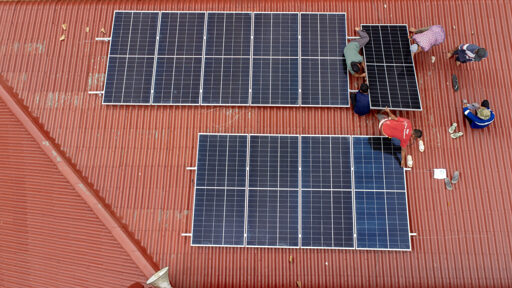
DENPASAR, Indonesia — Renewable energy uptake has yet to gather momentum across Indonesia’s more than 84,000 villages, a new report concludes, as the government of the world’s fourth-largest country pledges to achieve a radical energy transformation over the next decade. “Village street lighting has increased, while household use has declined due to high initial costs, minimal incentives, and the dominance of fossil fuel subsidies,” according to the Village Energy Transition Readiness Index, a report published by Jakarta-based think tank the Center of Economic and Law Studies (Celios) and Greenpeace. Indonesia’s statistics agency counted 84,291 villages across the world’s largest archipelagic nation as of 2025. Around 1.4 million people among Indonesia’s population of 270 million still lack all access to electricity, according to Eniya Listiani Dewi, the renewable energy lead at Indonesia’s mining and energy ministry. “Previously, many villages had clean energy initiatives, including solar power plants, micro-hydropower plants, and others, but the number of such initiatives has actually gone down,” said Wahyudi Askar at Celios. Despite technological progress and availability of cheaper solar hardware, the total number of villages and subdistricts reporting solar power use among households declined from 4,176 in 2021 to 3,076 in 2024, a reduction of 26.4%. However, the number of villages using street lighting powered by photovoltaics increased over the same period. Some 24,766 villages or neighborhood areas used solar to power streetlights in 2021, and this increased by 20.1% over the three-year period to 30,476 in total. For more than a decade, local governments and…This article was originally published on Mongabay
From Conservation news via This RSS Feed.