

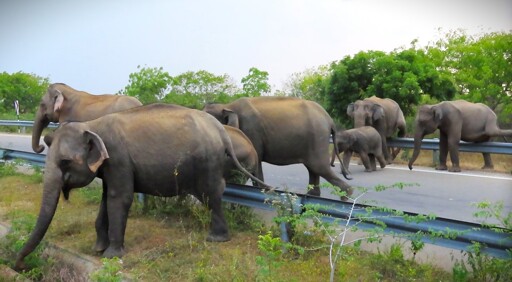
HAMBANTOTA, Sri Lanka — As a new wave of large-scale solar energy projects take shape along the fringes of Sri Lanka’s Managed Elephant Range, or MER, in the southern district of Hambantota, activists, farmers and wildlife conservationists are opposing the move. Those opposing the solar push — in a district that has significant ‘elephant terrain’ — warn that clearing forests in one of the most critical elephant landscapes on the island would escalate the existing human-elephant conflict (HEC) rather than reduce it. Sri Lanka holds one of the worst records for human-elephant conflict, an issue that continues to worsen as the island’s conservation efforts are no match for the escalating conflict. Every year, around 100 people and 400 elephants are killed in the country due to HEC. The Sri Lankan government has granted approval to set up multiple privately-owned solar power plants, forming a solar energy park bordering the Hambantota MER, with as much as 405 hectares (1,000 acres) of elephant habitat slated for clearance, according to Sajeewa Chamikara of the Movement for Land and Agricultural Reform (MONLAR), a network of farmer organizations and community-based organizations. “Ground investigations by MONLAR confirm that forest clearing has already begun, with heavy machinery being used to clear the scrub forests and to burn them,” Chamikara tells Mongabay. “This will inevitably escalate human-elephant conflict in an area already among the worst affected by HEC.” Local communities echo these fears. “We are already struggling with elephants, and we simply cannot bear any further intensification…This article was originally published on Mongabay
From Conservation news via This RSS Feed.