

Bullets:
The war in the Persian Gulf has shut down oil flows, and the price of diesel fuel has rocketed higher, everywhere.
Trucking companies are driving fewer miles, slowing delivery times, and rejecting loads outright while waiting for lower prices.
Even before the war, the total cost of ownership comparisons skewed clearly in favor of electric over diesel, even in areas with low fuel prices.
But with the new higher operating costs, and local bans on operating diesel trucks during nighttime hours, even energy-rich countries are electrifying their trucking fleets.
China enjoys significant competitive advantages in this shift. Deep experience in electric vehicle batteries are now fully developed for heavy trucks, and domination of global supply chains, mean strong cost savings when sourcing electric trucks from Chinese manufacturers.
Inside China / Business is a reader-supported publication. To receive new posts and support my work, consider becoming a free or paid subscriber.
Report:
Good morning.
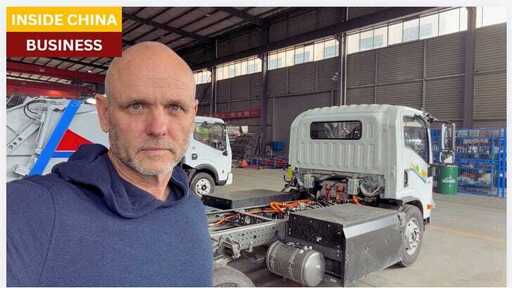
We’re in Suizhou this week, at a factory that builds specialty heavy trucks. Chinese electric vehicles are taking over markets, wherever they’re allowed to be sold to car buyers. We will see that same dynamic in electric heavy trucks.
We were looking at the assembly line here, in this workshop for new energy vehicles for municipal governments. Garbage trucks, street sweepers and other sanitation equipment — there is booming demand for this equipment across the world. Several of the trucks on the line are headed to Moscow, and it’s good to wonder just why a country that is complete self-sufficient in oil and gas, like Russia is, would need to electrify their truck fleets. And when we dig into why engineers from Moscow are buying electric trucks from this factory in Hubei, we see soon enough that this factory – and a handful of others just like it – are taking over this industry.
Diesel trucks are loud. And cities across the world have restrictions on the use of diesel during nighttime hours. That means that diesel trucks can only be operated during the day, which is also when street traffic is the heaviest. Electric trucks are quiet, far quieter than trucks running on diesel. By switching to electric, operators can run their trucks round-the-clock. Drivers and companies can make better use of equipment and time, and can make deliveries at night instead of just during the day. European countries are relaxing the rules for electric trucks. Sweden, Austria, Italy, and Norway have exempted electric trucks from the nighttime bans on other trucks.
In the United States, local governments across the country have noise abatement laws around public buildings and hospitals which apply not only to diesel trucks, but also to construction equipment.
For companies located in urban areas, and in countries that have strict regulations for noise levels, electric trucks open up the rest of the day, and the calendar. They can bid for construction and municipal contracts, and run their operations 24/7 and thereby avoid heavy traffic for half the day.
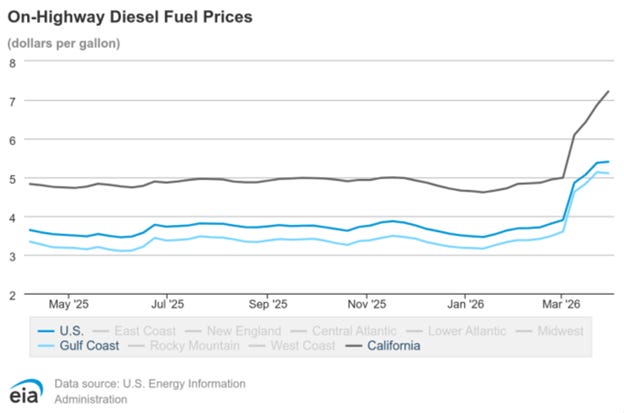
That’s new. What else is new is that the total cost of ownership comparisons between diesel trucks and electric have blown out, now unambiguously in favor of electric because of the war in the Persian Gulf. The United States also has a lot of oil and gas, but diesel prices are rocketing higher anyway, across all markets, and now over $7 a gallon in California. Truck drivers in the US are cutting deadhead miles—those are miles driven when the truck is empty—going after lighter loads, and reducing speed, which means longer delivery times. Some drivers are just parking their trucks, waiting for lower fuel prices.
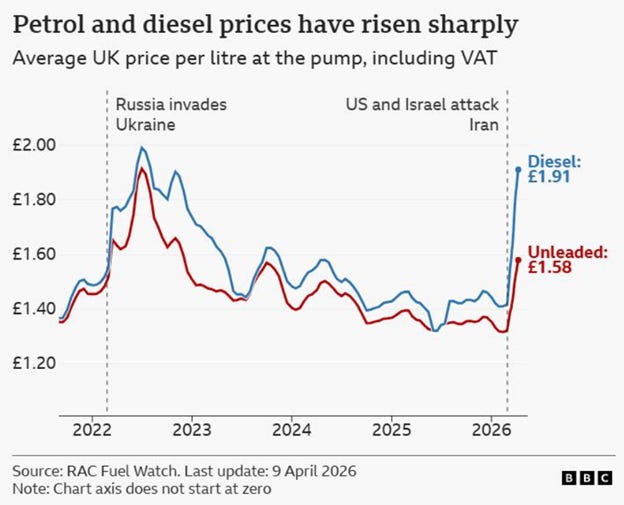
Similarly jumps in prices in the UK. In Australia diesel prices have more than doubled, and it’s a full-blown crisis. Driving companies are requoting contracts, there is a shortage of trucks that will lead inevitably to supply chains locking up completely, soon:

Sixty million people live in Kenya, and Africa has the same problems everyone’s got now.
The Total Cost of Ownership calculations take into account upfront costs, and then the ongoing fuel and maintenance expenses, comparing diesel trucks to electric. This study is from the United States, and pre-dated the war against Iran. It’s true that electric vehicles cost more than diesel. But over a 5-year period or longer, the lower operating costs for electric equipment mean they’re a better buy long-term. In California, the cost to buy and operate a battery-powered vehicle for 5 years costs $1,600 less than diesel. In Texas, surprisingly, the cost savings of BEV vs diesel after five years is $11,000, because Texas has less expensive electricity.
Even before these huge jumps in diesel fuel costs because of the war on Iran, the breakeven costs of electric vehicles were trending lower. Now diesel is prohibitively expensive, to the point that trucking companies across the world are parking their rigs and waiting for lower prices. Then we have the noise problem, and that governments are allowing electric trucks to operate 24 hours a day. Those all factor, heavily, in the switch to electric trucks.
But the reason it will be Chinese trucks taking over this industry is this part right here:
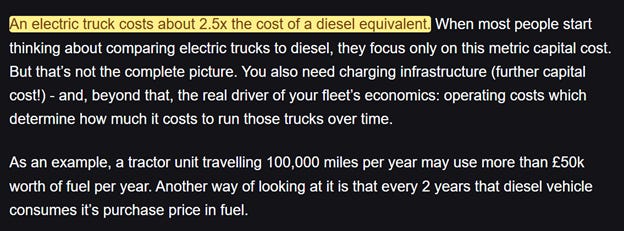
A key assumption of these Total Cost of Ownership analyses is that the upfront cost of an electric truck is far higher than for buying diesel, on average 2.5 times higher in the United States. But in China, electric trucks cost only 30% more than diesel equivalents, and Chinese diesel trucks also cost far less than diesel rigs in North America or Europe.
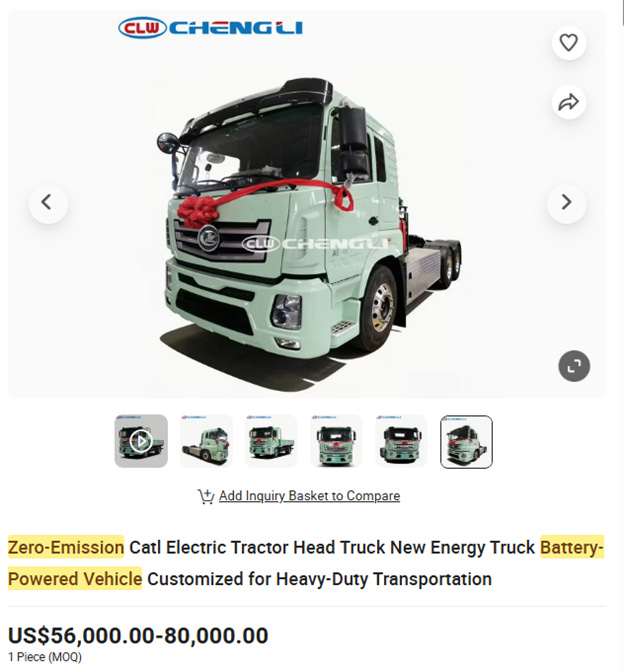
Chinese electric trucks offer value so compelling that two months ago Russians were booking flights to Hubei. In two months from now we’ll be seeing a lot more Africans and Australians. And in two years even the Americans will come.
Be Good.
Resources and links:
U.S. Diesel Prices Hit $5.40, Top $7 in California
https://www.truckinginfo.com/news/us-diesel-prices-hit-540-top-7-in-california
The economic case for zero-emission vehicles is often hidden in plain sight: The ICCT’s Total Cost of Ownership (TCO) Calculator reveals it
https://theicct.org/the-economic-case-for-zevs-is-often-hidden-in-plain-sight-the-iccts-total-cost-of-ownership-calculator-reveals-it-mar26/
Kenya fuel prices rise sharply despite reduction in tax due to Iran war
https://www.bbc.com/news/articles/cgrlll7qgdzo
‘Out of control’ diesel prices threaten Australia’s crucial freight industry
https://www.bbc.com/news/articles/cde5d8y8lx9o
How much does it cost to run an electric truck?
https://www.flexiblepowersystems.com/news/how-much-does-it-cost-to-run-an-electric-truck/
Heavy Construction Equipment — Diesel or Electric? The Impact of Noise Ordinances on Construction Equipment”
https://www.nussgrp.com/heavy-construction-equipment-diesel-or-electric-the-impact-of-noise-ordinances-on-construction-equipment/
All is quiet at E-Trucks Europe
https://e-truckseurope.com/en/all-is-quiet-at-e-trucks-europe/
Sweden opens door to night-time operations for electric heavy trucks
https://www.electrive.com/2025/11/27/sweden-opens-door-to-night-time-operations-for-electric-heavy-trucks
Inside China / Business is a reader-supported publication. To receive new posts and support my work, consider becoming a free or paid subscriber.
From Inside China / Business via This RSS Feed.