

MANILA – An additional 1.34 million Filipinos are pushed to poverty due to the oil price shocks since the United States and Israel’s aggression on Iran, a study revealed.
The Philippine Institute for Development Studies (PIDS) policy brief states that the shock is deeply regressive, with poor households losing 16.2 percent of their annual income in real purchasing power, compared with 3.4 percent for the richest households.
The aggression on Iran resulted in the closure of Strait of Hormuz, the world’s most critical oil chokepoint. Despite the declaration of so-called ceasefire between the United States and Iran, domestic fuel prices remain volatile due to the lack of government regulatory oversight to the oil companies – legalized under the Oil Deregulation Law – allowing them to raise prices without restriction .
Since the onset of the aggression, the impacts of more than 100 percent increase in oil prices on the marginalized sectors, particularly the transport sector, urban poor, and the rural poor, have been felt.
Read: Fishing expenses up by 120% since oil price hike – fishers group
“When oil prices go up, the prices of rice, fish, meat, vegetables — everything people need to survive — also go up,” PIDS senior research fellow Jose Ramon Albert said in a Filipino statement, underscoring how rising fuel costs ripple to the supply chains, food prices, and utility costs that disproportionately affect the purchasing power of the poor.
Angeline Mendoza, services staff of urban poor group Kalipunan ng Damayang Mahihirap (Kadamay), told Bulatlat that the government failed to see the larger picture of the oil price hikes, especially its impact on the poor communities.
“In food, many of our households opt to cut their rice consumption. Before, we could still afford rice for breakfast, but that is no longer the case,” she said in Filipino. “Now it’s just coffee, because you have to stretch what little rice you have since it’s become so expensive. Rice prices are extremely high now.”
The average retail price of regular milled rice nationwide rose to P51.11 per kilogram, which is a five to eight percent increase from its prices last month, March 2026. It is 15-percent higher compared to its prices from April 2025, based on data from Philippine Statistics Authority.
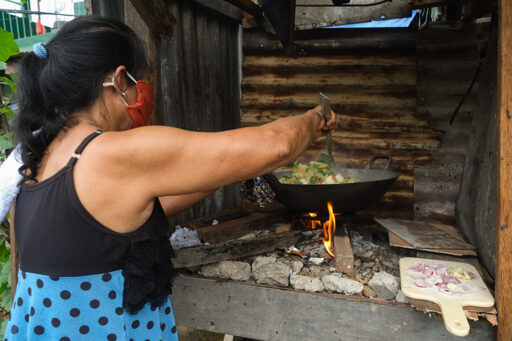
“We cannot even cook using LPG or even a simple stove anymore because prices of gas have doubled. We’ve turned to charcoal, but even that is expensive. The prices are choking us, what choice is left for us?” Mendoza added.
The policy brief also stated that the impact may also fall hardest in rural areas where poverty is projected to increase from 18.5 percent to 20 percent. Rural families, many of whom rely on farming and other fuel-dependent livelihoods, face limited income opportunities while spending a larger share of their earnings on food.
Regions already struggling with poverty—including the Bangsamoro Autonomous Region in Muslim Mindanao, as well as parts of the Visayas, Bicol, MIMAROPA, and Mindanao—are expected to bear the brunt of the crisis, further widening inequality.
The analysis also shows that a prolonged crisis also means more Filipinos being pushed to poverty: Up to 2.35 million more Filipinos could be pushed into poverty if the oil prices reach $ 125 per barrel. If it reached $ 145 per barrel, the number of poor families could swell to 3.50 million.
“Millions of our fellow poor Filipinos urgently need help from the government. That is what you should be addressing—not just trying to look good,” Kadamay Secretary General Mimi Doringo told Bulatlat in Filipino. “Ferdinand Marcos Jr. failed to address our problems, especially this oil price shock. Up to now, people are still hungry. Many have no stable livelihood. Workers are not even earning a living wage.”

A family of five needs P1,266 a day to live decently, according to economic think-tank Ibon Foundation. But the minimum wage in the National Capital Region (NCR) is at merely P695 a day.
The group also added that there are 2,263 exempted medicines for value-added tax (VAT) as of February 2026. But it is only 5 percent of the 50,000 recorded government-procured medicines.
“We are severely lacking in the basic services that the government is supposed to provide. If these are not delivered, the poor and the Filipino people will continue to fight until our needs are met,” Doringo added. (RTS, RVO)
The post Oil price shocks push more than 1M Filipinos to poverty – study appeared first on Bulatlat.
From Bulatlat via This RSS Feed.