

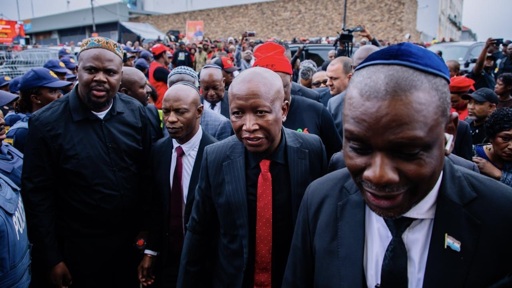
On April 16, a Magistrate’s court in South Africa sentenced Julius Malema, president of the Economic Freedom Fighters (EFF), the fourth largest party in the parliament, to five years’ imprisonment for celebratory gunfire during a rally on its fifth founding anniversary in 2018.
Should the appeals he will be making at higher courts fail to overturn this verdict, it will spell the end of Malema’s parliamentary career, as the law prohibits anyone sentenced to longer than a year’s imprisonment from being a legislator.
This case against Malema, popular for championing Black power assertion, was brought by AfriForum, a far-right, white supremacist group in South Africa with ties to its counterparts in Europe and the US.
AfriForum has also been at the center of the disinformation campaign, peddling concocted stories about a genocide against the white population in South Africa.
Lobbying Trump
Irked by South Africa’s case in the International Court of Justice (ICJ) to halt Israel’s genocide in Gaza, US President Donald Trump weaponized this “White Genocide” narrative, unleashing a series of hostile economic and diplomatic actions AfriForum had long been lobbying for.
Read more: Pressured by US, France rescinds its invitation to South Africa for G7 summit
During the tense Oval Office exchange in May 2025 with South Africa’s president, Cyril Ramaphosa, Trump showed random, unrelated images as evidence of White Genocide. Playing clips of Malema singing the popular anti-apartheid resistance song, “Kill the Boer”, in a political rally, Trump also demanded to know from the South African President, “why wouldn’t you arrest that man?”
However, earlier that March, South Africa’s Constitutional Court had already ruled in a case brought against Malema by AfriForum that the song, in which “Boer” referred to the white minority landowning class that helmed the Apartheid regime, does not constitute “hate speech”.
Happening Now
NOMA KUBI SIYAYA! #HandsOffMalema pic.twitter.com/BDpNuKQhYQ
— Economic Freedom Fighters (@EFFSouthAfrica) April 16, 2026
“At no point in South African history have Black people ever victimized White people. The very suggestion is an insult to truth and justice. The real victims in this country have always been Black people: enslaved, dispossessed, massacred, and subjected to centuries of institutionalized racism. Yet, it is white supremacists like AfriForum who seek to erase their and their forefathers’ crimes while falsely claiming persecution,” the EFF said after the judgment acquitting Malema.
A celebratory gunshot, eight years ago
But only months later, in October 2025, the Magistrate Court in South Africa’s city of East London convicted Malema in another case brought against him by AfriForum.
Malema had fired his bodyguard’s rifle into the air in late July 2018, at a rally celebrating the fifth anniversary of the party he had founded after parting ways in 2012 with the ruling African National Congress (ANC), whose youth league he was heading.
AfriForum was quick to file a case against Malema, while the EFF maintained that the gunfire was in “celebration and memory of our struggle during colonial and apartheid times.”
Over seven years later, in the aftermath of the Oval Office exchange and amid the deteriorating relations with the US, the Magistrate court convicted Malema on five charges, including unwarranted discharge of the gun and unlawful possession of the firearm and ammunition.
Malema, however, was not the owner of the weapon. The court itself had found that the weapon belonged to his bodyguard and also his co-accused, Adriaan Snyman. Snyman was nevertheless acquitted. His weapon was returned to him.
“The judge”, who sentenced Malema for five years, was herself “unaware of this fact,” the EFF said. The National Prosecuting Authority (NPA), which led the offensive, “lacked thoroughness in handling evidence while paradoxically pursuing the harshest possible sentence against Malema.”
The NPA had, in fact, sought 15 years’ imprisonment, which must be “met with juridical sobriety,” argued Mametlwe Sebei, a lecturer in the Department of Jurisprudence at the University of South Africa (UNISA).
While acknowledging Malema’s “recklessness” in “discharging a firearm in a crowded stadium, even into the air”, he added, “But criminal law distinguishes between risk creation and harm realization. It punishes the latter more severely, and the former only proportionately. No person was injured. No property was damaged. The state’s case rests entirely on a hypothetical catastrophe — a logic that would imprison half the nation for near-misses.”
Sebei, who is also the president of the General Industries Workers Union of South Africa (GIWUSA), drew attention to the “political character of the prosecution, initiated by AfriForum.” He argued that its embrace by the state reveals an increasing alignment with the “imperialist interests” against the poor Black population.
“The grandchildren of Apartheid”
However, the ruling ANC’s secretary-general, Fikile Mbalula, called the sentence “too harsh”. This case by AfriForum, he argued, is part of a broader campaign against leaders who “dare stand up for” the rights of “marginalized” Black people, by “the grandchildren of apartheid”.
Even decades after the defeat of the Apartheid regime, the White minority, amounting to just over 7% of the population, continues to own 72% of the country’s agricultural land, expropriated from Black Africans under colonialism and Apartheid. Constituting 81.4% of the population, the Black population owns only 4% of the land.
In a largely “symbolic gesture” toward addressing this failure to correct the historic expropriation of Black Africans by European settlers, South Africa enacted the Expropriation Act in January 2025.
Read more: From colonial theft to agrarian justice: South Africa’s long road to land reform
The EFF criticized this act for being too weak, calling it “a legislative cop-out” by the ANC, “to fool our people into believing that the party is doing something to address the almost tyrannical neglect of the land question in this country.”
Nevertheless, AfriForum was quick to launch a disinformation campaign against the Act, fear-mongering about the likelihood of a mass land confiscation from the White landowners. Bolstering AfriForum’s campaign, Trump, who had just assumed his second term in the White House, claimed on social media that “South Africa is confiscating land, and treating certain classes of people VERY BADLY.”
Posting images of its officials in the White House wearing visitor tags, AfriForum celebrated Trump’s decision to halt “all future funding to South Africa until a full investigation of this situation has been completed.”
South African President Cyril Ramaphosa explained in a post that the “Expropriation Act is not a confiscation instrument, but a constitutionally-mandated legal process that ensures public access to land in an equitable and just manner as guided by the constitution.” He added that the US also has “expropriation laws that balance the need for public usage of land and the protection of rights of property owners.”
Nevertheless, Trump persisted with the false claims of land confiscation and White Genocide at the Oval Office meeting with Ramaphosa in May 2025, while AfriForum, on that very day, filed a legal challenge in the Pretoria High Court, asking it to declare the act unconstitutional.
Calling the case “our most important local battle”, its spokesperson, Ernst van Zyl, welcomed the “spotlight that US President Donald Trump has so far placed” on this legislation. President Ramaphosa has slammed AfriForum for leveraging the US government to advance its domestic interests.
The ruling ANC, which Ramaphosa presides over, has time and again characterized AfriForum as “unpatriotic and dangerous”. However, the ANC is not the only ruling party anymore.
Contradictions exerting state power in opposing directions
Falling short of a parliamentary majority in the 2024 election for the first time since the post-Apartheid election in 1994, the ANC, instead of finding common cause with the opposition parties on its left, turned right, forming a Government of National Unity with the Democratic Alliance (DA).
Historically, the main opposition, widely regarded as a party defending White privilege, DA had opposed the ANC government’s decision to take Israel to the ICJ over its genocide in Gaza earlier that year.
Even after the Unity government was formed, the DA retains more common cause with AfriForum than with the ANC. Calling the Expropriation Act “unconstitutional”, the DA had filed a legal challenge in the Western Cape High Court, months before AfriForum moved the court in Pretoria.
The DA has effectively blamed South Africa’s own “labor laws” and the affirmative action policies it deems “racial legislation” for the deteriorating relations with the US.
While ANC general secretary characterized AfriForum’s case against Malema as a campaign by “grandchildren of Apartheid”, the DA has welcomed the sentence against him, citing the need to discourage gun violence as the ostensible reason.
It is against the backdrop of such contradictions within the ruling coalition, exerting state power in opposing directions, that AfriForum’s case against Malema was aggressively pursued by the National Prosecuting Authority (NPA).
**“We are fighting the enemy, and the enemy is White Supremacist”**
The NPA, which “routinely fails to secure convictions in cases of violent crime, including murder, rape, and armed robbery, where victims suffer irreversible harm,” has nonetheless “mobilized its full capacity to ensure” Malema’s imprisonment, the EFF said.
“This case,” it maintains, “has always been pursued in a highly politicized environment, with clear intentions to criminalize a revolutionary political voice that represents the aspirations of the oppressed and marginalized.”
Addressing the EFF Red Berets demonstrating in solidarity outside the court, Malema, on bail to appeal to higher courts, labeled Magistrate Twanet Olivier, who handed him the sentence, “a racist of note,” and “possibly a member of AfriForum”. He recalled her protesting against the mention of AfriForum while hearing arguments in the case brought by AfriForum.
Further recalling several alleged instances during the arguments when she betrayed a lack of knowledge of the basic facts of the case, he claimed the judgment she delivered was actually written by an “invisible hand controlling the proceedings”.
Reiterating his intention to challenge this at higher judicial levels, all the way to the Constitutional Court, Malema declared, “We are fighting the enemy, and the enemy is White Supremacist.”
The post Julius Malema is latest target of the Trump-backed white supremacist lobby in South Africa appeared first on Peoples Dispatch.
From Peoples Dispatch via This RSS Feed.