

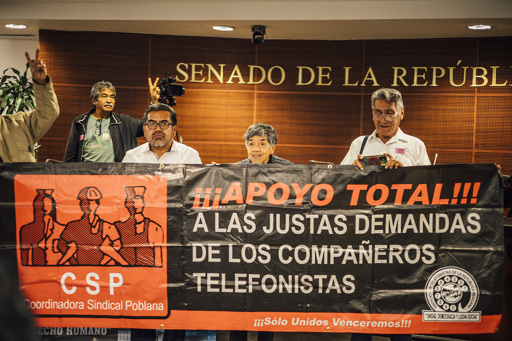
This article by Darylh Rodriguez originally appeared in the April 13, 2026 edition of Revista Contralínea.
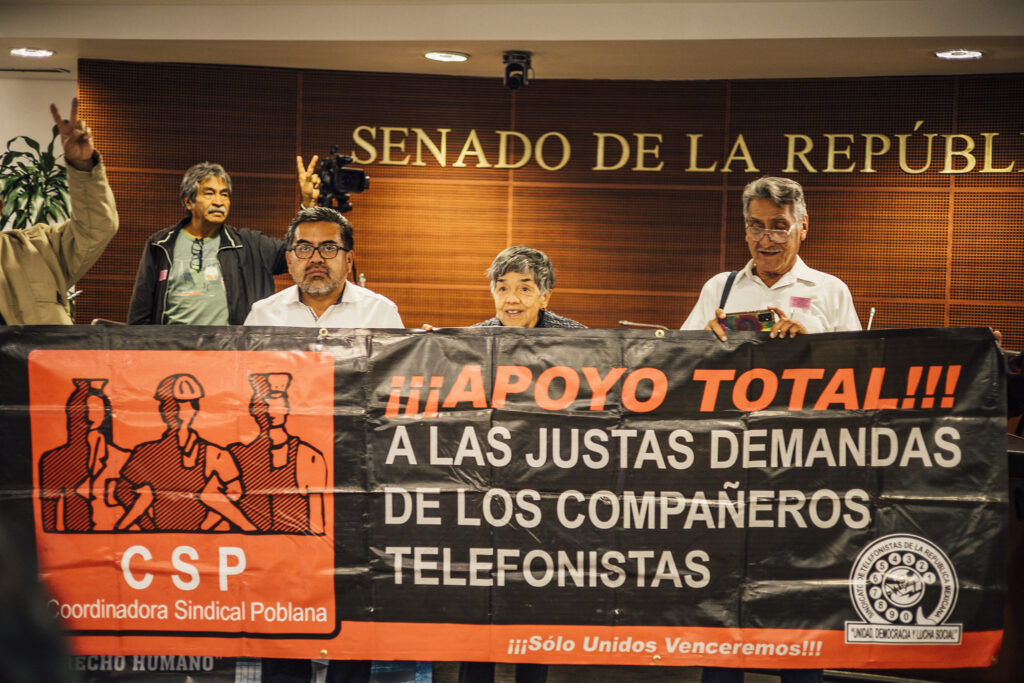
Telmex workers are denouncing the terms of the new 30-year concession granted to the company by the government, claiming they violate their labour rights. According to the telephone workers, the concession weakens the strategic obligations of the telecommunications sector and eliminates the prohibition on cross-subsidies between concessioned services and their subsidiaries. The new concession was granted by the Federal Telecommunications Institute (IFT) in early 2023 and took effect last March. The now-defunct “autonomous” agency was repeatedly accused by former President AMLO of favoring private interests instead of acting in the best interests of the majority.
The new concession agreement for Teléfonos de México (Telmex), owned by businessman Carlos Slim Helú, came into effect on March 11, 2026, amid allegations of labor rights violations and the weakening of strategic obligations in the telecommunications sector. This situation has raised concerns among workers’ groups, who denounce the infringement of their labour rights.
Among the most significant changes is the elimination of the prohibition on cross-subsidies between concessioned services and their subsidiaries. This means that the company can transfer resources between different business units within the same group to promote competitive services, without any restrictions. The previous legislation—in effect for 50 years (1976-2026)—clearly stipulated that Telmex could not engage in such practices; a provision that, according to telephone workers, protected both free competition and the public interest.
In Mexico, telecommunications should always have remained strategic sectors of the nation as a point of national security; however, the neoliberal project imposed privatization.
According to the Alianza Nacional Telefonista (ANT), a dissident group within the Mexican Telephone Workers Union (STRM), the new concession granted to the country’s wealthiest businessman also eliminates obligations related to technological modernization. Under the previous concession, the company was required to update its network by incorporating technological advancements, as well as to conduct industrial research to strengthen the country’s competitiveness in telecommunications. Now, both of these requirements have been removed from the new concession framework, which, they say, could weaken the sector’s ability to meet national needs.
“A very sensitive issue for us is that the concessionaire is exempted from the obligation to modernize telecommunications and technological research, and to invest in training and technological education,” states the ANT document against the concession sent to the Senate of the Republic.
For the dissident unions, these changes are not minor; rather, they represent a fundamental setback. They constitute a blatant violation affecting both workers and the nation, a result of neoliberal policies implemented with greater fervor following the creation of the now-defunct Federal Telecommunications Institute (IFT), the body responsible for regulating, promoting, and overseeing the efficient development of the sector, as well as guaranteeing competition and free market access in telecommunications.
In this context, unionized telephone workers consider it urgent to make the project that supports the extension of the concession transparent in order to subject it to public scrutiny and, with this, stop the dismantling process of the sector, in addition to recovering labour rights that have been violated; among them, the loss of the subject matter of work, because currently “thousands of workers” are subcontracted to perform functions that, according to the collective agreement, correspond exclusively to unionized personnel.
“Today we have thousands of outsourced workers handling our work, when legally our collective bargaining agreement, in clause nine, specifies that we, the union members, are the ones who have to handle it. They have already stopped filling the vacancies for telephone operators, which was an obligation of the company,” says Miguel Ángel Sebastián Viveros, a member of the dissident faction of the STRM, explaining that, since the 1990s, Telmex has committed to filling “all the positions created,” so there is currently a backlog of more than 20,000 unfilled vacancies.
The situation doesn’t end there. Alicia Colchado Ariza, leader of the council of the same union alliance, warns that reviewing the concession is essential given an international context marked by the rise of the far right, a movement that violates human rights. “If we look at the current global crisis, every blow dealt to progressive governments is preceded by the partisan manipulation of telecommunications,” she told Contralínea.
“In Mexico, telecommunications should always have remained strategic sectors of the nation as a point of national security; however, the neoliberal project imposed privatization and now, with the Fourth transformation, we have the hope that this sector will recover with that classification: as a strategic sector of the nation.”
Cross-subsidies in New Concession
As you may recall, Teléfonos de México, SAB de CV is part of a larger corporate network, which maintains links with various subsidiaries, such as the América Móvil consortium – a corporation that emerged from the telephone company itself in 2000 and has a presence in Latin America and Europe – or firms such as Radiomóvil Dipsa SA de CV (Telcel).
In this context, the union dissidents argue that, since the privatization of the company, a scheme has been configured that has allowed it to systematically transfer the work to other companies of the same corporate group, such as Triara, Uninet, Red Uno or Telcel, from where “services that originally corresponded to Telmex are provided.”
According to the Union Alliance, this process has been sustained through practices such as subcontracting and so-called ” cross-subsidies ,” thanks to an environment marked by a lack of intervention from regulatory authorities, including the Federal Economic Competition Commission (Cofece) and the IFT, both recently dissolved agencies. Thus, under this logic, the telephone workers allege that these practices have resulted in a violation of their labour rights.
The seriousness of “cross-subsidies” lies in the fact that this concept allows any company within the same group—such as Telcel—to use resources, revenue, or even the infrastructure of a concessioned service—in this case, Telmex—to strengthen its market position. This means that capabilities financed under a public concession can be indirectly transferred to other business units, creating “unfair advantages” over competitors. In this regard, telephone workers point out that Telmex has already transferred operations and resources to its subsidiaries, which is affecting free competition and the livelihoods of unionized employees.
“From 1990 to the present, everything has been made easier for businessman Carlos Slim to take the work to his other companies, such as Triara, Uninet, and Red Uno, from where telephone services and everything else that we should be providing through Teléfonos de México are offered. But, throughout these years, the IFT played a role in tailoring the system to Carlos Slim’s needs, so that he could continue to enrich himself through his other companies,” Alicia Colchado told this weekly publication.
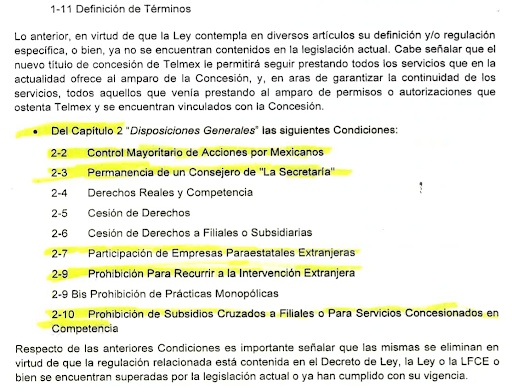
Screenshot of the ANT document against the concession for commercial use in favor of Teléfonos de México, sent to the Senate of the Republic.
This, she warns, means that although these practices were already underway, the new concession agreement eliminates “key” restrictions, which could legalize previously prohibited activities. Furthermore, the relaxed investment requirements “open the door” to greater foreign investment in the sector.
“One of the issues in the extension of the concession title is that the obligation stipulated in the original title, which prohibited cross-subsidies, is no longer in place. This means that a single business owner cannot own one company, create another, and transfer the profits from one to the other. And although this practice has been occurring, as of March 11, 2026, it will no longer be legal. Furthermore, the requirement that the majority of investors in the telecommunications sector be Mexican is no longer in place. This takes precedence over transnational interests, including those of our own telecommunications companies.”

Carlos Slim with President Claudia Sheinbaum
Monopoly Practices
This situation is not new. In March 2014, the then-IFT determined that the economic interest group comprised of América Móvil, Telmex, Teléfonos del Noroeste, Telcel, Grupo Carso, and Grupo Financiero Inbursa constituted a dominant economic agent in the telecommunications sector. This ruling implied recognition of its high market concentration, as well as the imposition of specific regulatory measures to prevent harm to competition and free market access.
However, that wasn’t the company’s only history. Telmex’s dominance in the fixed-line telecommunications market led to numerous accusations of monopolistic practices. Complaints against the company began in 1999, and by 2007, these had intensified. As a result, the Federal Economic Competition Commission (Cofece) determined that the company possessed “substantial market power”—a capacity that could not be matched or countered by any of its competitors.
“The monopolistic concentration of telecommunications is a threat to democracies; we call it a national security issue,” warns Alicia Colchado.
“Carlos Slim says there are no more profits, that he’s only keeping the company out of ‘love for the business,’ but that it’s no longer profitable for him; that is, it’s no longer profitable for him, but he’s asking for a 30-year extension of the concession. It’s not credible.”
Alongside these concerns, the alliance denounces a progressive deterioration of its working conditions. This decline is characterized by the elimination of profit sharing for active workers, as well as the loss of benefits and the tightening of retirement requirements.
“Carlos Slim says there are no more profits, that he’s only keeping the company out of ‘love for the business,’ but that it’s no longer profitable for him; that is, it’s no longer profitable for him, but he’s asking for a 30-year extension of the concession. So, it’s not credible,” questions Amado Lozano, a member of the ANT.
According to the testimonies, retirement conditions have also changed significantly in recent years. “Before, women could retire after 25 years of service; now it has been raised to more than 35, and the retirement age is 65, whereas previously they could retire as early as 52. We are talking about a loss of at least a decade in labor rights,” they explain.
Alicia Colchado also explains that, until about nine years ago, women could retire from the age of 48 after completing 25 years of service, while men could do so from the age of 53. In both cases, the pension corresponded to 70 percent of the total salary, with the possibility of increasing it to 80 percent if they extended their working life to 31 years of service.
Now, that reality seems distant. With the current changes, women must retire at 65 with barely 30 percent of their salary, which implies an increase of up to 17 years in the retirement age and a substantial reduction in the pension amount. “Before, there was no age limit: you could reach up to 80 percent of your salary with 31 years of service, or retire from age 48 with 25 years of service, although with a lower percentage. Today, practically everything has been lost.”
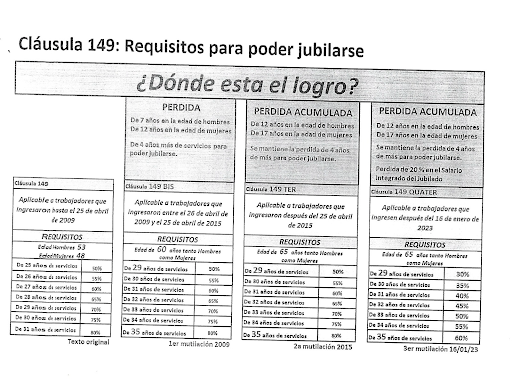
Representative table of retirement requirements. Prepared by the ANT.
Similarly, she recalls that, at the time, these differentiated schemes did reflect a historical recognition of women’s working conditions. “It was understood that we had a double or triple workload, so early retirement was also a form of social recognition. That has disappeared today,” says Alicia Colchado.
This is compounded by an internal climate of union control that stifles complaints. “People don’t dare to complain because there are reprisals; they are denied loans or even excluded from union benefits,” says the leader of the ANT council. According to the dissident union, these practices have even led to attacks against dissenting workers, some of which have been reported to the authorities.

Telephone Operators Union of the Mexican Republic
The Mexican Telephone Workers Union was founded in 1950 as one of the most important labour organizations in the country’s telecommunications sector. Currently, its leadership is headed by engineer Francisco Hernández Juárez, who has held the position of general secretary for over 50 years.
In this context, the dissident union points out that this prolonged period in leadership has led to a corrupt system of internal control that inhibits criticism and genuine democratic participation. “An organization that once represented more than 60,000 workers cannot be under the command of a single person for so long without a permanent apparatus of control and repression,” Colchado states.
With this, the dissident alliance denounces a deterioration in working conditions, including the elimination of profit sharing for active workers, as well as the progressive loss of benefits. “Many things have been taken away from us since General Secretary Francisco Hernández Juárez took over. And people don’t complain because there are reprisals; they lose more rights or their union rights are canceled; they are denied loans or prevented from recommending new workers,” the activist adds. She even points out that members of the STRM have been attacked for expressing their grievances.
However, the union leader rejects these accusations. In an interview with this magazine, Hernández Juárez maintains that the STRM “has internal democratic mechanisms”; although he acknowledges that there will always be “dissenting voices.” “They have always expressed their opposition, they have never liked the way we run the union, and they have always tried to destabilize the organization by claiming to represent the majority of our members, but that is disproven by their actions. We renew our Executive Committee every four years through universal suffrage; the same applies to delegates and local committees in the 191 sections across the country.”
Regarding Telmex’s situation, the union leader acknowledges that, since the early 2000s, the company has undergone a structural reconfiguration, marked by the “transfer of the most profitable services” to other companies within the group, such as cellular telephony. This process “reduced the company’s financial capacity and limited its investment levels.”
“Starting in 2000, 2002, and 2003, the structure of Teléfonos de México began to change because the owners, let’s say, started to divest the most profitable services from Telmex, and obviously its financial condition changed because the services that generated the most revenue began to be transferred to another corporation, Telcel, starting with cellular telephony, for which the original concession belongs to Telmex. So, they looked for ways to reduce Telmex’s presence in two ways: by divesting the most profitable services and by starting to limit investment levels in the company itself.”
In this regard, Hernández Juárez criticizes the regulatory policies applied to the sector, particularly those derived from the declaration of dominance, considering that Telmex was “forced” to share its infrastructure without generating sufficient incentives for other companies to invest in their own networks.
At the same time, he questions the “lack of dialogue” with government authorities regarding the new concession title. “We found out through the company; the authorities haven’t contacted us, and we don’t see any willingness to engage,” he states. He adds that, despite the IFT’s dissolution, the legal framework remained substantially unchanged, meaning that the regulatory measures negatively impact the company without generating any benefits for the country.
On the other hand, in response to criticism from dissident unions regarding an alleged lack of defense of labour rights, the general secretary asserts that legal resources and institutional actions have indeed been pursued on behalf of telephone workers. However, he maintains that several of these processes have been limited by court rulings, particularly in institutions such as the Federal Judiciary, which at the time was led by more conservative voices.
“Yes, we are hopeful that with this new Judiciary we can have a closer relationship. The truth is that before we hadn’t even had the possibility of approaching the Judiciary, but with this new one we do, and we hope that this will open up opportunities for us to renew our concerns, because our appeals were recently rejected. And I am about to review with my legal team what the grounds are to see if there is any recourse we can pursue, but in principle I can say that they were denied.”
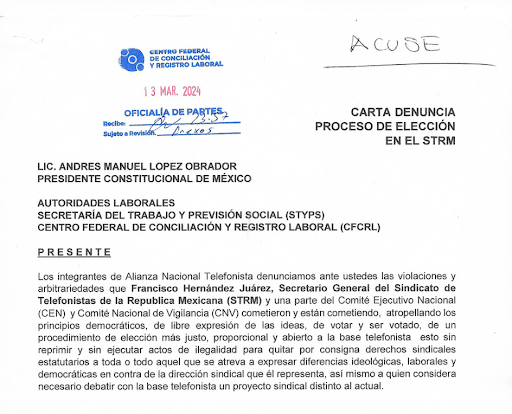
Although the official defends his work leading the telephone workers’ union, the dissident group links the union’s internal dynamics to the deterioration of working conditions, accusing it of practices that have resulted in the progressive loss of rights, as well as alleged corruption that ultimately affects telephone workers. “The main reason many of us telephone workers have suffered, and why we are objecting to the position of Secretary General Francisco Hernández Juárez, is primarily because of the loss of rights we have experienced,” says Miguel Ángel Sebastián Viveros.
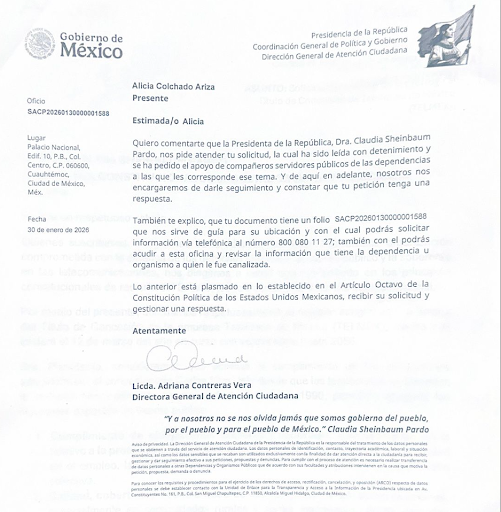
Such is the discontent of the National Telephone Workers Alliance that their demands have escalated to levels such as the Presidency of the Republic, something that occurred during the administration of Andrés Manuel López Obrador. Now, following the dissolution of the Federal Telecommunications Institute (IFT) and the creation of the Agency for Digital Transformation and Telecommunications—an agency under the federal executive branch—the dissident workers are hopeful that a thorough review will be conducted of Telmex’s concession title, as well as of the union’s working conditions and the role played by the leadership of the Mexican Telephone Workers Union (STRM). For now, they await a response from the Presidency, headed by President Claudia Sheinbaum Pardo.
“We have conveyed our concerns to legislators; they are aware of the issue. And frankly, we are pleased about the elimination of the IFT, but we haven’t seen any progress from the Digital Transformation Agency on our behalf. However, we will continue to seek contacts and do everything necessary in both chambers to be heard. But the Digital Transformation Agency itself should have already listened to us,” Colchado reiterates.
-

Who is Blocking Mexicans’ Right to Food?
April 20, 2026April 20, 2026
A Mexican food law which would exclude corporations from participating in decision-making is dying from neglect: the government has stalled on implementing it for the past two years.
-
Government Handing Telmex Over to Carlos Slim for 30 More Years Violates Labour Rights: Telephone Workers
April 20, 2026April 20, 2026
The new concession weakens regulations, the necessity of updating technology and opens the door to even more profiteering & union-busting by one of Mexico’s wealthiest billionaires.
-

Mexico’s Plan to Build 100,000 Homes for Government Employees
April 20, 2026April 20, 2026
The program will include self-build projects, participatory design, urban amenities, and services such as grocers and healthcare in housing developments.
The post Government Handing Telmex Over to Carlos Slim for 30 More Years Violates Labour Rights: Telephone Workers appeared first on Mexico Solidarity Media.
From Mexico Solidarity Media via This RSS Feed.