

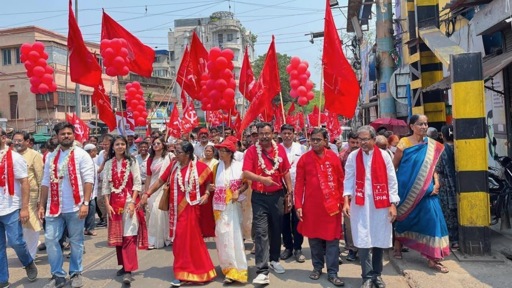
With a promise to spend at least 30% of the state’s budget on health and education, the Left Front is seeking to revive welfarism in the electoral discourse in the Indian state of West Bengal.
The Left Front has vowed to provide more employment opportunities to the rural poor in the state if elected to power. The rural poor in West Bengal are largely forced to migrate to urban areas or to other states in search of jobs.
The left is also promising a greater focus on providing expanded and cheaper access to all basic amenities to the millions in the state still forced to live without running water, electricity or access to health care.
West Bengal is one of India’s largest states. It shares a long international border with Bangladesh and is mostly agricultural. It has a population of around 100 million with the majority living in poor or very poor conditions.
The state legislative elections are scheduled to be held later this month in two phases; April 23 and 29. Around 70 million voters will cast their ballots to elect 294 representatives to the state legislature.
Whichever party or coalition wins the majority of the seats in the state legislature will form the government for next five years.
The Left Front
There are four major parties or coalitions competing to gain the attention of voters in the state, the ruling centrist Trinamool Congress (TMC), led by current chief minister Mamata Banerjee, the main opposition ultra-right-wing and Hindu supremacist Bharatiya Janata Party (BJP), the Left Front, and the Indian National Congress (INC).
The Left Front is a broad electoral coalition of India’s major left parties, including the Communist Party of India (Marxist), the Communist Party of India (CPI), the Communist Party of India (Marxist-Leninist) Liberation, the Revolutionary Socialist Party (RSP), and Forward Block.
All except the CPI (ML) Liberation have been part of the electoral coalition since the 1970s and have jointly ruled the state between 1977 and 2011.
The many years of Left Front rule was marked by high growth in the state’s agricultural output and extensive land reforms. The left governments were also credited to strengthening democracy by empowering the local self government bodies called Panchayats.
Ever since it lost power in the state to the centrist TMC, the overall development indicators of the state have largely stagnated. TMC rule has also seen a strong rise in the ultra right wing in the state’s politics, led by the BJP.
The rise of the BJP has led to the domination of issues related to religious and ethnic identities with development and welfare of the people getting almost negligible attention.
The divisive politics of the BJP, which portrays the substantial Muslim population in the state (around 27% of the population) as “infiltrators” has led to the strong polarization of the electorate, forcing minority communities to give priority to survival over livelihoods and better living conditions and voting in mass to the TMC.
Revival of the secular, development-oriented discourse
In a press conference on Wednesday, Mohammad Salim, one of CPI (M)’s national leaders and secretary of the state unit, dismissed the attempts of the BJP to further push sectarian discourse in the state elections. He claimed that West Bengal has largely been a secular and harmonious society and the left will make sure that it continues to remain so.
Salim also underlined the Left Front’s slogan of Bangla Bachao! Desh Bechao! (Save Bengal, Save the nation) in this election. He called the slogan an attempt to revive the livelihood issues faced by the people to counter the divisive politics of the BJP.
The Left Front which had its electoral base in the state among its landless poor and socially deprived sections of the society in the past is seeking to revive it in this election by pointing out how the 15 years of the TMC rule in the state has failed to tackle the issues of poverty, forced migration and access to basic amenities.
Months before the elections were announced, the left held statewide marches to meet millions of people with the Bangla Bachao slogan, in its attempt to revive its core constituencies.
CPI (M) has put forward a large number of mostly young candidates, in an attempt to attract young and first-time voters in the state.
Its campaign, both on social media and in person, canvassing by candidates, has focused on issues of unemployment and lack of livelihood among the youth, which is forcing a large number of them to migrate to other states in search of jobs.
The candidates have also focused on the failure of the government to maintain law and order, particularly affecting the women, who have been on the receiving end in various cases in the last few years in the state.
In 2024 the brutal rape and murder of one woman doctor in the capital Kolkata led to large-scale public outrage.
The left has also questioned the Special Intensive Revision (SIR) of the electoral rolls in the state conducted by the Election Commission of India (ECI) just before the elections.
It has termed the SIR process because of which more than 9 million voters, mostly from socially deprived sections of the society and Muslim minorities, have lost their right to vote in the elections, an attack on one of the most fundamental rights of the poor in a democracy
The post Left Front advances people-centric agenda to regain ground in West Bengal elections appeared first on Peoples Dispatch.
From Peoples Dispatch via This RSS Feed.