

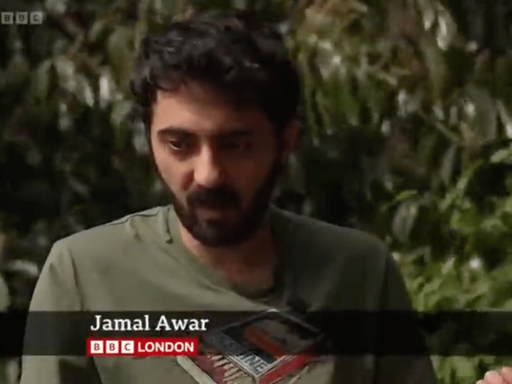

The BBC interviewed me about the war on Lebanon. By the end of it, I felt used. It felt dirty.
They approached me through BBC London. The angle was: how the Israeli war on Lebanon is affecting Londoners with family back home.
I accepted, cautiously.
BBC wants my photos
They asked me to send photos of my family and friends in Lebanon. These, they said, would be used in the edit — and basically, the more photos I provided, the less they would need to “cut” from what I said.
I told the reporter I didn’t trust the BBC with something so personal. Not after the way it had reported on Gaza. I said I was worried my family’s images would be reduced to props — emotional flashpoints to package a story stripped of its political reality.
The interviewer reassured me. “It’s just us,” she said, gesturing to the camera operator. “We’re the ones editing this.”
Who am I to question people in front of me telling me to trust them? We had the interview.
I spoke about everything: Israel’s war, the history behind it, the reality of life under constant threat. Then I spoke about April 8, 2026 — when Israel launched around 100 airstrikes in the space of minutes. I said this was the extermination of a population. Indiscriminate carpet bombings. How there are evacuation orders for everyone in Dahye (the southern suburb) and everyone south of the Zahrani River (miles north of the Litani) in South Lebanon. How this is an act of ethnic cleansing and the media is barely mentioning it.


I tried to give context. When asked how my parents were feeling, I explained that no one in Lebanon is a stranger to Israeli aggression. That this isn’t new. That decades of attacks make the idea of resistance not only understandable, but inevitable.
Can you imagine a country being attacked by a settler-colonial state for around 80 years and not developing a tradition of resistance? That would be the real absurdity.
The BBC managed to remove all of that
https://www.thecanary.co/wp-content/uploads/2026/04/2WhatsApp-Video-2026-04-14-at-19.26.24.mp4
They didn’t just edit for time. They edited out the politics entirely. The photos that they said they needed to extend the interview were all placed at the very beginning of it. Like an ‘applause’ sign lighting up for an on-air TV show audience.
They turned a war into something strangely apolitical.
But it didn’t stop there.
Before my segment even began, the presenter said:
Israel says it is only targeting Hezbollah.
What a loaded sentence. Akin to a loaded gun.
It gives my oppressor — a state responsible for killing over 2,000 Lebanese people (at the time of reporting), according to the same BBC report — a pre-emptive defence. A disclaimer.
It frames everything I say afterwards as either emotional exaggeration or partisan bias.
If Israel is “only targeting Hezbollah”, then what am I worried about? Am I Hezbollah? Or am I simply being unreasonable?
This is how consent is manufactured.
A slap on the face of ‘objectivity.’ The BBC would never dream about minimising the experiences of Ukrainian Londoners worried about their families in this manner. No report will begin with: Russia says it only targets military infrastructure. It would be understood that this is a rhetorical tactic which minimises the actions of the aggressor, and flattens the experiences of those attacked.
Issam Abdallah
Then came another distortion.
During the interview, and due to questions of loss — who have you lost? have you lost anyone? The cow (me) hasn’t produced enough milk (tears) and needs to be milked some more — I went back to basics and talked about the loss of my close friend and colleague Issam Abdallah, the Reuters photojournalist that Israel killed on Oct 13, 2023.
I said:
Not sure if he was the first journalist killed by Israel in Gaza and Lebanon together, but definitely the first journalist, of many, that Israel killed in Lebanon.
When including that in the report, the reporter stated that Reuters had concluded — after an ‘investigation’ — that an Israeli tank killed him.
No shit? After an investigation?
This framing is deeply misleading.
It suggests uncertainty where there was none. Issam and other journalists had filmed the Israeli tank that killed him minutes before his death. There were witnesses present — mostly journalists for fuck’s sake — and the evidence was immediate.
This is a report written by the Committee to Protect Journalists dated 13 Oct 2023.
Yet Reuters took two months to officially say what everyone already knew — and that in itself was abhorrent.
By emphasising the ‘knowledge’ came after an ‘investigation’, the BBC creates the impression that the truth was unclear — that it needed verification. It introduces doubt where there was clarity. It softens the act.
So what does the final report do?
It humanises me — slightly. It names my oppressor ‘Israel’ — technically. But it strips away context, inserts disclaimers that introduce doubt, and sanitises violence.
The final score was: two goals for me, three for Israel.
And Israel wasn’t even on the field.
Track record
This is not accidental. The BBC has a long track record of diluting the suffering of Palestinians and Lebanese people (and now Iranians as well) while carefully managing the image of the Israeli state.
Meanwhile, the aggressor is afforded ambiguity, nuance, and endless benefit of the doubt.
Ethnic cleansing starts to look more like Disneyland. The violence is obscured. Everything is sanitised. There’s absolutely no context.
There is documented evidence of a strong pro-Israel bias among senior BBC figures. The editorial decisions in this report reflect that fully.
The reporter was upset when I told her on the phone what I thought of her report. “I worked so hard on this. I made sure the report humanised you.” Well, I can’t begin to tell you how glad I am to be humanised. Now I know how Pinocchio felt at the end of the (again) Disney movie.
Well-meaning but functionally useless journalists often think the story is about them — about balance, tone, professionalism.
It isn’t.
It’s about power and impact in terms of power dynamics.
When power is uneven, “neutrality” becomes a tool of distortion. It functions as a tool of oppression.
And stripped from context, emotions and pain become pure aesthetics.
I will leave you with a verse from a poem Mahmoud Darwish once wrote titled The Passport:
And to them, my wound was an exhibition
For a tourist who loves collecting postcards.
Featured image via the BBC
By Jamal Awar
From Canary via This RSS Feed.