


Stewart Huntington
ICT
DENVER — Colorado turns 150 years old this year and to mark the milestone — and the concurrent 250th anniversary of the founding of the country — the state Legislature established a commission to plan a series of commemorative events.
And what are Colorado’s Indigenous communities planning to bring to the parties?
The truth.
On a bus.
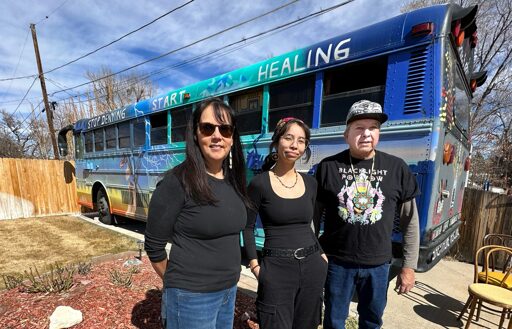
“We want to talk about what happened, what really happened, and our histories and bring that into the modern day, and see how we can we heal from this,” said Diné artist Nazhoné Morgan, who helped turn an ordinary school bus into a mobile exhibit on Colorado’s Native culture and history that will travel the state sharing the stories.
“I like to think of (the bus) as a comprehensive Indigenous peoples’ history in Colorado.”
Dubbed the Breathing Healing Bus, it was created by a community of Native artists, activists, and historians — a project that is set to be formally announced on Monday, April 20. It grew in part out of the 2023 report of the Native-led Truth, Restoration and Education Commission, or TREC, that detailed the history of Native people in Colorado.
The report identified dozens of Native nations with ties to the Colorado landscape but highlighted the plight of the 10 federally recognized tribes that ceded land within the state borders — most of whom were driven from their homelands to places such as Wyoming, Montana or Oklahoma. Today, only the Southern Utes and the Ute Mountain Utes maintain territory on reservations in the state.
But despite the severity of the history, the message of the bus project remains, well, healing.
“Our main goal is to help in the healing process and also to get our people shown in a beautiful light, in a good way,” Sid Whiting, a Sicangu Lakota citizen, told ICT.
Whiting admitted, however, that “that might seem hard to do with this bus,” which is focused on the difficult history in Colorado — much of it depicted in the stories and artwork in the bus.
Among those stories are the Sand Creek massacre and the annihilation of the buffalo, said Whiting, who is the cultural engagement coordinator with Create aYa, one of the groups behind the bus projects.
In 1864, U.S. Army soldiers and Colorado territorial volunteers killed more than 230 Cheyenne and Arapaho people over the course of seven hours in an attack along Sand Creek in southeastern Colorado Territory, about 170 miles southeast of Denver.
Colorado also witnessed the slaughter of thousands of buffalo as part of 19th Century U.S. policy to kill off herds as a way to starve and drive off Native nations that relied on the herds for sustenance.
“You would think that by showing [those stark facts] it would really be harmful to people,” Whiting said. “But people begin to understand their own healing once they see the trauma of others. And that’s kind of what we want to accomplish — to begin this healing process by showing what Native people have been through.”
The converted school bus houses a mobile, immersive art and storytelling experience that centers Indigenous perspectives often excluded from official histories. The exhibits combine Native youth artwork, multimedia storytelling, and guided reflection experiences. Visitors can move through a museum-style installation featuring photography, spoken word, interactive art, and audio storytelling that highlight both historical truths and present-day Indigenous voices.

An exhibit inside the Breathing Healing Bus details some difficult elements of Colorado history as the 150th anniversary of Colorado approaches i 2026. Credit: Stewart Huntington/ICT
Dr. Terri Bissonette, a scholar and educator from the Bay Mills Indian Community, is a central figure behind the 2024 TREC report and the bus project. She said she sees hope for positive outcomes from the bus tour — for Native communities and those throughout the state.
“We want to show that truth and healing can exist in the same space,” she told ICT. “It’s extremely important. We don’t want anybody to go through this exhibit feeling triggered, traumatized, retraumatized or feeling guilty. None of that stuff. We want folks to feel uplifted. We want them to feel inspired. We want them to have a call to action.”
Echoing one of the recommendations of the TREC Report, Bissonette said she hoped the bus tour sparked support for revising the state’s education curricula to more accurately reflect Native experiences.
“Native history is Colorado’s history,” she said. “And it’s important for as many Coloradans to know and understand that history, because Native people today are at the bottom of every good statistic and at the top of every bad statistic.
“We don’t do well in schools. We die young. All of those kinds of things. And it stems from unresolved historical trauma. And one of the best ways to combat that is to shine light on it with honest education in our schools so that we can confront it and we can all move forward together. And that is really what the ultimate goal is.”
That goal is not lost on members of the America 250-Colorado 150 Commission, which allocated $7,000 to the Breathing Healing Bus project in an effort to ensure Native voices were heard during the commemoration events.

Nine-year-old Justice Maldonado, a Northern Arapaho photographer, contributed photographs to the exhibits in the Breathing Healing Bus, a mobile history and culture exhibition about the Native experiences in Colorado. Credit: Stewart Huntington/ICT
“We’re really interested in understanding how we got to now, and we understand that there are many moments that we don’t celebrate that brought us to now,” Commissioner Jason Hanson told ICT. “Because we think of this anniversary as a moment to take stock and also to look to the future. I think we all want to envision a brighter future.”
To focus on that future, organizers made sure that youth were a central part of the bus project. Sixteen of the 20 contributing artists are under 30 years old. Through a youth photo mural exhibition, spoken word, and contemporary art installations, the mobile bus exhibit presents present-day Indigenous perspectives, offering not only truth-telling, but vision, resilience, and leadership.

Elizabeth Tafoya, Jicarilla Apache, contributed artwork to the Breathing Healing Bus exhibit. The multidisciplinary artist says the central message of the bus is that, “We are still here.” Credit: Stewart Huntington/ICT
Elizabeth Tafoya, Jicarilla Apache, was one of the youth participants. The multidisciplinary artist shared what she perceives as the central message of the healing bus.
“We are still here, even though many people don’t understand it or don’t want to believe it,” Tafoya said. “We’re still here.”
Nine-year-old Justice Maldonado, a Northern Arapaho photographer, was more concise. When asked about the message of the bus, Maldonado answered simply, “The truth about Native Americans.”
More info
The Breathing Healing Bus will make stops across Colorado starting in late spring as the Colorado 150 and the America 250 events begin to gear up. Its official first stops are scheduled for the weekend of May 9 on the two Ute Reservations in southwest Colorado. Additional details about state-sponsored commemorations can be found at the America 250-Colorado 150 Commission.
The post ‘Truth and healing can exist in the same space’ appeared first on ICT.
From ICT via This RSS Feed.