

Bullets:
The Iran War and the closure of the Strait of Hormuz have taken Qatari energy supplies completely off the market.
Russian natural gas fields were shut out of Europe beginning in 2022, and energy giants there invested massively into new pipelines to Asia.
China was a ready buyer for Russian oil and natural gas, and also invested heavily into huge strategic stockpiles of crude and natural gas storage.
Now Russian energy production flowing East, and China is already well-supplied.
Liquefied Natural Gas of Russian origin is offered at 40% discount to spot, to induce long-term supply relationships.
As a result, Asian economies are shifting their supply chains from the Persian Gulf to Russia-China. Meanwhile, EU countries are unable to get LNG at all.
Inside China / Business is a reader-supported publication. To receive new posts and support my work, consider becoming a free or paid subscriber.
Report:
Good morning.
The War on Iran has completely scrambled the supply chains for energy, and Russia and China are huge beneficiaries, along with—ironically—Iran itself. How we got here is a strange story, and it’s a combination of massive Russian energy production, and China’s so-called “overcapacity”, that Russia and China have become now a lifeline for Asian countries that are cut off from energy sourced from the Persian Gulf.
Russia did face a serious problem, when Europe cut off their purchases of Russian energy. It eventually turned out to be a far bigger problem for Europe than for Russia, but it did compel the Russians to seek out other export markets for their oil and natural gas. Russia hoped to find buyers for the 4 million barrels a day that were going to Europe.
The first place they looked was China, who is the world’s largest importer of crude oil, and Russia at the time was China’s primary supplier. China was also furiously building out petroleum reserves. The problem was the there weren’t enough pipelines at that time to move the crude and natural gas that used to go to Europe, over to China:
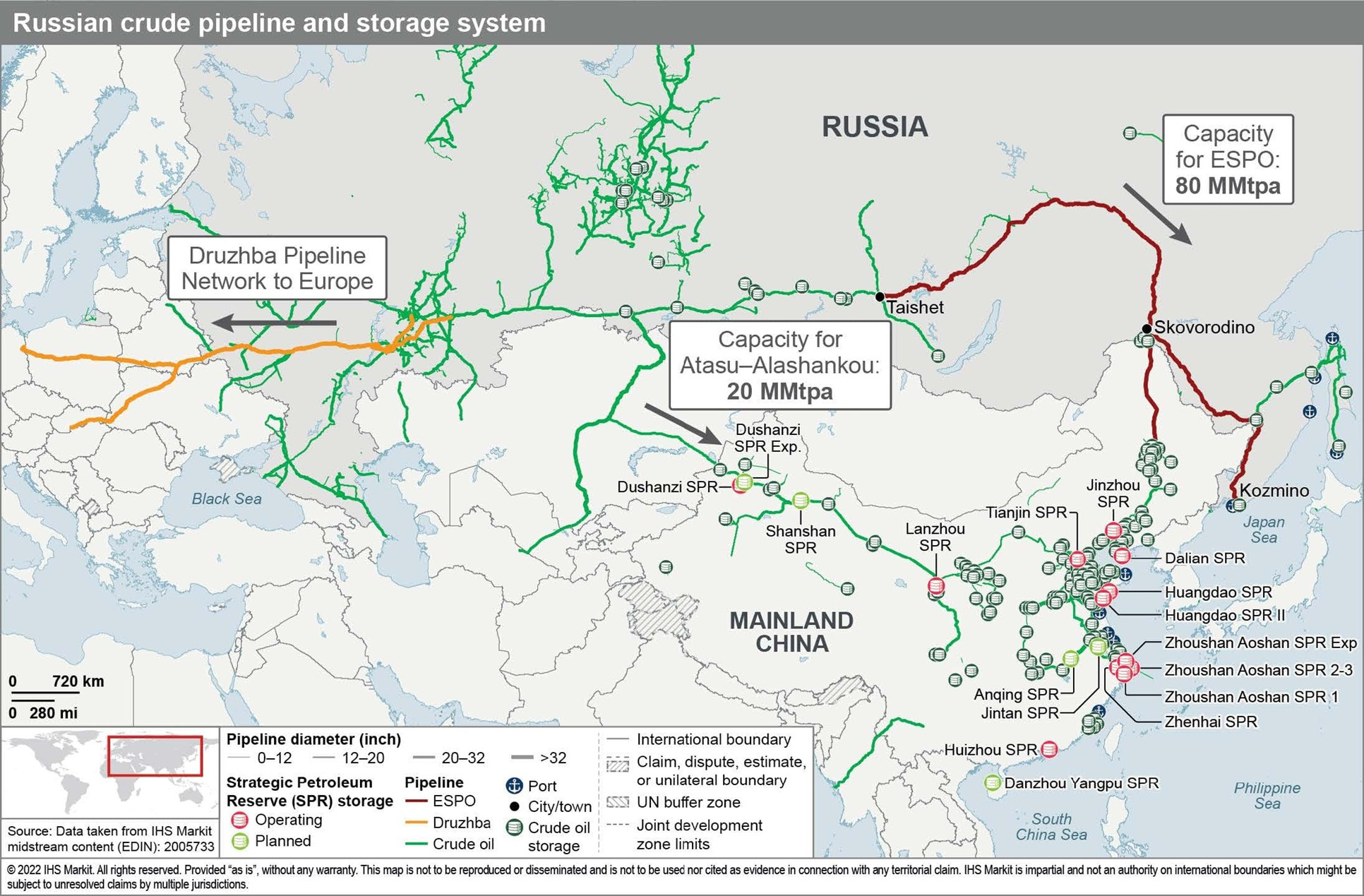
That’s to say that Russia was a desperate seller, and China an eager buyer, but they needed more pipelines to get it here. The ESPO pipeline contract called for 30 million tons a year from Russia to China in 2022, and China actually took 35 million tons.
So the question fast became this one—how to supply China with even more energy product? Last year the Power of Siberia 2, which is a natural gas pipeline, began construction, which will bring 50 billion cubic meters of gas a year. And two other existing pipelines were expanded, Power of Siberia One, to 44 billion cubic meters and Far East Gas to 12 billion.

Power of Siberia One was Russia’s biggest infrastructure investment in decades, and Siberia 2 will cost even more when it’s done. And just as in the crude oil markets, Russia needed China to take on demand to replace what was lost from the European markets. The EU had said they would shift their suppliers to Norway, the US, and the Middle East.
So Russia needed to develop new markets across Asia, and quickly. China is right next door, so they started here: In 2021, 10% of China’s natural gas imports was of Russian origin. By 2024, it was 25%, so Russian exports of natural gas to China more than doubled. Over a third of China’s pipeline imports came via Power of Siberia 1. 27 billion cubic meters. That was 2024.
In 2025, 38 billion cubic meters came through Power of Siberia One. As Russia expanded their pipelines, the Chinese did buy more–a lot more than the original contracts called for. What’s more, China was the only country who could take on the extra supply, anyway. These natural gas fields that used to supply Europe are a long way from China; the distance is vast. But Russia’s production costs are low, and as long as China is a buyer, it paid to build out the pipelines.
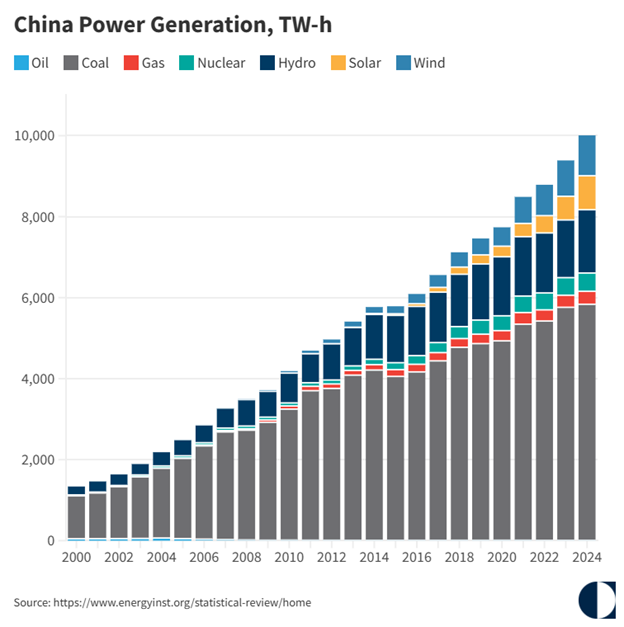
China’s energy demands continue to rise, China’s electricity production continues to grow faster than the rest of the world combined, and gas—that red part of those bars, still represents a small percentage of China’s overall energy mix.
This was an expensive gamble, on Russia’s part, to invest all that money on new pipelines East, to China, when in theory Europe could change their minds and resume buying Russian gas at any moment, or China may pull back their purchases that exceeded contract levels. But then the Middle East blew up, and all of Asia is now a hungry buyer for energy, no matter where from.
And here is where things get strange again—Russia has so much natural gas, and China already so well supplied, that they are offering discounts to new buyers in Asia, to lock up new gas business forever. The Strait of Hormuz is closed. Liquefied Natural Gas plants in Qatar have been blown up. A fifth of the world’s supply of LNG is off the market. Russia nevertheless is selling at a discount—when at first glance they could charge whatever price they want—but the objective is to expand markets and diversify their customer base in Asia. Trading companies in China and Russia will take the sanctioned energy in trade, and resell it to Asian buyers at a 40% discount to the spot market price.
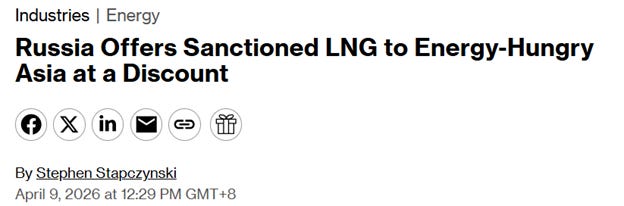
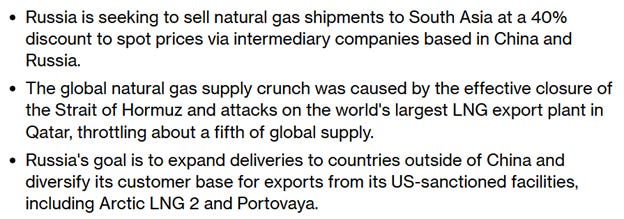
Iran has taken Qatari LNG off the market completely until the Strait of Hormuz is open. And even were the war to end today, Qatar is looking at tens of billions of dollars for infrastructure repairs, and almost 13 million tons a year of LNG offline for five years at $20 billion per, which adds up to around a hundred billion dollars’ more in losses.
Qatar declared Force Majeure on long term contracts to Europe. So the EU said no thanks to Russian oil and natural gas, moved their supply chains to Qatar, and now they can’t get any at all. Qatar also told China and Korea there’s no LNG going their way either, but thankfully for countries elsewhere in Asia, there were already lots of pipes built and expanded, and China already had lots of strategic reserves and so can afford to help their Russian friends expand into new markets.
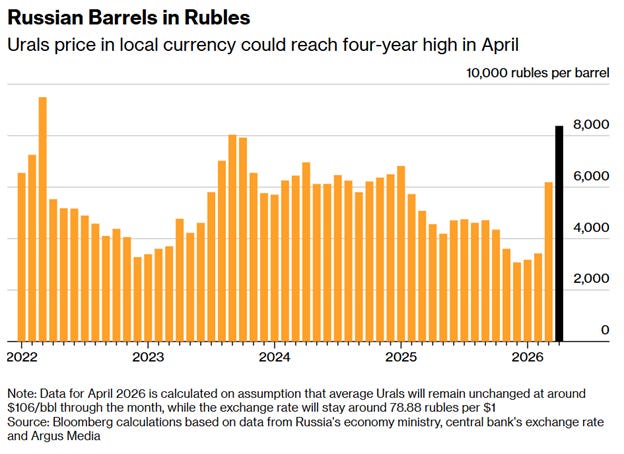
And Russia got more good news on crude oil, too. Exports of Urals crude are blowing higher, hitting the highest levels in years:
Be Good.
Resources and links:
Russia crude oil pipeline capabilities to mainland China—The ESPO crude oil pipeline
https://www.spglobal.com/energy/en/research-analytics/espo-crude-oil-pipeline
Power of Siberia 2 reshapes China’s energy security calculus
https://eastasiaforum.org/2025/10/31/power-of-siberia-2-reshapes-chinas-energy-security-calculus/
Russia’s Gazprom supplied 38 bcm of gas to China via Power of Siberia pipeline in 2025
https://www.reuters.com/business/energy/russias-gazprom-supplied-38-bcm-gas-china-via-power-siberia-pipeline-2025-2025-12-25/
Russia’s Oil Windfall From Middle East War Keeps Growing
https://www.bloomberg.com/news/articles/2026-04-14/russia-s-oil-windfall-from-middle-east-war-keeps-growing
Exclusive: Iran attacks wipe out 17% of Qatar’s LNG capacity for up to five years, QatarEnergy CEO says
https://www.reuters.com/business/energy/iran-attack-damage-wipes-out-17-qatars-lng-capacity-three-five-years-qatarenergy-2026-03-19/
Inside China / Business is a reader-supported publication. To receive new posts and support my work, consider becoming a free or paid subscriber.
From Inside China / Business via This RSS Feed.