

On the verge of the fortieth anniversary of Chernobyl, the worst nuclear disaster in human history, the vibe emanating from the newsreel remains the same as before. Everywhere, the intent is to neutralize the unremitting impact of the explosion that shook Reactor Number 4 at the Chernobyl Nuclear Power Plant on April 26, 1986 and its subsequent fallout. So, the news abound about research into the marvelous genetic adaptation and cancer resistance of the wolves inhabiting the radioactively contaminated area or about strange mushrooms (Cladosporium sphaerospermum) that feed on radiation, transforming a threat into a source of nourishment.
While the strategy of reassuring the public about the resilience of animal, vegetal, and fungal life in the face of high doses of radiation is obviously not new, the political context of the grim fortieth anniversary, us, just as obviously, unprecedented. Since Russia’s full-scale invasion of Ukraine in February 2022, Chernobyl has been in the headlines for another reason: nuclear blackmail. One of the first places to be occupied by the invading troops at the start of Putin’s “Special Military Operation,” Chernobyl was among the very first territories ‘taken’ in the still-ongoing war. As if a nuclear disaster site can be seized—as if it does not seize whomever and whatever is in its vicinity in advance, dictating its own rules of a deadly game. The occupying powers discovered the limits of mastery and of habitability the hard way, once they start experiencing the unmistakable symptoms of radiation sickness, prompting their hasty withdrawal on the last day in March of the same year.
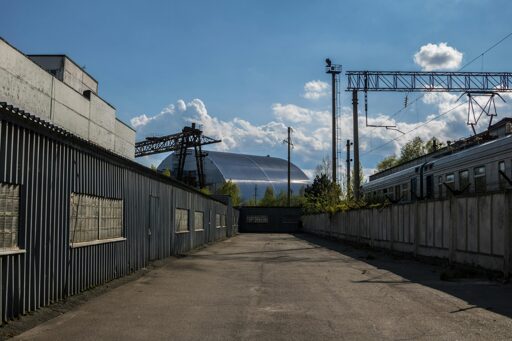
Later on, the containment structure, erected over the Sarcophagus, which, in its turn, encases the exploded reactor, was breached as a result of Russian military activity. A drone crashed into the protective shield of New Safe Confinement (NSC), causing a fire and puncturing a hole in its roof. As the UN’s International Atomic Energy Agency’s team confirmed in December 2025, the shield had lost its safety functions, including the capabilities of confinement. Add to this the more recent war the US/Israel are waging against Iran, where uranium enrichment is one of the many shifting justifications for the aggression and where airstrikes on nuclear facilities are being normalized. A pattern becomes evident: just as apparent strides are made in the technical safety of atomic energy production, political instability can at any moment irrupt in open hostilities around these facilities bringing carefully planned precautions and procedures to naught.
Anniversaries are times for reflection, for casting a retrospective glance at the path already traversed and contemplating the future course of a life, a career, a marriage. The anniversary of a nuclear disaster is no exception in this regard. At the time of the fortieth anniversary of what in a shorthand we are accustomed to naming with one word, Chernobyl, such reflections crystallize into a few nearly formulaic conclusions.
First, the distinction between “the peaceful atom” (used only for energy production) and the atomic weapons of mass destruction collapses. To be sure, the distinction has been strained from the get-go, not least given the militaristic origins, in which the process of atomic fission is steeped. Now, however, weaponization is absolute, as it encompasses, among other things, the power plants and storage facilities intended for industrial or civil purposes alone.
Second, whether illusory or real, the mitigation of risks related to methods of producing nuclear energy is at odds with the exponentially increasing political risks that involve the relevant infrastructure in the immediate geographical or local contexts, in which it is embedded. In addition, ecological risks are subject to an ideological deflation through numerous studies concerning the return of wildlife to the epicenter of the disaster and its vicinities.
Third, and rather tragically, severe disruptions in the supply of relatively cheap oil and gas due to the wars in Eastern Europe and the Middle East are driving European countries to revise their policies on nuclear energy. In light of the first two conclusions, this trend leads to the mutually reinforcing spiraling of risks further out of control.
Fourth, the prevailing assumption is that the extractivist energy paradigm which includes nuclear or atomic energy is the only possible one. While discontinuities between fossil, nuclear, and even certain “renewable” types of energy come to light, a basic continuity among them recedes from public view: each of the modes of deriving energy is extractivist. Fossils are extracted from the earth and the byproducts of their combustion are pumped into the atmosphere. Wind turbines and lithium batteries continue to depend on the extraction of metals and transpose the same old framework onto the worlds of the elements: water and air, above all.
And nuclear power? It brings the logic of extractivism to its culmination: energy is extracted from splitting the atom, from extracting a pure (and highly lethal) potentiality from tiny bits of the real. In each case, the processes are analogous: break through, shatter the whole to appropriate the potential it holds, leave the debris behind, clogging with it the living and still livable world. The default energy paradigm is, therefore, one of war, of achieving objectives through violence and destruction. Or, to paraphrase Carl von Clausewitz, war is the continuation of energy extraction by other means.
In 2026, Chernobyl is the condensation of the contradictions and hidden intuitions that far exceed the disaster that took place there forty years ago.
The post Chernobyl in the Global Turmoil: Between Political, Ecological, and Energy Disasters appeared first on The Philosophical Salon.
From The Philosophical Salon via This RSS Feed.