

By Misión Verdad – Apr 17, 2026
There are historical processes whose understanding depends, to a large extent, on the ability to preserve and reconstruct the memory of what they meant in everyday life. The period of Hugo Chávez’s government in Venezuela falls into that very category: a stage marked by social transformations that tangibly changed the conditions of access to rights for large sectors of the population.
This series starts from that need for review. In a previous article, Misión Verdad addressed the economic dimension of the Bolivarian model. In this case, the focus shifts to the social plane, as it is a fundamental axis from which the political project was structured.
Thus, this article deals with recalling a memory of processes of inclusion, access, and expansion of rights that marked a specific stage in the recent history of Venezuela. Revisiting that experience places the analysis in a concrete terrain, anchored in transformations that today remain part of the daily life of millions of Venezuelans.
Investment, not spending: the society at the center of the Bolivarian model
The starting point for understanding the social policy of the Chávez era is to locate the break that occurred with the previous model. During the decades prior to 1999, social spending fluctuated within margins that remained below half of the national budget, with ranges approximately between 24% and 50%. Starting from the beginning of the new political era, that pattern has been steadily modified to reach around 60%, marking a structural change in the allocation of public resources and the restructuring of state priorities.
The change is also conceptual. Public policy stopped viewing the social component as “spending” and began to call it “social investment,” emphasizing its strategic nature within the model. This redefinition translates into an explicit orientation of oil income toward the well-being of the population, with figures that reflect this shift: around $330 billion allocated over a decade, equivalent to about 60% of fiscal revenues. The notion of investment implies, in this sense, that the allocated resources are the basis for the expansion of rights and social capacities.
The magnitude of the fiscal effort associated with this policy becomes more evident when its cumulative total is considered. Social investment has exceeded $623.508 billion since 1999, representing approximately 64% of public revenues, a proportion higher than that of other countries in Latin America and one that multiplies by eight the amount allocated during the previous period. This leap expresses a political decision aimed at redistributing income toward key areas such as education, health, food, and social security.
From the perspective of its fiscal structure, social policy has become a stable component of Venezuelan public expenditure. Studies indicate that social investment remains around 57% of total public sector expenditure, even in contexts of economic variation. This sustained level is articulated through various channels, both the formal budget and extra-budgetary instances, including social missions, which gain significant weight during certain periods for the direct execution of public policies.
Finally, this process is also reflected in the relationship between social investment and the size of the economy. While in 1998 social spending represented around 8% of the Gross Domestic Product, a little over a decade later that proportion reached nearly 20%, making evident a significant expansion of the State’s role in redistribution of resources.
Social missions: inclusion and transformation of living conditions
The Social Missions emerged in 2003 as a direct response to a situation of social exclusion accumulated over decades. Their design responded to the need to bring the State to historically underserved territories, through programs aimed at guaranteeing free access to fundamental services in health, education, food, and housing. The missions constitute an integral architecture of social welfare, designed to address urgent needs and expand rights in the daily lives of the population.
The impact of this strategy is directly reflected in the poverty indicators. Since the implementation of these programs, the percentage of households in poverty has decreased from over 55% to around 26%, while extreme poverty has reduced from 25% to 7%. These figures reflect not only improvements in income but also the effect of policies aimed at ensuring access to basic services, food, and social protection for historically excluded sectors.
In the field of health, the implementation of the missions made access to healthcare an effective right. Nearly 75% of the Venezuelan population began to use the public health system, which represents more than 20 million people. Programs like the Barrio Adentro Mission expanded medical coverage in communities where regular care did not exist, reaching over 500 million consultations and helping to save more than two million lives. This demonstrates a sustained expansion of the infrastructure and the healthcare system’s capacity.
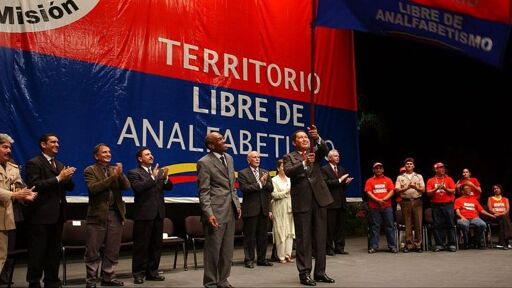
In the field of education, the missions become a mechanism for mass inclusion. The Robinson Mission helped eradicate illiteracy, with literacy programs for nearly 1.8 million people, while the Sucre Mission facilitates access to higher education, with over 700,000 graduates. These initiatives, along with other complementary programs, have expanded enrollment at all levels and reduced access gaps, integrating sectors that were previously outside the formal education system.
In terms of food, social policy aims to ensure direct access to basic products through distribution networks without intermediaries. Mercal and PDVAL, along with the Food Houses, reach nearly 15 million people, establishing a system that combines subsidies, territorial distribution, and direct assistance. The installation of thousands of access points throughout the country reinforces the massive nature of this policy and its impact on food security.
The Commune and Popular Sovereignty in Times of Imperialist Siege
Collective memory
The results of this process of social expansion are also reflected in structural indicators that are used for measuring broader transformations. The Human Development Index (HDI) in Venezuela rose from approximately 0.69 to 0.84 during the Chávez era, which implied significant progress in indices such as health, education, and living standards. In parallel, the Gini coefficient —which measures inequality— decreased from 0.48 to 0.39, ranking among the lowest in Latin America at that time, indicating a sustained reduction in social gaps.
These results were verified internally and were also recognized by international organizations. The Economic Commission for Latin America and the Caribbean (ECLAC) noted that Venezuela was among the countries that most reduced inequality in the region during the first decade of this millennium. Similarly, the United Nations Development Program (UNDP) highlighted the early achievement of several millenium goals, particularly in areas related to poverty reduction, access to education, and improvement of living conditions.
This performance is also part of a broader regional context, in which several Latin American countries promoted policies aimed at social inclusion and income redistribution. In this context, the Venezuelan experience was a reference within that shift, not only for the magnitude of social investment but also for the centrality that social rights acquired within the design of the State. Social policy ceased to be a complement to economic policy and became one of its structural pillars.
The construction of social memory about this period acquires a central dimension in the interpretation of the present. The accumulated evidence shows us that the period of Hugo Chávez’s government constituted a historical process of expanding access to social rights, sustained by a deliberate policy of income redistribution and capacity building. It is a model that transformed material living conditions and whose assessment continues to be a subject of study in the political and ideological realms.
Transformation: Orinoco Tribune
OT/SC/SH
From Orinoco Tribune via This RSS Feed.