

By Peter Kellner and Wyatt Miller
Minneapolis – On April 2, protesters gathered in Chute Square, a small park located at the busy intersection of University and Central Avenues Northeast Minneapolis. Commuters honked in solidarity at the sight of Palestinian, Iranian and Lebanese flags. The action, called by the Twin Cities-based Free Palestine Coalition, highlighted Israel’s renewed invasion of Lebanon amid the broader war surrounding U.S. and Israeli attacks against Iran that began on February 28.
“Trump thinks he can bomb his way out of the global economic upheaval he started, because he hasn’t yet realized that he’s bombed his way into U.S. hegemony’s unraveling in the region,” said Lina Jebara, speaking on behalf of coalition member U.S. Palestinian Community Network (USPCN). “Iran is redefining the status quo and leading the struggle against U.S. imperialism, along with the resistance fronts nestled in every nook and cranny in the Middle East, in their homelands, ready to defend their countries, lands and peoples to their dying breaths.”
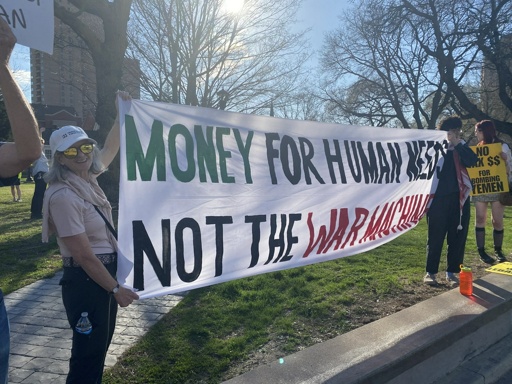
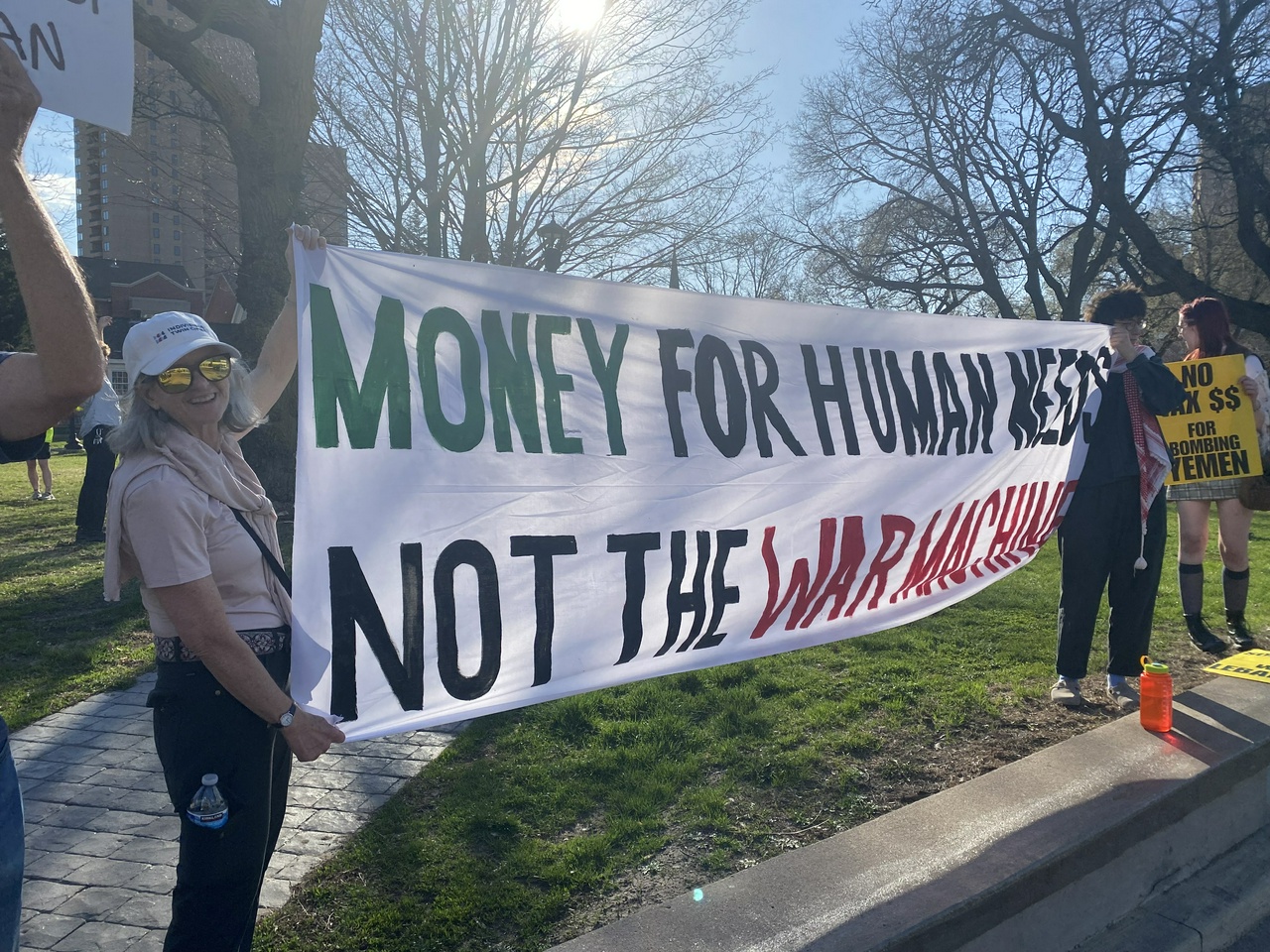
Two weeks later, on April 15, the war continued and protesters gathered again at Chute Square. This time, the occasion was Tax Day, in an action billed “No war on Iran – money for human needs, not the U.S. machine” organized by the Minnesota Peace Action Coalition as a part of the Anti-War Action Network’s day of action.
Protesters emphasized the extreme costs, both financial and human, of the U.S.– Israeli attacks on Iran, Lebanon and elsewhere. In the first 12 days of the war alone, the U.S. spent an estimated $12.7 billion as it bombed civilian targets, including the Minab girls’ elementary school, where over 160 students, teachers and parents were murdered in a double-tap strike.
Nadiyah Salawdeh, co-chair of the Minnesota branch of USPCN, spoke of the many ways U.S. acts of aggression have been paid for on the taxpayers’ dime, saying, “It was our tax money that paid to slaughter millions of Iraqis, Afghanis, and so many more in the endless so-called War on Terror. Our tax money that paid for the illegal kidnapping of President [Nicolás] Maduro. Our tax money that paid for the bullets that killed Hind Rajab and the explosives that flattened al-Shifa hospital, that made the genocide in Palestine possible for the past 80 years.”
Amber Mathwig is a member of About Face: Veterans Against the War. “What I did not learn about our taxes until later in life is that our military budget makes up approximately 25% of our government spending,” Martwig told the crowd. “This is up about 4% under the current Trump administration […] and this 4% will come from cutting programs related to housing, education, utility assistance, and of course – healthcare.”
Polls show the war is not popular among the U.S. population. According to a recent Pew Research poll, 61% disapprove of Trump’s handling of the war, while 37% approve, a nearly two-to-one margin. Western allies that have traditionally gone along with U.S. aggression have begun to distance themselves from the war. On March 25, Spain announced that all flights involved in the war were banned from its airspace. On April 14, Italy, due to popular grassroots pressure, canceled its 20-year-old defense treaty with Israel.
Speakers at the Tax Day protest connected the war to local issues. Montana Hirsch, an organizer with the Minnesota Immigrant Rights Action Committee, explained that “this federal occupation of our city cost Minneapolis alone at least $203 million.”
“The income that we have generated for this war-hungry government is being used to oppress people around the world,” said Kelly Thomas of Twin Cities Coalition for Justice. “This means that it is our responsibility to take a stand and fight back. As long as we are in the belly of the beast, it is our duty to fight for our freedom and for the freedom of everyone who is engaged in the struggle for liberation from capitalism and imperialism.”
In recent days, a ceasefire between Iran and the U.S., and Lebanon and Israel, have been reported. Oil prices seem to have stabilized at just under $100 per barrel, but with extreme uncertainty surrounding the ceasefire and commercial passage through the Strait of Hormuz remaining limited, organizers said they expected economic conditions to remain volatile unless the U.S. completely withdrew from the Middle East.
As of press time, U.S. and Israeli attacks since February 28 had killed over 3300 people in Iran, 2200 people in Lebanon, and at least 50 people in Iraq.
#MinneapolisMN #MN #AntiWarMovement #Iran #AntiWarActionNetwork
From Fight Back! News via This RSS Feed.