


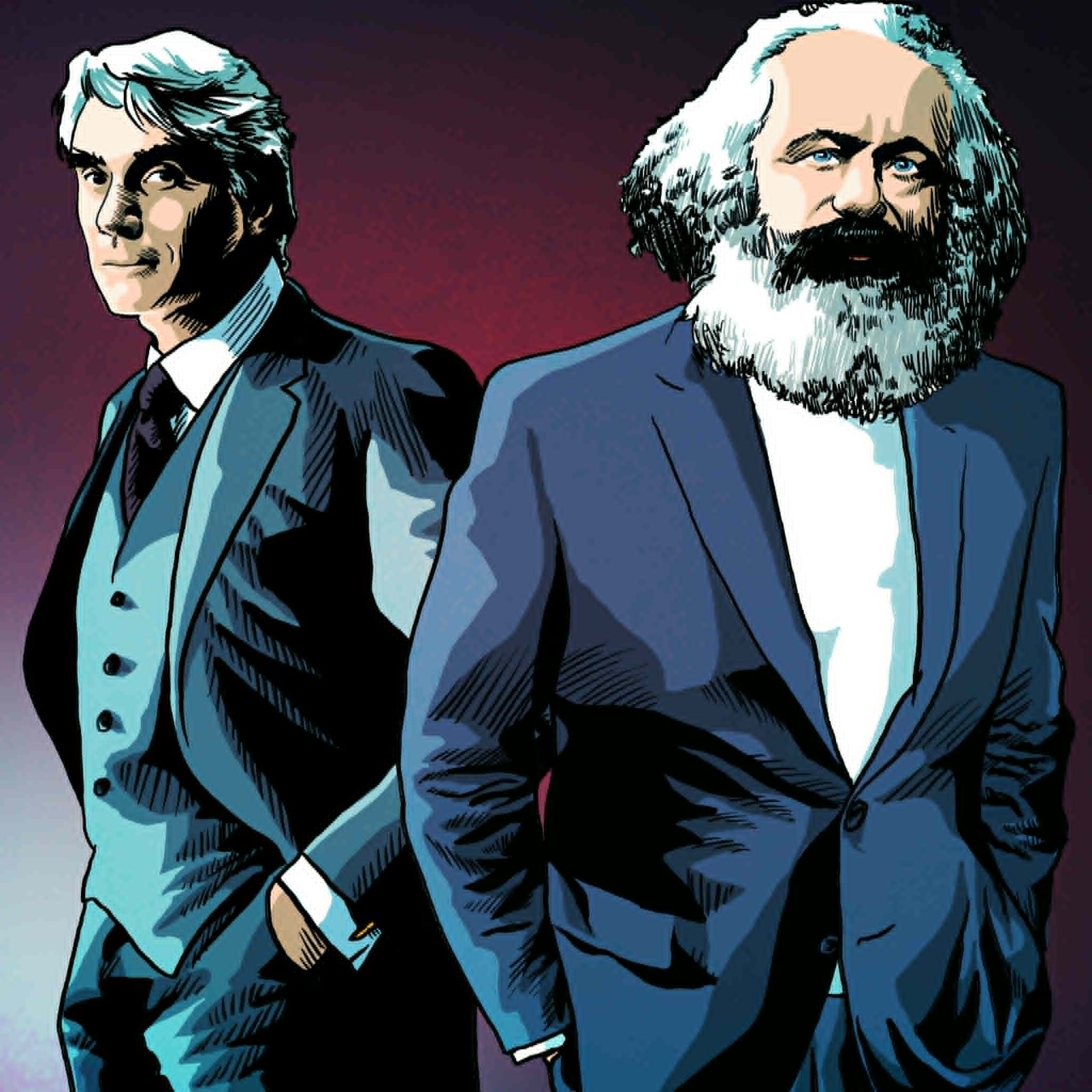
Robert Nozick’s book Anarchy, State, and Utopia is divided into two sections. Part I is dedicated to arguing for a libertarian “minimal state.” His primary target there is the “individualist anarchist” who rejects any state, even a minimal one. Part II is dedicated to arguing against any sort of more-than-minimal state that does things like giving all of its citizens health care (never mind, y’know, nationalizing the means of production).
At the beginning of Part II, Nozick tells us that, if “the world were wholly just,” the subject of “justice in holdings” (i.e. of who has a right to what) would be “exhaustively” covered by these cases:
1. A person who acquires a holding in accordance with the principle of justice in acquisition is entitled to that holding.
2. A person who acquires a holding in accordance with the principle of justice in transfer, from someone else entitled to the holding, is entitled to the holding.
3. No one is entitled to a holding except by (repeated) applications of 1 and 2.
Since the world isn’t wholly just, he has to add a principle of “rectification.” Like left-wing “redistribution,” libertarian “rectification” takes from some to give to others. But the goal of “rectification” isn’t to deliver what it’s fair or reasonable that everyone should have, but just to deliver to individuals what they in particular plausibly would have had if not for previous violations of their libertarian rights.1
Nozick differentiates his theory of “justice in holdings” from more standard views about distributive justice by describing the latter as theories of which patterns of distribution are just. Egalitarianism, for example, holds that there’s some important sense in which everyone has the same basic claim to whatever it is (resources, opportunities, etc.) that a given egalitarian theory says we should equalize. Sufficientarianism says that while inequalities per se aren’t objectionable, it’s unjust for the people at the bottom end of unequal distributions to not have enough. Meritocracy says that people with more merit should have more. And, as my favorite Slovenian would say, “and so on and so on and so on.”
![Anarchy State and Utopia Nozick, Robert [Used - Fair] [Softcover]](https://substackcdn.com/image/fetch/$s_!7qSD!,f_auto,q_auto:good,fl_progressive:steep/https%3A%2F%2Fsubstack-post-media.s3.amazonaws.com%2Fpublic%2Fimages%2F093d34f3-c457-457a-aa04-527471467421_334x478.webp "Anarchy State and Utopia Nozick, Robert [Used - Fair] [Softcover]")
In all cases, what makes these “patterned” views of justice is that we can test whether a particular distribution passes muster on each of them by asking questions like:
- Does anyone have less that S (where S is some standard of sufficiency)?
- If some people only have S, do other people have S x 400?
- If so, is it because the people who have more are especially meritorious?
…and so on. If you find out that there’s there’s an individual A who has 400 times more of whatever an egalitarian wants to equally distribute than individuals B, C, and D have, the egalitarian will condemn this as unjust without even knowing who A, B, C, or D are. If B, C, and D have less than S, the sufficientarian doesn’t need to know who they are to object, and so on. These are theories of which patterns of distribution are justified, regardless of who in particular occupies each point in the structure.
Nozick denies that justice operates at this level at all. He thinks particular individuals have particular claims to particular holdings, understood in terms of 1-3 above (plus a principle of rectification) and that’s all there is to say about which distributions are just.2
Nozick’s best remembered critique of “patterned” views of justice in Anarchy, State, and Utopia is his Wilt Chamberlain argument. I wrote about that one at the end of 2024 for Jacobin. What I’m interested in here, though, comes just before he introduces that thought experiment.
At the beginning of Ch. 7, which I just went over with the Substack philosophy class, Nozick explains his preference for the slightly awkward phrase “justice in holdings.”
The term “distributive justice” is not a neutral one. Hearing the term “distribution,” most people presume that some thing or mechanism uses some principle or criterion to give out a supply of things. Into this process of distributing shares some error may have crept. So it is an open question, at least, whether redistribution should take place; whether we should do again what has already been done once, though poorly. However, we are not in the position of children who have been given portions of pie by someone who now makes last minute adjustments to rectify careless cutting. There is no central distribution, no person or group entitled to control all the resources, jointly deciding how they are to be doled out. What each person gets, he gets from others who give to him in exchange for something, or as a gift. In a free society, diverse persons control different resources, and new holdings arise out of the voluntary exchanges and actions of persons. There is no more a distributing or distribution of shares than there is a distributing of mates in a society in which persons choose whom they shall marry.
I obviously disagree with the central conclusions of the book. But Nozick is a careful philosopher, often attentive to distinctions others miss, and Anarchy, State, and Utopia contains real insights. (As I’ve mentioned before, I think the critique of utilitarianism in Part I is brilliant.)3 Nozick is also a top-notch philosophical writer. When he wants you to feel the force of a moral intuition, he knows just how to draw it out.
This last virtue, though, can be a double-edged sword. Nozick at his best is cautious and rigorous, but when he’s not, sometimes his rhetoric is so good it covers over massive holes in his logic.
Nozick plays up the contrast between “patterned” distributions and the glorious chaos of a “free society” by reference to a slogan most famously used by Karl Marx in his Critique of the Gotha Program (1875). “From each according to his abilities, to each according to his needs.”
To think that the task of a theory of distributive justice is to fill in the blank in “to each according to his _______” is to be predisposed to search for a pattern; and the separate treatment of “from each according to his_______” treats production and distribution as two separate and independent issues. On an entitlement view these are not two separate questions. Whoever makes something, having bought or contracted for all other held resources used in the process (transferring some of his holdings for these cooperating factors), is entitled to it. The situation is not one of something’s getting made, and there being an open question of who is to get it. Things come into the world already attached to people having entitlements over them. From the point of view of the historical entitlement conception of justice in holdings, those who start afresh to complete “to each according to his_______” treat objects as if they appeared from nowhere, out of nothing. A complete theory of justice might cover this limit case as well; perhaps here is a use for the usual conceptions of distributive justice.
If you were nodding along to the rest of that paragraph, you might barely notice the part I’ve put in bold. You might just register it as Nozick scrupulously covering all of his bases. Taken seriously, though, it’s a game-changing concession.
To ease our way into thinking about this, let’s think about a very different way you could get a distribution that showed no obvious pattern. Imagine an absolute monarchy ruled by a mad king, prone to sudden and dramatic mood swings.4 The king can and does demote high-ranking nobles to the landless peasantry and award vast estates to his random people he meets on the street as the fancy strikes him. To celebrate the birthday of a household servant he’s taken a liking to, he may have a duke executed, and present the duke’s severed head, with a proclamation stuck in the mouth declaring the servant to be the new duke, entitled to all the duke’s lands and treasure.
If the king somehow escaped assassination plots, and the kingdom escaped catastrophic economic collapse, over the course of a decade or two of this kind of thing, the distribution of wealth and property might start to seem as random and chaotic as the distribution “of mates in a society in which persons choose whom they shall marry.”
The unpatterned nature of spouse-distribution (where two people might end up married despite coming from radically different backgrounds, or having such apparently different personalities that their friends are baffled by the union, or they might end up getting divorced and then someone getting remarried a few years later) really does feel like a healthy symptom of a society that respects personal choice. We’re unlikely to feel the same way about the chaotic property distributions that emerge from the sum of the mad king’s whims, even though it’s certainly true that the king himself is radically free from any constraints on his behavior.
There are (at least) two important differences between the cases. One is pointed to by Nozick’s occasional talk in Anarchy, State, and Utopia of “the separateness of persons” and how we each have our own distinctive life to live and we should be able to guide it in the direction that seems best to us. He seems to assume that this way of rhetorically supporting libertarianism fits together seamlessly with his official theory of libertarian rights (1-3 above, plus rectification). Hold that thought. Putting aside Nozick’s official theory, though, one very common and intuitive way of thinking about the idea that each of us has a wide-ranging right to steer our own life course is that each of us should have as much power over our life as is compatible with everyone else having the same amount of control over their own. (“My right to swing my first ends at your face” and all that.) If so, one obvious distinction between the chaotic distribution of spouses in a liberal-cosmopolitan society and the chaotic distribution of wealth under the mad king is that the decisions of the mad king have large and asymmetrical consequences for everyone else’s ability to steer the course of their lives.
Note that the issue here isn’t just that the king’s decisions have consequences for the lives of his subjects. Everyone’s decisions have consequences for other people’s lives. If Lucy is trying to choose between suitors Arthur, John, and Quincey, whichever decision she makes will change the life plans of the other two. But not being able to marry one particular person leaves open a vast array of life possibilities, and the impacts are roughly symmetrical. If Lucy chooses Arthur, that’s bad news for Quincey, but then, if Arthur changes his mind (perhaps because he runs away with Lucy’s friend Mina), that’s equally bad news for Lucy.
While I think this difference (between the mad king’s decisions imposing large and asymmetrical limitations on the course of his subjects’ lives and everyone’s choice of spouse imposing modest and at least very roughly symmetrical limitations on other people’s love lives) is an important and morally relevant one, though, I don’t think it’s the most important difference between the cases. Nozick certainly wouldn’t think so. He’d say (and I think he would have a point here) that the really important difference is that your affections are yours to do with what you like, while the king has no morally legitiamte claim to treat the kingdom as a whole, with all its land and all its people, as his playthings.
So when we go to the question of capitalist property relations and the beautifully “unpatterned” distribution of property they give rise to, the question is whether we should think of that as more like the distribution of spouses in liberal modernity or the distribution of wealth under the mad king—a symptom of a kind of human freedom worth wanting, or a symptom of arbitrary power running roughshod over ordinary people’s ability to govern the course of their lives?
Remember, Nozick wrote:
From the point of view of the historical entitlement conception of justice in holdings, those who start afresh to complete “to each according to his_______” treat objects as if they appeared from nowhere, out of nothing. A complete theory of justice might cover this limit case as well; perhaps here is a use for the usual conceptions of distributive justice.
Let’s think a bit harder about that. Nozick presents a situation where we have to decide how to divide up resources that were not themselves the results of human labor as a fanciful “limit case.” As G.A. Cohen puts in a footnote buried in his paper “How to Do Political Philosophy” (published as Ch. 11 of On the Currency of Egalitarian Justice), Nozick seems to be imagining something outlandish here along the lines of manna that’s supposed to have miraculously fallen from heaven to feed the Israelites as they wandered through the desert after the exodus from Egypt. Like, yeah yeah, sure, if manna starting falling from heaven, maybe some patterned view of justice would be relevant to how we should distribute it. But Nozick, Cohen notes, “signally and consequentially failed to observe that the raw resources of the planet Earth are manna from heaven.”
If he had noticed it, Nozick would have faced a choice between closing the loophole for pattern-based determinations of distributive justice and throwing out the Locke-inspired view of “justice in acquisition” with which he fleshes out point 1 above. Locke thinks that someone who starts homesteading unowned land acquires a right to that land. But that only makes sense if you think no one else had a right to it prior to the homesteading. If some pattern-based view of justice tells us how the planet’s resources should be distributed, though, the homesteader taking more than they would get in whatever pattern we settle on would be like a squatter farming someone else’s land.
And that’s a homesteader who’s personally mixing his own labor with the land. The typical situation of capitalist agriculture is one where you as the owner have a legal entitlement to the land (acquired by whatever historical mechanism) and this together with the rest of your resources lets you hire the labor of people who are only working for you because they lack the resources they’d need to work for themselves. To switch examples, no one would work in a coal mine if they owned a coal mine (and had enough starting capital to buy mining equipment and pay the wage bill of the miners while they waited to sell enough coal to earn it back). But the coal wasn’t put in the ground by previous human labor. It’s manna.
Some Marxists dislike this kind of point because it reminds them of “property is theft” (an expression associated with Proudhon) and they know that Marx had many criticisms of Proudhon. But they should pay attention to what Marx said about this subject.
In the same section of Critique of the Gotha Program from which Nozick pulls the “from each _______, to each _______” phrasing, Marx objects to the slogan “labor creates all wealth” proposed by his Lassallean factional rivals. He explains:
Labor is not the source of all wealth. Nature is just as much the source of use values (and it is surely of such that material wealth consists!) as labor, which itself is only the manifestation of a force of nature, human labor power. […] And insofar as man from the beginning behaves toward nature, the primary source of all instruments and subjects of labor, as an owner, treats her as belonging to him, his labor becomes the source of use values, therefore also of wealth. The bourgeois have very good grounds for falsely ascribing supernatural creative power to labor; since precisely from the fact that labor depends on nature it follows that the man who possesses no other property than his labor power must, in all conditions of society and culture, be the slave of other men who have made themselves the owners of the material conditions of labor. He can only work with their permission, hence live only with their permission.
Marx, to be clear, wasn’t doing moral philosophy. His work often contains implicit moral judgments, but his intellectual energies were put into theorizing about economics and historical change, not rigorously thinking through different principles about rights and justice. Even so, it seems to me that this paragraph perfectly and succinctly connects capitalist property relations and the massive distributive inequalities they generate to both of the points we made above about spouse distribution vs. the distributive mood swings of the mad king.
The distribution of property underlying capitalism gives some people an arbitrary claim on the use of manna from heaven that’s denied others. And that in turn is used to award the beneficiaries wildly asymmetrical power over the lives of others.
At the end of the chunk of Anarchy, State, and Utopia we’ve been discussing (so, just before the Wilt Chamberlain example), Nozick suggests that there’s one “from each _______, to each _______” slogan that would describe his views after all. We can cover all the dizzying variety of ways that property might change hands as people freely buy, sell, barter, give each other gifts, lose property in poker games, and so on, with the motto, "From each as they choose, to each as they are chosen.”
The contrast here is supposed to be that all the other “from each _______, to each _______” slogans reflect patterns imposed on society, while “as they choose, as they are chosen” merely summarizes the results of individual choice. But the contrast misrepresents what Marx means when he uses the slogan “from each according to his abilities, to each according to his needs” in Critique of the Gotha Program.5
Marx isn’t suggesting criteria that will be used by some future Committee of People’s Commissars for Labor and Distribution to decide who will be required to do what work (as the commissars evaluate each person’s abilities) or who will be permitted to have which consumer goods (as they decide what, in their judgment, each person needs). In context, the picture Marx is painting is pretty well the opposite of that.
He grants that in the first phase of a post-capitalist society, consumption will still have to be tied to labor contributions (as it is, at least for the working class, under capitalism). He sees this as an unfortunate necessity, and highlights various normative “defects” of any such set-up (e.g. the uneven distribution of natural talents, which means some people are able to do more or better work than others, and the uneven distribution of needs). But he thinks in the “lower” stage of socialism we may just have to live with these “defects.” He’s optimistic, though, that as technology continues to develop, and cultural progress follows in its wake, we can move to a “higher” stage.
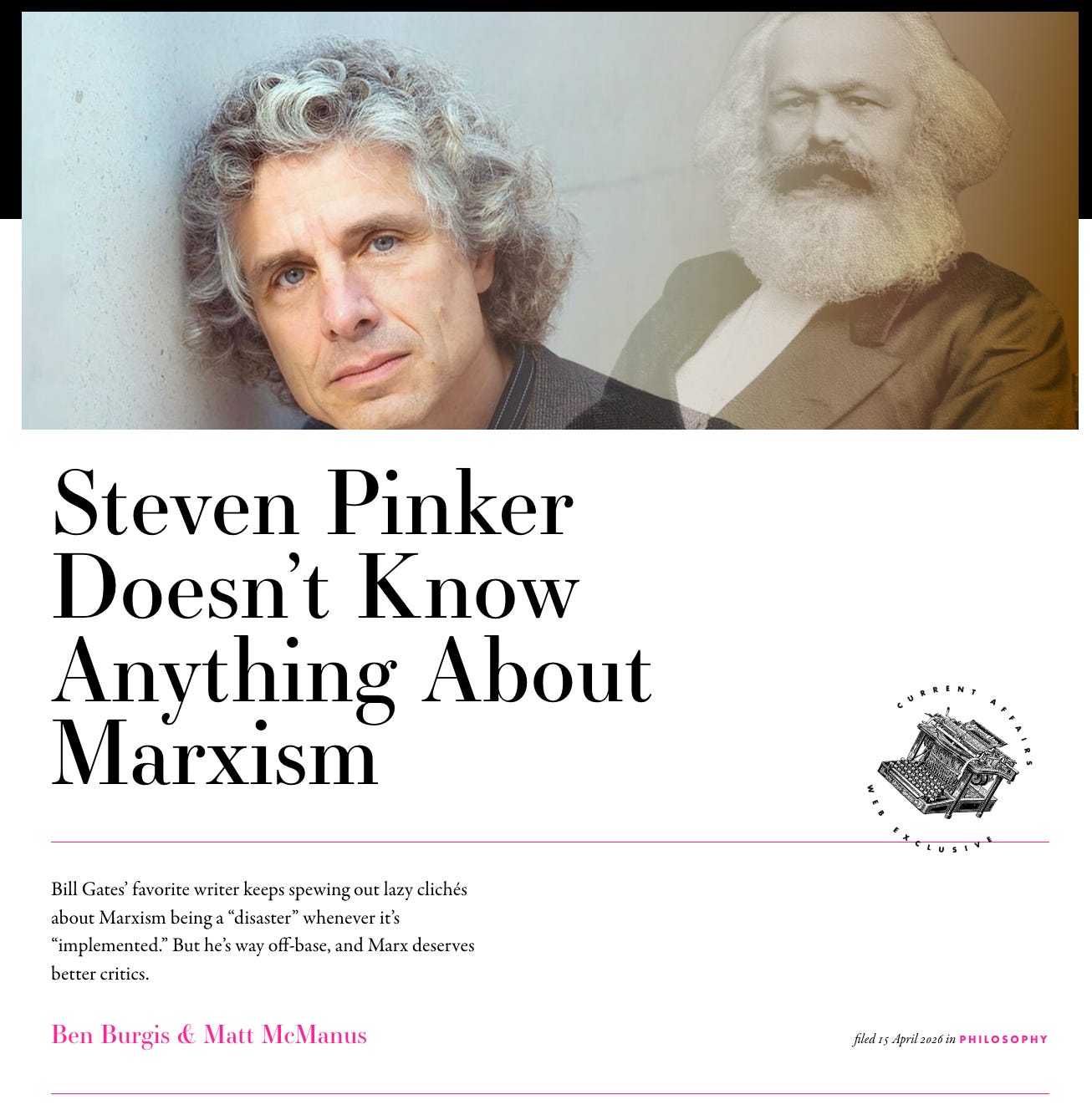
Under capitalism, the benefits of advancing technology are captured by the owners of the means of production, while workers who are lucky enough to have a job continue to work as many hours as ever and those who aren’t so lucky are thrown into destitution. Under socialism, though, when we all collectively and democratically control the means of production, Marx thinks we can all reap the benefits of automation, working shorter and shorter hours with no loss to consumption, until, as Matt McManus and I put it in our Current Affairs article earlier this week, “we’re all living in post-scarcity idyll where everyone can pursue their own projects without income needing to be tied to labor contributions, and there will be so much to go around, everyone can simply take what they want.” At this point, to put the point anachronistically, some people might sit around playing videogames all day, and others will spend their days writing novels or climbing mountains, but enough people’s idiosyncratic personal passion will be computer engineering that what work still needs to be done by humans will get done as a side effect of everyone pursuing whatever their passions happen to be. That’s what Marx means by “from each according to his abilities, to each according to his needs.”
Is this a plausible prediction? Perhaps not. I certainly think some form of socialism is possible, and I’m optimistic that under socialism most people can have far more free time than the working class (or even the constantly hustling petty bourgeoise) has right now. But all of that is compatible with skepticism that we’ll ever quite make all the way to Marx’s vision of collectivized super-abundance.
Either way, though, it seem to me that at least the “from each as they choose” half of Nozick’s motto is actually a pretty good description of that vision. In fact, to put a finer point on it, what Marx is doing is giving an exact description of what it would take to fully realize “from each as they choose.” And even if it’s never fully realized, if in other words we never make it all the way to that kind of post-work utopia, every step society takes in that direction (even incremental “reformist” steps like moving from a 40- to a 32-hour workweek) expands the kind of human freedom that’s actually worth wanting.
On the other hand, it strikes me as an absurdly misleading description of Nozick’s “minimal state,” where the free-market chips fall where they may, there’s no redistribution to pay for a social safety net, and there are no restrictions on what labor contracts people can back into “voluntarily” agreeing to in order to keep their heads above destitution. If where the chips fall is that some people inherit coal mines from their fathers, and other people have to spend the only life they get working 16-hour days in those mines because it beats begging or stealing or prostitution, there’s a lot you could say about how the second group’s lives are going. But one thing you couldn’t (sanely) say is that they’re living “as they choose.”
Thanks for reading Philosophy for the People w/Ben Burgis! This post is public so feel free to share it.
Something Nozick (at the stage of his career when he wrote Anarchy, State, and Utopia) and e.g. Adolph Reed would agree on, although they’d put the pluses and minuses in opposite places, is that reparations for the descendants of slaves fit more naturally into this kind of libertarian “rectification” theory than a standard left-egalitarian way of thinking about redistribution.
He throws in an odd appeal to popular opinion here. Contrasting his “historical” account of who deserves what (where you can only have a legitimate claim to a bit of the material world by application of 1-3 above or “rectification” for past violations) to views according to which the pattern of distribution at the “current time-slice” (i.e. the world as it is now) can be just or unjust without any reference to what came before, Nozick writes:
“Most persons do not accept current time-slice principles as constituting the whole story about distributive shares. They think it relevant in assessing the justice of a situation to consider not only the distribution it embodies, but also how that distribution came about. If some persons are in prison for murder or war crimes, we do not say that to assess the justice of the distribution in the society we must look only at what this person has, and that person has, and that person has…at the current time.”
And look. Even putting aside any issue about whether the truth about this kind of thing is best pursued by taking a vote, I don’t doubt that Nozick is right that “most persons” don’t think that the justice or injustice of larger patterns is “the whole story” in evaluating who has what without reference to individual-level facts. The example about justly imprisoned murderers and war criminals makes that point nicely. We could also make it by thinking about an otherwise egalitarian society where the only remaining small variations in wealth were due to the inheritance of small family heirlooms with sentimental value. Examples like these should, I think, make even a committed egalitarian think the social demands of distributive justice sometimes need to be balanced in complicated ways with individual-level claims and individual-level accountability.
But that’s not Nozick’s position! He’s anti-balancing. He thinks (or he does during the period where he writes Anarchy, State, and Utopia, anyway) that libertarian property rights absolutely trump the desirability of particular patterns of distribution when the two come into conflict. And given that, what work is the “most persons” argument doing for him? Does Nozick really think “most persons” think 1-3 plus rectification are “the whole story,” such that if the rigorous application of 1-3 led to a society where 99% of the population lived on the knife’s edge of extreme poverty while the top 1% hoarded enough wealth to provide a comfortable middle-class existence for everyone, “most persons” would see no injustice there?
Even on subjects where I think he’s dead wrong, Nozick often makes arguments that can’t be easily dismissed. Adapting Kant’s famous line about reading Hume, G.A. Cohen once said that reading Nozick awoke him from his “dogmatic socialist slumber.” He didn’t stop being a socialist. But, he did realize that his normative commitment to socialism required a more complicated and rigorous defense than he’d previously felt any need to provide.
Citizens of the American Republic in 2026 may have an easier time imagining what this might be like than they once did.
To be fair, the phrase predates Marx. It was certainly used by Louis Blanc, and may have predated him, and previous authors may have had different things in mind. But Marx is most definitely who Nozick has in mind here—he’s not riffing on obscure threads of the history of pre-Marxian socialism.
From Philosophy for the People w/Ben Burgis via This RSS Feed.