

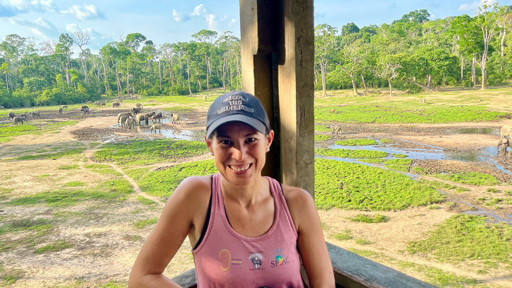
In the far southwest of the Central African Republic, where dense forest gives way to a broad clearing, elephants gather in numbers rarely seen elsewhere. The place is known as Dzanga Bai. Forest elephants are among the least visible large mammals in Africa. In closed-canopy rainforest, they move in small groups, often at night, communicating over long distances through low-frequency calls that travel beyond human hearing. Much of their social life unfolds out of sight. Dzanga Bai is one of the few places where that pattern breaks. Here, elephants emerge from the forest to feed on minerals in the soil. They linger. Families converge, separate, and return. Individuals can be recognized over years. Behaviors that are otherwise inferred—through tracks, fragments of sound, or brief encounters—can be followed more directly. Dzanga Bai in Dzanga-Sangha Special Reserve, Central African Republic. Photo by Rhett Ayers Butler For decades, the clearing has drawn researchers trying to understand a species that resists easy study. Long-term work here, including that of researchers such as Andrea Turkalo, has shaped much of what is known about forest elephants. Ivonne Kienast is part of that effort. She leads the Dzanga Forest Elephant Project, part of the Elephant Listening Project at Cornell University. Her work combines long-term behavioral observation with passive acoustic monitoring. The objective is to understand how forest elephants live and to detect early signs of change. In practice, this means continuous field presence, physically demanding work, and coordination across a network of relationships that extend well beyond…This article was originally published on Mongabay
From Conservation news via This RSS Feed.