

Our children have been shaped by their experiences and by history. They think critically and deeply. That awareness may be unsettling to some, but it is also transformative.
MANILA – Can something that has not been committed be considered a crime?
Under Senate Bill No. 1366, or the proposed Terror Grooming and Radicalization Prevention Act, this is possible.
Sen. Ronaldo “Bato” Dela Rosa filed the bill in September 2025, claiming this would combat “radicalization of vulnerable groups.”
The bill specifically targets what the senator calls “terror grooming,” which the bill defines as the “systematic manipulation of individuals to facilitate their involvement in extremist violence.”
Lawyers and members of the academe argued the proposed measure would instead put at risk those who practice critical thinking and exercise their democratic rights, such as the right to express grievances and academic freedom.
Wrong use of ‘grooming’
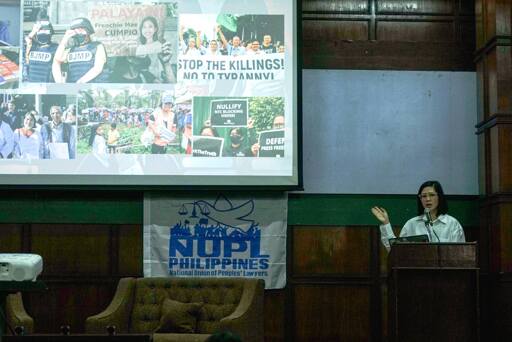
Josalee Deinla, secretary general of the National Union of Peoples’ Lawyers, said in a forum April 15, 2026 that the term “grooming” in the bill is problematic as it is usually associated with predatory sexual behavior, especially involving the manipulation of children or minors to gain trust for exploitation.
That concept, she stressed, clearly belongs in the context of child protection. But the bill hijacks the term “grooming”, which is intended for child protection.
Deinla also said that the term “‘grooming’carries a strong emotional weight: it evokes urgency, fear, and suspicion toward anyone labeled as a ‘groomer’.”
Once applied, she said, that label can stick and lead to stigma, discrimination, and other harmful consequences.
In its explanatory note, Dela Rosa’s bill defines vulnerable sectors such as children, youth, Indigenous Peoples, farmers, fisherfolk, laborers and the marginalized that are “often targeted by terrorist recruiters.”
According to Deinla, this falls under a false premise as it treats poverty, exclusion, and political grievances as signs of susceptibility to terrorism, rather than conditions that need real solutions.
She said that it reflects a counterinsurgency mindset where dissent is seen as ideological manipulation, not as a legitimate political demand.
There is also mention of abuse of freedom in the bill, by “extremists” which, Deinla said, refers to progressive groups, activists, and human rights defenders advocating for social change.
The bill also claims that basic freedoms like freedom of expression, belief and assembly, are being abused by “extremists”.
“But the problem here is that content-based restrictions must satisfy the clear and present danger test. According to Supreme Court cases, danger must be substantive and imminent. Not speculative, not inferred from the possibility of misuse,” Deinla said.
Deinla also said that the proponents of the bill also argued that existing laws only cover the recruitment and commission of overt acts, but not “early radicalization.”
She said that the current laws already address preparatory acts such as planning, facilitation, material support, and recruitment under the Anti-Terrorism Act of 2020.
These may also fall under the Cybercrime Prevention Act of 2012 if done online, and under the Revised Penal Code of the Philippines for offenses like incitement to sedition or rebellion.
“So this bill is completely needless,” Deinla said.

Photo by Altermidya
She also said that the bill is also vague when it comes to the term, “extreme” views.
Under Section 3 of the bill, the term radicalization is defined as the “process by which individuals or groups adopt increasingly extreme political, social, or religious views, that directly and imminently advocate for, or incite to, violence or terrorism.”
Deinla explained that the basic principle of criminal liability requires two elements, the actual overt act that constitutes a crime (actus reus) and the criminal intent (mens rea) or “guilty mind.”
“If you think about it, it’s very difficult to prove a person’s state of mind. So how could you do that? Through overt acts. So these two elements must be present, for the state to claim or to be able to prosecute an individual for a violation of a penal law,” Deinla said.
“The state may punish what the person does. It has never been permitted to punish what a person thinks, believes, or is in the process of becoming.”
This is what the bill seeks to subvert, said Deinla.
“It wants to occupy what we call the pre-criminal space. There is no crime yet, and yet, the state wants to criminalize behavior that it believes qualifies as a crime in that realm.”
Deinla stressed that “in every case, the law waits for the internal to become external before it intervenes.”
Violation of academic freedom
Deinla also noted that the so-called prohibited acts in Section 4 of the bill could penalize academic narratives or things that are normal in the academic setting such as discussions, studies or research, especially if they are seen as being used in a “manipulative” way to promote extremist beliefs.
“The problem is that key terms like ‘indoctrination’ and ‘manipulative manner’ are not clearly defined. This lack of clarity means they can be interpreted subjectively,” Deinla explained.
“For example, lectures on revolutions, social movements, or national liberation could be viewed with suspicion and even treated as linked to extremism,” she said.
The bill seeks to penalize “knowingly and intentionally engaging in a deliberate series of acts directed to a person – especially a minor or vulnerable individual – using psychological, ideological, or emotional manipulation to build trust or dependency with the intent of preparing, conditioning, or facilitating that person’s involvement in terrorist or violent extremist acts.”
The dela Rosa bill also penalizes “indoctrinating any person with violent extremist ideologies, which directly and imminently incite to violence or terrorism, for the purpose of preparing them to support, join, or commit acts of terrorism.”
Deinla also cited Section 4(11) of the bill which penalizes “using cultural, religious, academic, or ideological narratives in a deceptive or manipulative manner with the intent to justify, promote, normalize, or facilitate extremist beliefs, ideologies, or acts of terrorism.”
Deinla said this creates a risk that teaching and academic discussion could be unfairly targeted.
Another major concern is that the penalties are disproportionate, ranging from 15 to 40 years in prison, plus fines of up to P10 million ($167,633) if convicted. For educators, the penalties can be even stricter, including no eligibility for early release or parole.

Maria Mayla “Mayi” Garzon, mother of Charlize “Ceeka” Garzon expresses her support to human rights groups. (Photo by Altermidya)
The Philippines’ commitments under international law
In international law, there are provisions that protect freedom of thought and academic freedom.
Deinla cited the UN conventions and even the Philippine Constitution protect such rights. These rights, she said, will be trampled upon should the proposed measure is enacted.
The International Covenant on Civil and Political Rights for one protects freedom of thought under Article 18.
Deinla stressed that “the internal sphere of thought is absolutely protected. It cannot be regulated. It cannot be encroached upon. It cannot be restricted or lessened. The state has zero authority in relation to this aspect of freedom of thought.”
The United Nations also recognizes academic freedom as an autonomous human right grounded in the right to education.
Deinla refers to the report of Special Rapporteur on the right of education Farida Shaheed, to the UN Human Rights Council in 2024 where she stated “that academic freedom be considered as an autonomous human right grounded in several provisions of international law.”
Such rights are indicated in the International Covenant on Economic, Social and Cultural Rights (ICESCR), to which the Philippines is a state party.
Shaheed said in her report, “academic freedom comprises the freedom of individuals to access, disseminate and produce information, to think freely and to develop, express, apply and engage with a diversity of knowledge within or related to their fields of expertise or of study” in class or from outside the academic community.
“It is a human right, the exercise of which carries special duties to seek the truth and to impart information according to ethical and professional standards and to respond to contemporary problems and needs of all members of society,” the report said.
Deinla said the Supreme Court, in Garcia vs Faculty Admission Committee, has laid out four essential academic freedoms: who can teach, what can be taught, how it is taught and who can be admitted.
Deinla said the high court ruled that these decisions are to be made by schools and not the state.
Deinla also noted the decision in Pimentel vs Legal Education Board (LEB) — a government body that regulates legal education.
In this case, the LEB required a standardized test before students could enroll in law schools.
When the issue reached the Supreme Court, it ruled that this was an encroachment on academic freedom.
“So the court laid down this important rule: supervision versus control. The authority to check, but not to interfere. The state may set minimum standards, but may not exercise control that intrudes into the four essential freedoms or aspects of academic freedom,” Deinla said.
The deterioration of academic freedom
Meanwhile, Sol Iglesias, a professor at the Department of Political Science at University of the Philippines-Diliman, said academic freedom in the Philippines has declined in recent years under the administration of Ferdinand Marcos Jr.
She said that recent data by the Network in Defense of Historical Truth and Academic Freedom suggest that academic freedom in the country is at its lowest point since the end of the Marcos Sr dictatorship in 1986.
Its recent data from 2022 to 2025 showed more incidents of violations of academic freedom such as harassment and red-tagging.
She added that what’s more troubling is the surge of attacks on academic freedom in 2025, many of which involve students and young people.
These incidents range from police disruptions of student protests to legal charges filed against student leaders and activists.
She added Mindanao State University in Marawi banning raised fists while singing the “Himno ng Pamantasan” in 2024 and the National Security Council alleging recruitment into New People’s Army in the UP Mindanao campus in 2021 were also attacks on academic freedom.
She added First Lady Liza Araneta-Marcos joining the law faculty of the West Visayas State University may have secured funding for the school “but there was this subtle censorship, silencing of dissidence and pressure, especially on teaching and other activities on the Marcos legacy and government issues.”
On these types of attacks on academic freedom, Iglesias said, it is the students who are the most vulnerable, especially those who are expressing dissent.
Despite this, Iglesias said “we need to hold on to the basic idea that academics and students, our role is to remain as social critics.”
‘An insult to the youth’
Gabriela Secretary General Clarice Palce said the bill is an insult to the youth whom it portrays as susceptible to “terror grooming.”
She added in Filipino, “In fact many youth and women in the communities are the ones who lead the discussions on issues that directly affect them.”
Dino Peralta, father of Kaliska Peralta, who was killed by state forces in April 2024, said the state should address the reasons behind armed conflict and why there are people who decide to take up arms.
“For me, this is not just about ideology, it goes much deeper. The state should not underestimate our ability to think, to study, and to understand what is happening, and to make decisions based on reality,” he said in Filipino.
“Our children have been shaped by their experiences and by history. They think critically and deeply. That awareness may be unsettling to some, but it is also transformative,” he said.
He said the state and military labeling people as “demons” and “terrorists” helps justify harming “those who are simply striving for a humane life.
Meanwhile, he said, those who continue to struggle for a better society face the risk of losing their lives at the hands of people who act like “demons”.
“But no meaningful change comes without giving time, strength, intelligence and sometimes even life itself. Because our goal is pure: to live in a more compassionate and humane society, we must continue striving to achieve it,” Peralta said. (JDS, RVO)
The post Proposed ‘Terror Grooming’ bill seen as insult to youth, threat to academic freedom appeared first on Bulatlat.
From Bulatlat via This RSS Feed.