

Bullets:
Hubei province is home to China’s automotive industry, with over two thousand local suppliers.
Suizhou is a major manufacturing center for the specialty and heavy truck segment.
Chinese factory groups work directly with companies and governments across the world, thereby going around middleman companies, agencies, and dealer networks, which are prevalent in North America and Western Europe.
By dealing directly with Chinese factories and their engineering teams, global buyers slash their procurement costs, and maintenance and repair expenses.
Inside China / Business is a reader-supported publication. To receive new posts and support my work, consider becoming a free or paid subscriber.
Hubei province is home to China’s automotive industry, with over two thousand local suppliers.
Suizhou is a major manufacturing center for the specialty and heavy truck segment.
Chinese factory groups work directly with companies and governments across the world, thereby going around middleman companies, agencies, and dealer networks, which are prevalent in North America and Western Europe.
By dealing directly with Chinese factories and their engineering teams, global buyers slash their procurement costs, and maintenance and repair expenses.
This is a transcript, for the YouTube video found here:
Report:
Good morning.
We are in Suizhou for the week. Suizhou is in Hubei province, and it’s the home to CLW Group, who is one of the biggest manufacturers of specialty trucks in the world. Our company works for buyers of their heavy trucks, and so we work closely with CLW’s engineering and sales teams here. For this particular visit, we are with their divisions for emergency vehicles, new energy equipment and trucks – for municipal government buyers—and heavy specialty truck. We also needed to learn how dump trucks are made.
This factory group is more interesting that almost any of the others we work with, because they make such a wide variety of products. They use assembly lines, but for their orders there is a very high degree of customization involved. So they have heavily automated production of their raw materials, molds, laser cutting, but there is a far higher degree of hands-on, skilled labor that puts the vehicles together.
It’s typical to think of an assembly line in the traditional way, where the factory is making the same thing a hundred times, or a hundred thousand times. But the factories our company works with are different—the capsule house factory has 50 going at a time, all slightly different, and here at CLW they have six different truck types on the same line, and that same story on two hundred different assembly lines.
The videos for YouTube this week are going to be a little different. We’ll shoot video when we can, in between everything else we’re doing.
Over 8,000 people work here, including hundreds of engineers and skilled technicians, on the dozens of production and assembly lines. But on a given day there are hundreds of foreigners here as well.
This company is typical of a factory group that does OEM and ODM. Hundreds of thousands of companies across the world go to China for OEM for electronics, or household appliances, or fashion, or consumer goods. CLW is also an original equipment manufacturer, but for the heavy trucks and specialty equipment segment. Over 200 automative and trucking brands from across the world outsource their design work and manufacturing to CLW. So for companies with a strong local reputation, not only can they save money by buying directly from the factory, but they also put their own company’s name on the equipment.
Chinese factories, and China’s industrial system itself, have created a new business model. And it is one that is quickly being adopted–and preferred–by business enterprises, and especially for governments. CLW and factory groups like this one do not have distributorships across the world, for most of their product lines. Their customers buy directly from this factory. Customer service and equipment maintenance and repair—that is also direct with the factory here and its engineers.
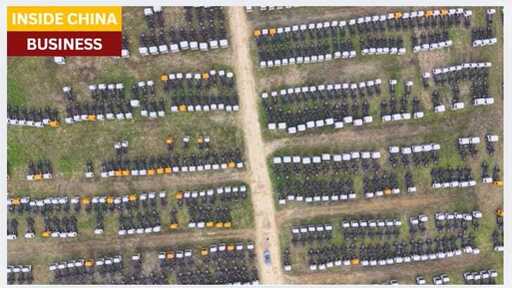
So there are two things working strongly in favor of that business model, especially compared to manufacturing companies and processes in the United States. First, the rate of production is very high compared to manufacturing centers in North America and Western Europe. For example, about 5,000 fire trucks are built and sold in the United States each year. Oshkosh / Pierce is the leading maker of fire engines in the US, with output of around a thousand each year. Just in these three big buildings here in Hubei, CLW produces over 20,000 a year.
Then comes the fact that buyers are direct with the factory. Again, using the fire truck example. A city that buys fire trucks from Oshkosh, or Volvo, also signs a maintenance and repair agreement to have its trucks serviced by the dealer networks, who can set their own prices locally. That feature is a major driver of future profits for the manufacturers and their dealer networks. That’s not how it works with Chinese factory groups. Buyers are dealing directly with the factory, and when new parts are needed for routine maintenance, or from damage, the engineers here just put the part on a plane and send it over. Fire departments and companies who use heavy trucks typically have qualified mechanics who can swap out parts anyway, so this is a major cost savings. So everything is faster and less expensive with no middlemen in the way.
We’re in Hubei province, and another key advantage for this particular factory, in this particular industry, and at this particular location, is China’s industrial clustering policy. Last month we were in Foshan, which is where all the furniture in the world comes from now. Next month we’ll be in Henan and Shandong, where all the heavy construction and ag machinery gets built.
Hubei province is automotive. Over 2,000 suppliers in the automotive industry are here. This is Suizhou, where the niche segments are, like specialty trucks. This factory group has over 400 suppliers, all within an hour away.
And that’s the trick. It’s how this company can offer over a thousand different varieties of specialized trucks and vehicles, across over a hundred countries, and still deploy the push-pull production and inventory management system. CLW does not have giant piles of raw materials or parts that may be used, eventually. Raw materials and components are ordered when needed, and equipment is produced as ordered.
This is a supply chain channel. We look hard at where things come from, and try to understand why things come from there. And there are just a lot of reasons why everything comes from China now.
This is Wuhan. In Hubei. Be Good.
Resources and links:
China’s Hubei Auto Industrial Cluster at a Glance
https://autonews.gasgoo.com/articles/news/chinas-hubei-auto-industrial-cluster-at-a-glance-2031619805872771073
Get to Know Sutphen, Which Has Been Making Fire Engines in the United States Since 1890
https://www.sutphen.com/get-to-know-sutphen-which-has-been-making-fire-engines-in-the-united-states-since-1890/
Major Industrial Clusters in China
https://www.china-briefing.com/news/chinas-industry-clusters-comprehensive-overview/
WATCH HOW Space Capsule Houses are built and shipped to AirBnb’s, ADU dealers, and resort properties
Three days at the Louvre: How China took over the global furniture industry
Inside China / Business is a reader-supported publication. To receive new posts and support my work, consider becoming a free or paid subscriber.
From Inside China / Business via This RSS Feed.