

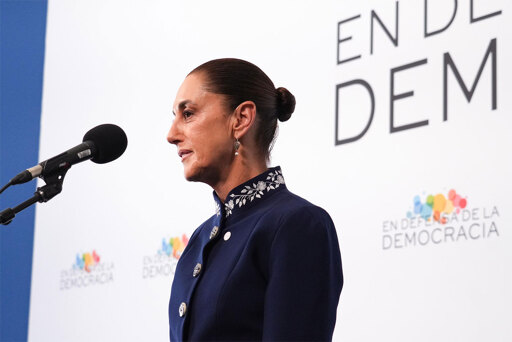
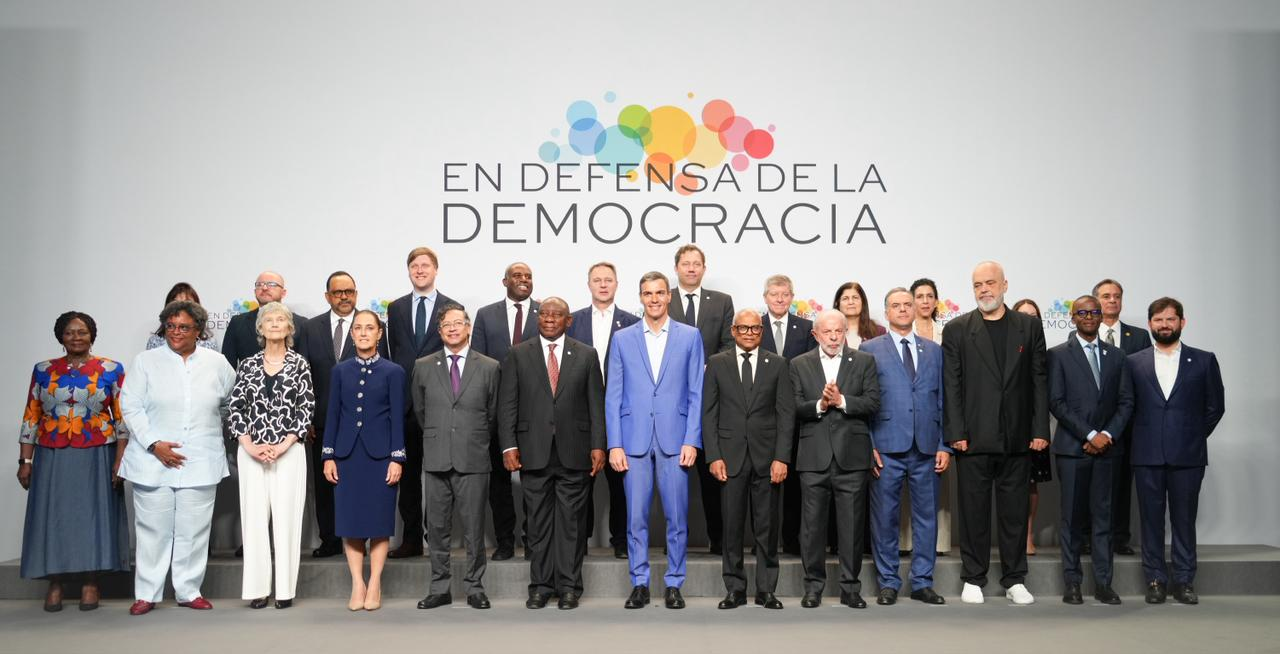
Thank you very much, President Sánchez. Thank you for the invitation. Thanks to all my colleagues—presidents, prime ministers, Gabriel Boric.
I come to the Summit for Democracy on behalf of a hardworking, creative, and resilient people, but above all a deeply generous people—a people that has learned to resist without hatred, to defend its rights without ceasing to respect others, to believe in peace even when history has placed difficult trials and tribulations before it.
I come on behalf of a caring people, even amid adversity, a profoundly humanist people, that resists individualism, rejects discrimination, and refuses with dignity to look at others with contempt.
I come from a people that recognizes its origins in the great Indigenous cultures—those that were silenced, enslaved, and plundered, but never defeated, because there are memories that cannot be conquered and roots that can never be uprooted. I come from the Pyramid of the Sun; I come from Tlaloc, from Huitzilopochtli, from Coatlicue. I come from a millennial history that is not confined to the past, but a living presence in our communities, in our languages, in our way of viewing the world.
I come from a people with deep spiritual values, who know that their history is sacred, because in it they find the strength to rise up, to resist, and to continue forging their destiny with dignity.
I come with the legacy of Miguel Hidalgo y Costilla, who in 1810 raised his voice for independence and days later had the courage to declare the abolition of slavery. I come with the legacy of José María Morelos y Pavón, who in the Sentiments of the Nation wrote words that still resonate: that sovereignty emanates from the people, that poverty and wealth should be moderated, that dignity admits no castes, only the distinction between vice and virtue.
I come with the legacy of Leona Vicario, who defied her epoch to defend the right of women to fight for their country.
I come bearing the dignity of Josefa Ortiz Téllez-Girón, who reminded us that those who serve the nation should not be rewarded, but those who exploit it should be punished. I come bearing the legacy of the Benemérito de las Américas, President Benito Juárez, an indigenous Zapotec fighter who, along with Mexican liberals, separated Church and State in the mid-19th century, defended the Republic against foreign invasion, and when victorious left us with a truism that belongs to the entire world: “Among individuals, as among nations, respect for the rights of others is peace.” I come bearing the legacy of Zapata, Villa, Madero, Carranza, Felipe Ángeles, Adela Velarde, Hermila Galindo—women and men who in 1910 rose not because of ambition, but rather for justice; not for power, but for the right of the Mexican people to live in a democracy, to control their natural resources, and to decide their own destiny.
I come bearing the legacy of General Lázaro Cárdenas, who, when the world closed its doors to Spanish republicans, opened Mexico’s doors to those fleeing pain and war. I come from a country that embraced exiles and turned solidarity into action. I come recognizing the courage of Frida Kahlo, who despite physical fragility, filled the struggle for justice with color.
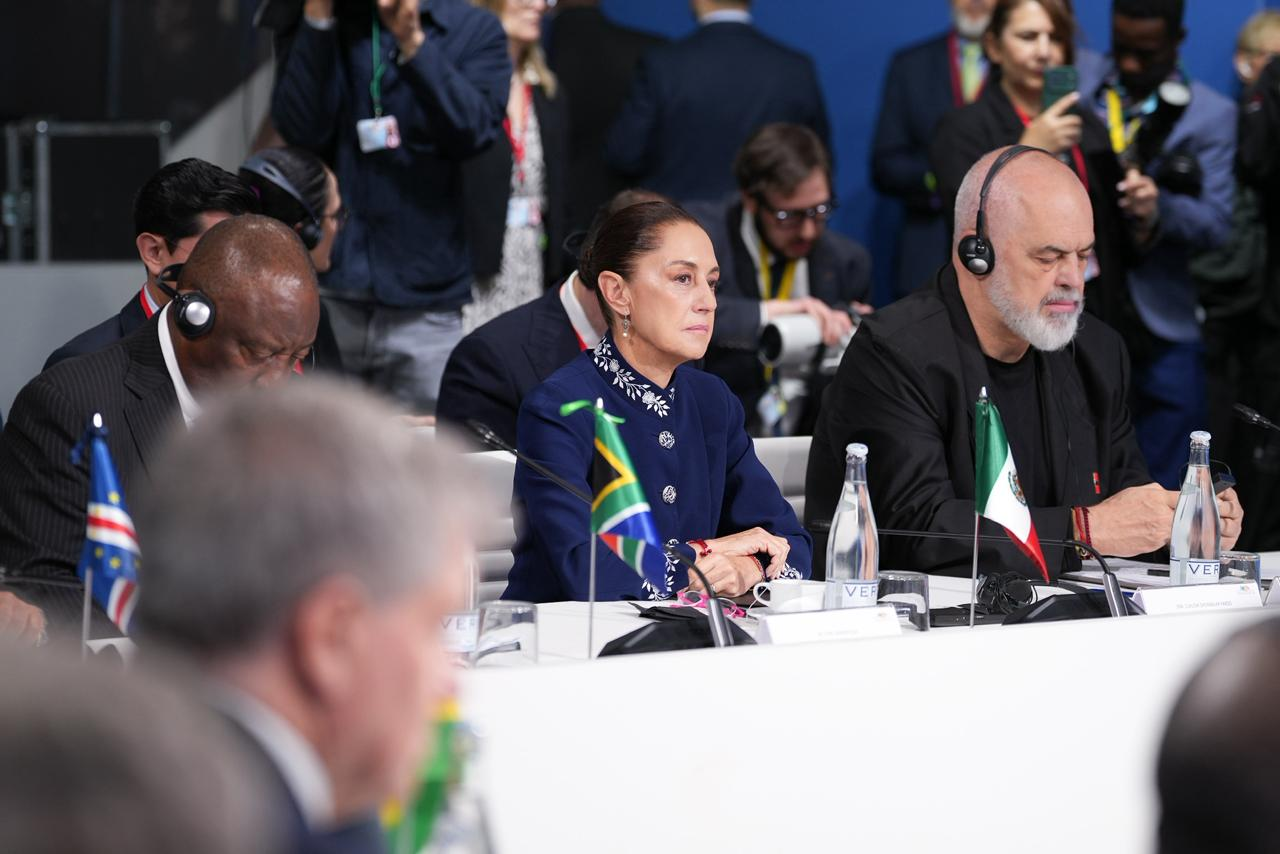
I come to remind you that Mexico has upheld its principles even in isolation, that it raised its voice against the blockade of Cuba in 1962 when others remained silent. To this day, speaking of that small Caribbean island, we believe that no people is small, but rather great and steadfast when defending its sovereignty and the right to a full life. I also come from the conscious youth who fight every day for a free, democratic, and fairer country—from women and men who believe in peaceful transformation, in social justice, and in human dignity as a universal principle. I come proud of my people, of their history, of their ability to resist, to share, and to never forget those who are most in need—a people who in 2018 decided that democratic development exists when we work for shared prosperity, or as we say in Mexico, “for the good of all, the poor come first.” I come from a people who in 2024 decided to break with a history of machismo and elected their first woman president so that all of us could advance.
I come to the Summit for Democracy to congratulate my fellow presidents who fight for it every day. I come to share what Mexico holds as constitutional principles, born from its history, democratic principles in foreign policy—principles that today resonate loudly and clearly and are more alive than ever on the world stage: respect for the self-determination of peoples, non-intervention, the peaceful resolution of disputes, rejection of the use of force, the legal equality of states, the need for international cooperation for development, respect for human rights, and the ongoing struggle for peace.
Because in a world suffering from war and inequality, these democratic principles remain Mexico’s contribution to the peoples of the world as a symbol of hope. Democratic principles also mean freedom.
But it’s worth asking: what kind of freedom? The freedom defended by conservatism? The freedom to submit to external interests? The freedom to turn nations into modern colonies? Or the freedom of an unregulated market that turns many into nothing and a few into everything? No.
We believe that democracy implies freedom. But freedom is an empty word if it is not accompanied by social justice, sovereignty, and the dignity of peoples. When we speak of democracy, it is not the democracy of elites, but of the people. Not the concentration of wealth, but its distribution. Not imposition, but participation. Not war, but peace. Not indifference and exclusion, but cooperation and inclusion.
When we speak of democracy, we refer to the democratization of culture, access to education, access to healthcare— and the ultimate purpose of governments, which is to ensure the well-being of their people. Democracy, as Abraham Lincoln said, is government of the people, by the people, and for the people. There is no democracy when there is no option for the poor, for the dispossessed.
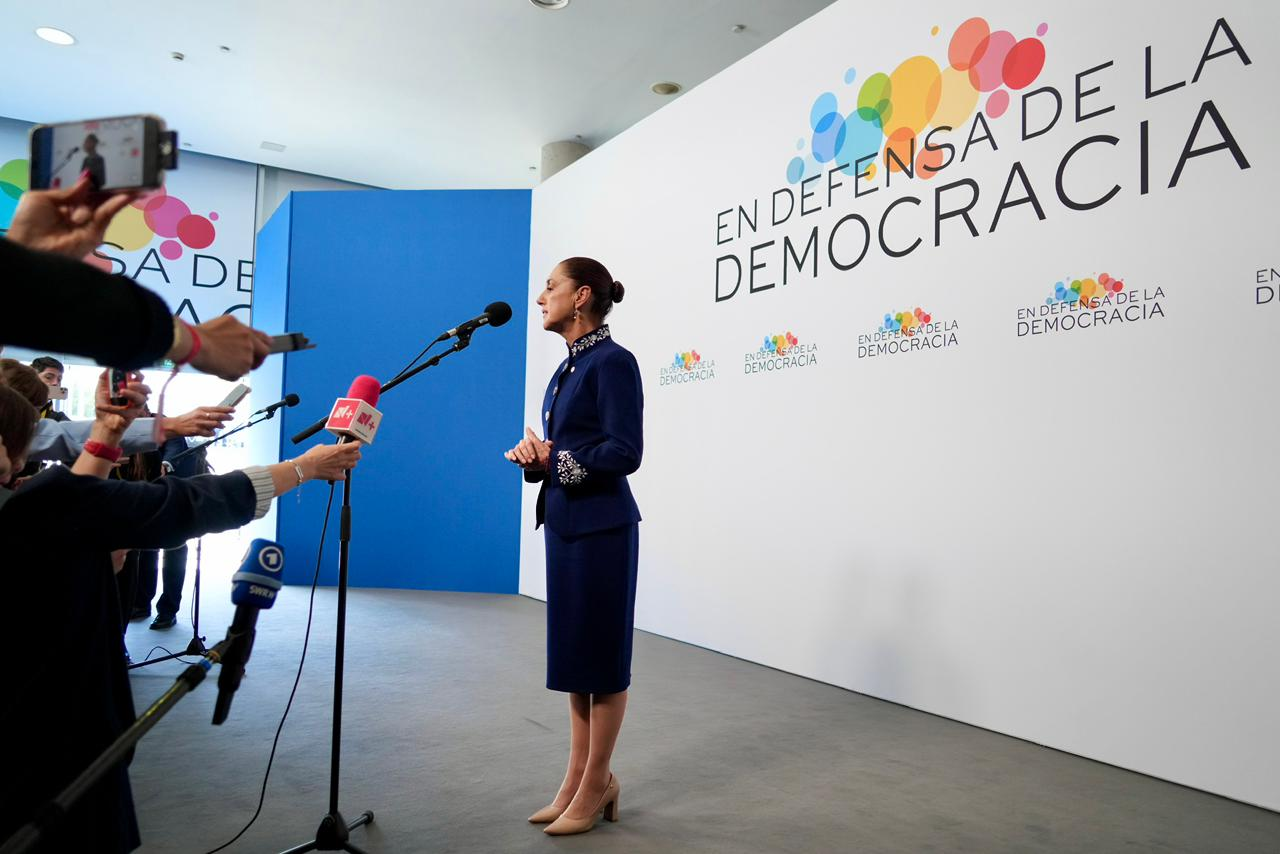
Therefore, I would like to propose a concrete action that I presented at the G-20: a simple proposal based on a new vision of the United Nations—allocating 10% of global military spending, which amounts to billions of dollars, to promote a global program that would enable millions of people to reforest millions of hectares of land each year. Instead of promoting war, let us promote peace; let us promote life.
I would like to propose a declaration against military intervention in Cuba, so that dialogue and peace may prevail. I would also like to extend an invitation for this summit to be held next in Mexico, where we can engage in dialogue on an economy centered on well-being and on a democracy that responds to the real needs of the people. Because democracy means placing love above hate, cultivating generosity instead of greed, brother and sisterhood above war.
Democracy means that life is not for sale, nor are the freedom or dignity of peoples. Democracy means that only respect for diversity and love for others will make it possible to build a world where everyone belongs—every people, every language, every culture, every nation.
I am a woman of peace, and I represent a nation that loves freedom, justice, and fraternity, and that understands democracy as the great Benito Juárez expressed it: “With the people, everything; without the people, nothing. With the peoples, everything; without the peoples, nothing.”
Thank you very much.
-
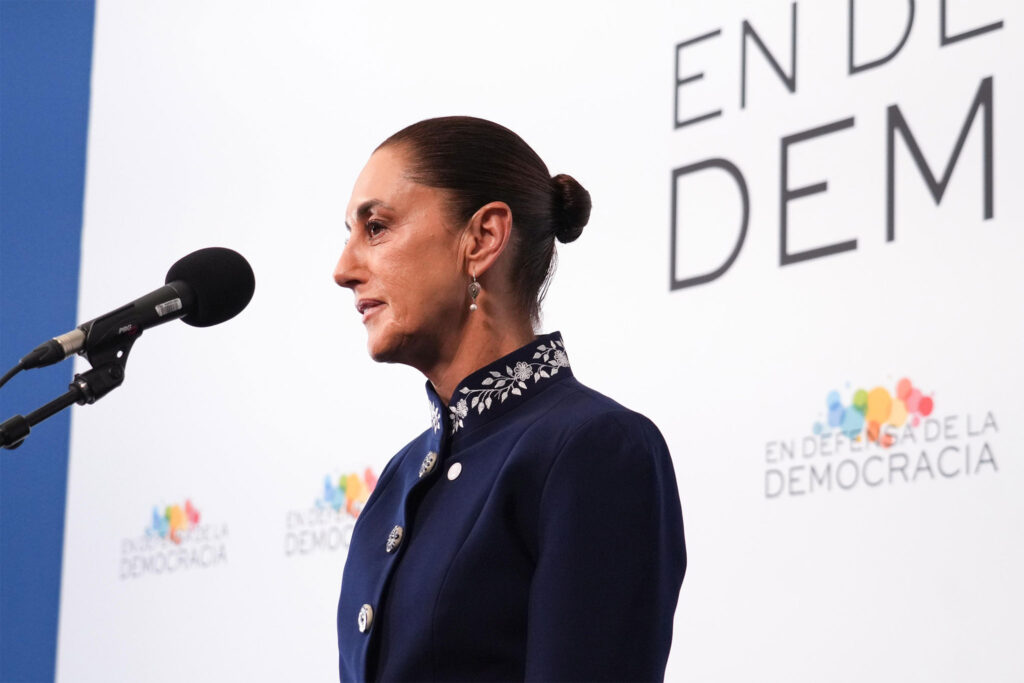
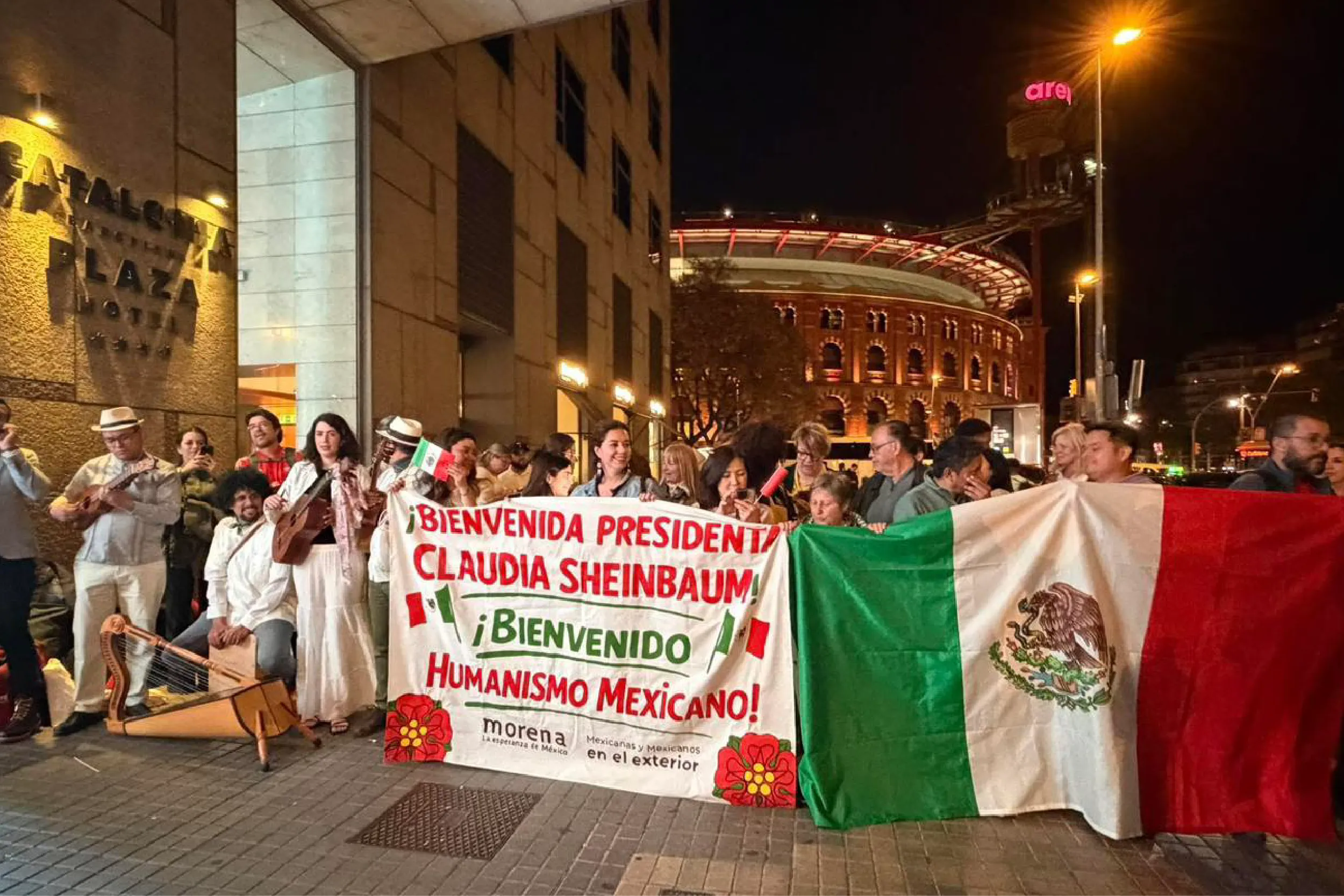
President Sheinbaum’s Address to Barcelona Summit in Defense of Democracy
April 18, 2026April 18, 2026
Remarks delivered by the Mexican President in Spain on Saturday, April 18th.
-
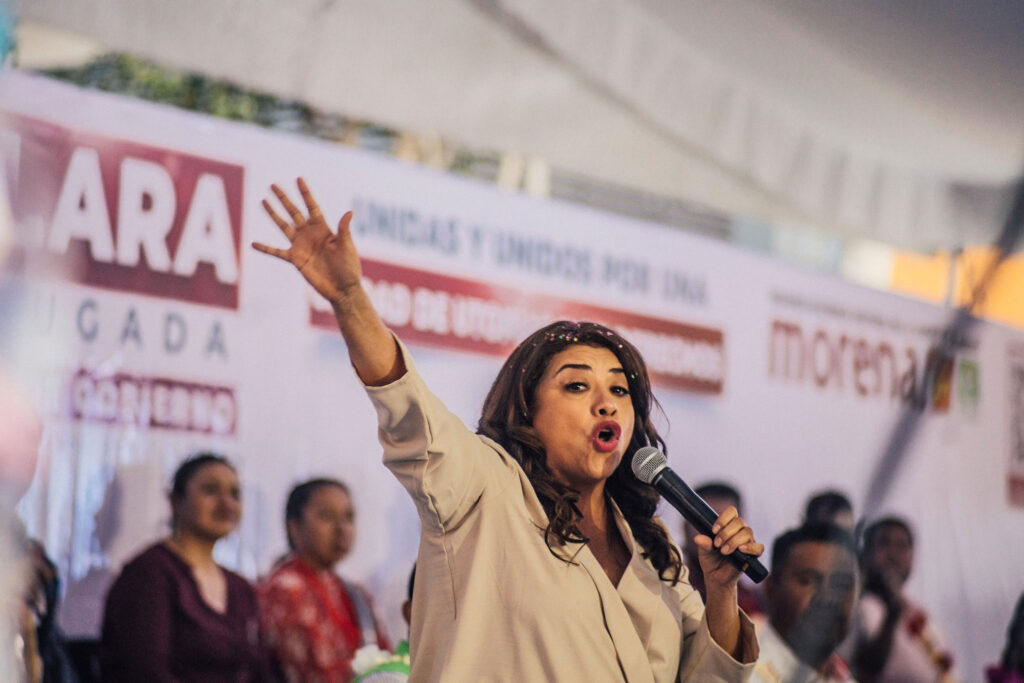
CDMX’ Brugada Confirms Problems with Metro, Allocates 50 Billion MXN for Rehabilitation
April 17, 2026April 17, 2026
Mexico City’s head of government emphasized that the metro is the “heart of mobility”, & therefore requires not only maintenance, but complete renovation.
-

People’s Mañanera April 17
April 17, 2026April 17, 2026
The Mexican President’s daily press conference, with comments on protection from AI, enforced disappearances, and electoral reform. Delivered by Minister of the Interior Rosa Icela Rodríguez in President Sheinbaum’s absence.
The post President Sheinbaum’s Address to Barcelona Summit in Defense of Democracy appeared first on Mexico Solidarity Media.
From Mexico Solidarity Media via This RSS Feed.