

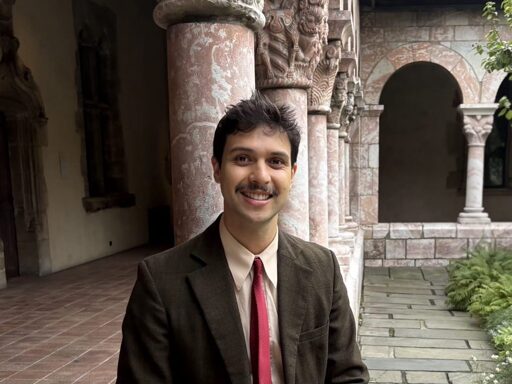

Nīkau Wi Neera (Photo supplied)
A popular trope about Indigenous languages suggests that they’re morally superior for lacking words for modern concepts. This is a problematic myth, writes Nīkau Wi Neera.
One of the most persistent and frustrating phrases common among Indigenous peoples of the west is something to the effect of: “There’s no word for ‘profit’ in our language.” Other frequent candidates are words like “sell”, “sovereignty”, or “ownership”.
Such sentiments are usually expressed to paint a difference between our Indigenous ways of life and western, typically capitalist, systems. The implication is that these concepts are so totally foreign to Indigenous peoples that we are simply incapable of describing them.
This is not so.
It’s often second-language speakers I hear making these sorts of comments — typically those with basic conversational fluency in their Indigenous language, which gives them enough confidence to make bold claims about supposed fundamental differences in cultural cognition.
Usually, this sort of person speaks only English fluently, was raised and educated in a western setting, and, aside from English, speaks only his or her own Indigenous language with any degree of proficiency. To a certain extent, the resulting attitude is to be expected. I went through this phase myself.
Learning another language is, for many, their first introduction to a different way of thinking about the world. It’s natural, then, that the stir of discovery might be extrapolated into somewhat grander anthropological theories.
This is especially common among those speakers of a certain political persuasion — often those who are reacting against marginalisation by asserting their Indigenous identity. However, this tendency reflects a broader, recent trend towards the essentialising of Indigenous difference — the belief that we’re fundamentally different from other human beings. This has counterproductive results.
There are several issues with framing cultural differences in terms of the absence of words. In the first instance, this misguided linguistic essentialism risks dragging Indigenous peoples back to the old trope of the Noble Savage. A supposed lack of words for “profit”, “greed”, or “lust” implies that these universal human impulses and motivations never existed before European contact.
Yet the oral, historical, and archaeological record is full of instances of conflict in Indigenous societies, often brought on by groups and individuals transgressing the social order. It’s unhelpful to think of Indigenous people as idealised, perfect creatures. To do so is to separate us from the flaws, and thus the humanity, that we share with all human beings.
Another problem is that, if Indigenous cultures can be considered innocent of western vices*,* it follows that those same cultures may lack certain western virtues. One example is the popular notion that my language, te reo Māori, lacks an original word for the term “kiss”. The term in common use, *“*kihi”, is a Māori borrowing of the English “kiss”.
If we entertain this notion of absence, are we then to believe that before the adoption of the term “kihi”, Māori had no way whatsoever to express the meaning of a kiss? Our oral histories speak of kissing. There are written accounts of kissing — or something that looked to Europeans like kissing — in traditional Māori society.
To say there is no word for “kiss” in our language suggests that the act of romantic kissing was unthinkable to Māori — and, more dangerously, that Māori society was without romance. In this way, an apparently simple assertion of a lexical absence can in fact serve to reinforce colonial prejudices about Indigenous capacity for love.
Saying “there was no Māori word for kiss” suggests to the average person a corresponding absence of all the things that go along with kissing: love, intimacy, tenderness, and so on. This, in turn, reinforces narratives of Māori savagery and insensitivity.
Not allowing a people the capacity for love, as an outsider might understand it, is to once again permit only a diminished humanity for that people — to see them as less than human.
Such concepts or capacities don’t even need to be particularly ethical or emotional. I wouldn’t like to be told by an English speaker that I am utterly incapable of understanding complex terms like “laparoscopic appendectomy” or “collateralised debt obligation” merely because I speak Māori.
Moreover, it would be considered racist, and rightly so, for a westerner to say that the cultural and mythological connotations that go along with the word “finance” are incomprehensible to a person from an Indigenous culture that traditionally practices a gift economy.
Assertions of this kind can also lead to absurd and supernatural claims. Benjamin Lee Whorf, who studied the Hopi language under the guidance of Edward Sapir in the 1950s, concluded, largely because of an imperfect understanding of Hopi ways of talking about time, that the Hopi fundamentally did not experience time, or worse, were incapable of experiencing it in the same way as Europeans.
This strain of argument, especially as it relates to concepts of time, seems particularly attractive to social media new-age types — think healing crystals, vibrations, dreamcatchers. Not to mention some Indigenous people who, disconnected from the lore and cosmology of their culture, adopt hippie caricatures of other Indigenous cultures and nonsensically map them onto their own.
For example, you occasionally see Māori on TikTok talking about how our ancestors “knew about sacred vibration-time”, or other similarly absurd, imported concepts, simply because we “lacked” a term for clocks. The argument, based on such specious linguistic evidence, is that if you can’t talk about it, you don’t experience it.
This way of thinking casts Indigenous peoples as something akin to magical, time-travelling elves, like the four-dimensional squid-things in the 2016 film Arrival. It’s not a comparison that does Indigenous people any credit. If there is an iwi (Tūhoe, I reckon) that knows the secret of time travel, we’re yet to hear about it down in Ngāti Toa!
Sapir and Whorf’s theories of extreme linguistic relativity were shown to be wrong in the 1980s. Whorf had misunderstood the Hopi language. He had appreciated neither its subtleties nor its strategies for expressing temporal statements that, in English, might require fewer words or be expressed with more straightforward language. The linguist Ekkehart Malotki demonstrated that, far from having no concept or experience of time, the Hopi speak about time in terms of a spatial progression emanating outwards from the speaker, moving from the past to the future.
Despite some lingering academic debate about the exact nature of Hopi time, most linguists agree that the Hopi, like all other known human cultures, speak about time using spatial metaphors. The particulars of this metaphor differ somewhat from culture to culture, but the approach is universal.
The communication of the same temporal concepts between cultures, it must be said, merely requires a little skilled translation. The necessity and beauty of this translation is the true lesson we should take from the failures of Sapir and Whorf. I know of no evidence that suggests that it is utterly semantically impossible for any one language to express an idea that another can, given the existence of infinite phonemes, speaker identity, inflection, cosmological explication, tone, and so on.
The mere fact that we can discuss complex cultural concepts from Indigenous societies using the English language disproves such theories.
The danger of fetishising our own Indigenous languages as fundamentally different and semantically firewalled from settler languages is that we may lose access to our deep cultural knowledge and metaphysics. An Indigenous person discovers these things when she learns the strategies within her language for talking about topics that are not intuitive to it.
It is in the feeling of a language flexing, bending, and working hard to express something foreign that the speaker truly learns that tongue’s nature. Hence, fluent or native speakers of Indigenous languages are less likely to say their language lacks a term for something. More often, these wise people will say: “It’s hard to explain. It’s kind of like . . . . except with a sense of . . .”
The skill, profundity, and mastery of native bilingual speakers are evident in their ability to communicate similarity, rather than difference. This, I believe, is the real treasure of an Indigenous view of language.
If there’s any kernel of truth in the claim that “there’s no word for this in my language”, it’s that in some cultures, certain concepts are more proximate — closer, more natural, intuitive — but they are never unthinkable.
In some cases, proximity can be merely convenient: New Zealand English frequently uses untranslated Māori words, such as wairua or whānau, to convey complex ideas more quickly.
More importantly, this understanding of proximity reveals the sublime depth required for cross-cultural communication and translation. To communicate “collateralised debt obligation” in exclusively Māori terms is a feat just as impressive as explaining “manaakitanga” in exclusively English terms.
Moreover, there is an original Māori word for kiss: ūngutu, which means a “firm meeting of lips”. On encountering this translation, an English speaker might feel its depth and tenderness, and perhaps relate it to his own fond memories of a passionate kiss.
As with so many things Indigenous, relationality — the principle that people and ideas are defined by their relationships — is the key to communication. Explaining something in someone else’s terms usually involves drawing on the commonalities between you, using shared understandings as a starting point to communicate ideas that might be less culturally proximate to the other person.
Who are you to me? Who am I to you? How do we each think about this?
Heoi anō, if there is an essential difference in Indigenous thought, it’s the universal belief in relationships and relating, especially in communication.
Mihi
Kei ngā manu arataki — ōku kaumātua, ōku ahorangi, kei āku hoa mahi anō hoki — e mihi ngaio ana: Luke Wihone, Barnaby Elder, Miriam Bright, John Whitman, S Henhawk, A T Smith, Cameron Hartley, Gahsëni’de’ Hubbell.
Nīkau Wi Neera (Ngāti Toarangatira, Kāi Tahu, Ngāti Koata, Ngāti Pāhauwera, Ngāpuhi*)* is an archaeologist working with Indigenous communities in the US.
The post There’s no word for this in my language appeared first on E-Tangata.
From E-Tangata via This RSS Feed.
You must log in or # to comment.
English doesn’t have a word for “doch” - English speakers can’t object.
