

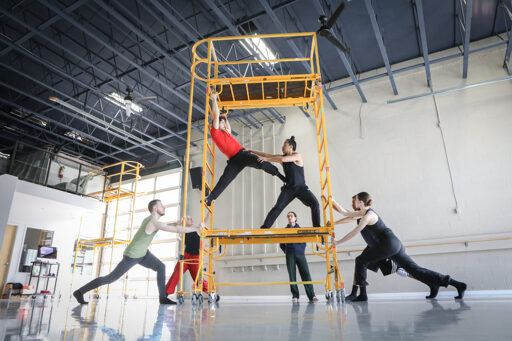
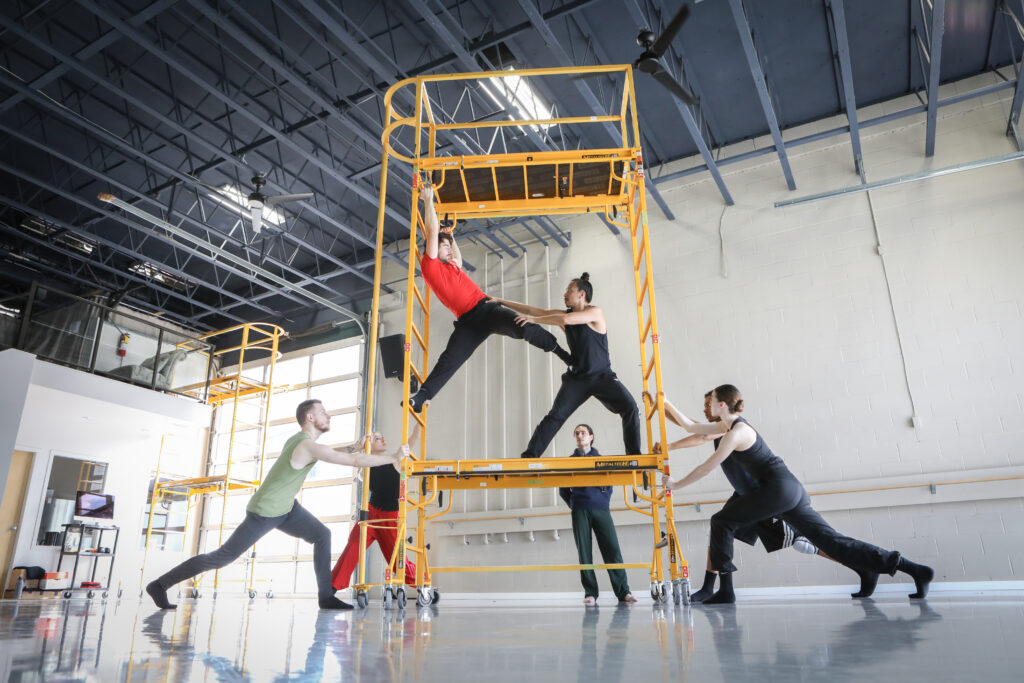
Cameron sinkʷə Fraser-Monroe (centre back), a Tla’amin Nation member and associate artist for Ballet Kelowna, directs dancers during an April 13 rehearsal in syilx homelands for his upcoming production of Cikilaxʷm: Controlled Burn. Photo by Aaron Hemens
Cameron sinkʷə Fraser-Monroe wants his dance audiences to reflect on their emotional relationship to smoke and flames — and how emotional avoidance may be hampering our collective response to wildfires.
The Tla’amin choreographer’s upcoming narrative ballet explores the past, present and future of Indigenous fire stewardship.
Cultural or prescribed fires have been used for millennia by many Indigenous Peoples worldwide.
Cikilaxʷm: Controlled Burn is Fraser-Monroe’s first full-length production, and will premiere in kiʔláwnaʔ (Kelowna) on May 1 on syilx homelands.
Produced by Ballet Kelowna and the National Arts Centre, the two-act ballet — which he wrote, choreographed and directed — marks only the second time the ballet company has ever commissioned such a large work.
In an interview, Fraser-Monroe explained his creation is set in a dystopian future “where wildfire season has no end.”
The ballet’s story revolves around a young Indigenous firefighter, Nathan, who is “being pulled between” two of his mentors: “The fire chief, who’s suppressing fires and putting them out,” he told IndigiNews, “and mothkʷ, who’s carrying the traditional knowledge around prescribed burns.”
Cikilaxʷm: Controlled Burn will be staged three times on May 1 and 2 at the Kelowna Community theatre, with discounts available for Indigenous people.
‘Worsening fire seasons every single year’
The ballet’s story is inspired and named after the syilx practice of cikilaxʷm.
In the nsyilxcən language — the language spoken by syilx people — the word means “traditional burning of the land for the health of our tmixʷ, which is our land and resources,” the Okanagan Nation Alliance states on its website.
“In today’s climate, we also burn for the safety and security of our communities and the people who live on this landscape.”
An associate artist for Ballet Kelowna, Fraser-Monroe became the ballet company’s inaugural artist-in-residence in 2022.
He has produced several shorter performances grounded in Tla’amin Nation’s history, protocols and stories.
But Cikilaxʷm: Controlled Burn is his first experience working with syilx culture.

READ MORE: Tla’amin choreographer brings ‘Wild Man of the Woods’ ballet home to the West Coast
He consulted closely with syilx Nation experts Tara Montgomery and Elliott Tonasket, as well as Elders from his own Tla’amin Nation, Betty Wilson and Elsie Paul.
He thanked Montgomery and Tonasket for their “generosity in guiding me through these practices” including providing the ballet’s nsyilxcən title.
“That was built on my long history with Elders in my community,” he said, “and the teachings that they’ve given me around reciprocity, respect and care for our culture.”
He stressed the importance of grounding his story specifically in syilx homelands, where with “worsening fire seasons every single year, every year is a new record.”
Yet he highlighted the fact that Indigenous Peoples worldwide manage fire through controlled burns.
He recalled a discussion he once had with theatre artists from “Australia” who talked about Indigenous use of fire on those lands.
“That’s really the relevance of the work,” he said.
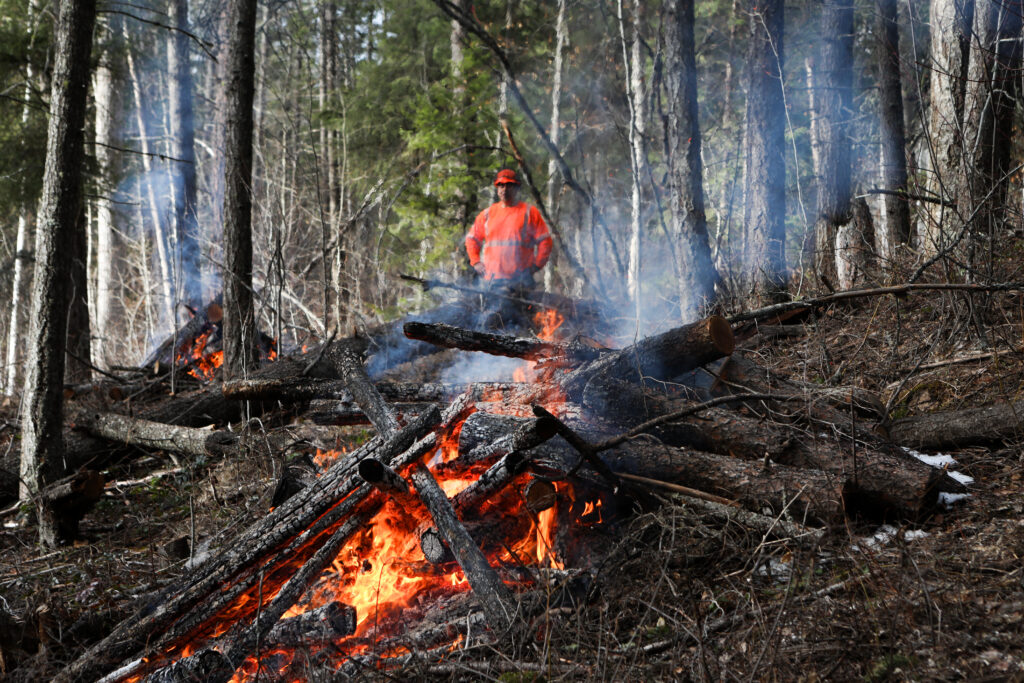
syilx Nation member Charles Kruger, a technician with Ntityix Resources, monitors controlled burn work in Westbank First Nation, in syilx territories, last year. Photo by Aaron Hemens
Using dance to ‘address this fear response’
While his production is meant to bring awareness about such ancestral practices, Fraser-Monroe stressed his ballet is still a work of art, “not a scientific argument.”
He said its story tackles what he called many people’s “fear response” in the Okanagan Valley to see nearby fire and smoke in their landscape.
“Where this piece is doing its work is in saying that we need to address this fear response,” he said.
“We need to address this aversion to smoke, if we’re going to be able to practice our controlled burns.”
He wanted to create an artistic space for audiences to reflect on their relationship with fire and the wildfire “global emergency” worsened by climate change.
Fraser-Monroe hopes to transform “that emotional response,” he said. “More than just changing someone’s intellectual understanding.
“I think we’re all going to approach the work in different ways, depending on our relationship to fire.”
Before settler-colonialism outlawed Indigenous use of fire on the land, including through laws such as the 1874 Bush Fire Act, syilx Okanagan people and other Interior Salish Nations had been prescribing fire to the land for thousands of years.
Burn cycles were designed to nurture and support certain types of landscapes and ecosystems. They often also help sustain biodiversity for hunting and harvesting berries and medicinal plants, and to support ceremonies.
This work of regular burning — also known as cultural or controlled burns — helped maintain the ecological health of the land by limiting overgrowth and reducing fuel available for wildfires.
READ MORE: Amid climate impacts, leading Secwépemc firekeeper shares ‘a better way of looking after the land’
However, over the last century, settlers effectively removed such beneficial fire from the landscape by trying to rapidly extinguish any wildfires.
This has resulted in trees growing across landscapes not historically forested, all of which has led to the accumulation of wildfire fuels and debris across landscapes.
These conditions, combined with the effects of climate change, have contributed to the increasing frequency of “megafires” throughout the country, especially in the semi-arid homelands of the syilx people.
But today the practice is seeing a resurgence among First Nations communities and has gained the endorsement of the B.C. Wildfire Service. Last year, the province saw 76 projects implemented, up from 48 in 2024, and 23 the year before, according to the provincial agency.
“The science behind controlled burns is now just catching up to our thousands-of-years-old knowledge,” said Fraser-Monroe.
“It’s still that emotional response to fire — it’s still that emotional response to these practices that we need to work with and help people through. That’s what the piece is about.”
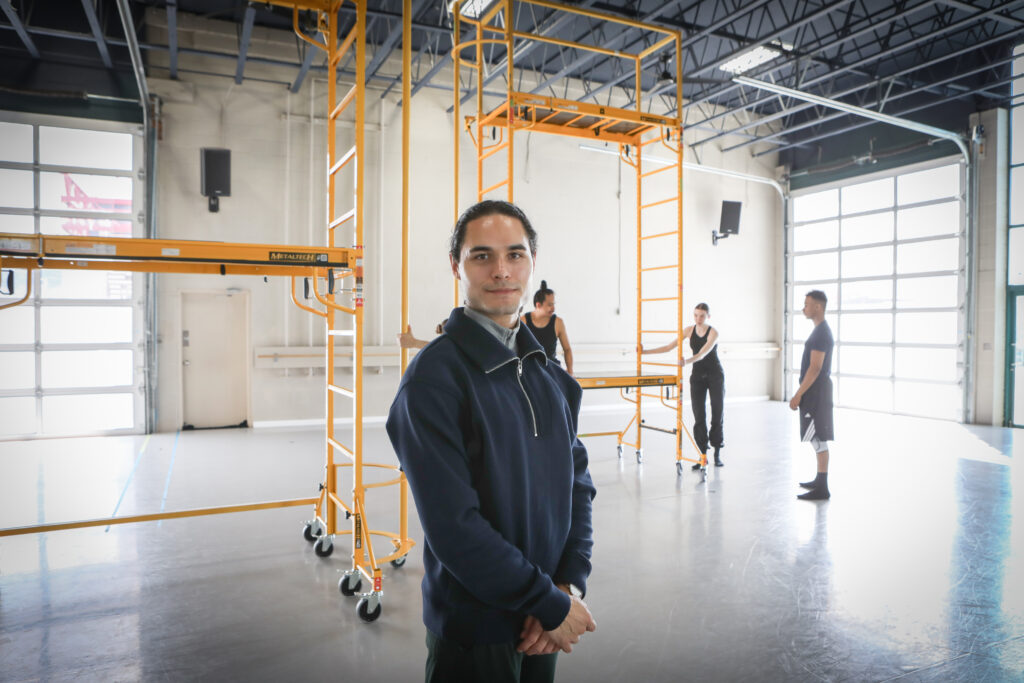
Cameron sinkʷə Fraser-Monroe, a Tla’amin Nation member and associate artist for Ballet Kelowna, is the choreographer and director for the company’s upcoming show Cikilaxʷm: Controlled Burn. Photo by Aaron Hemens
‘A clear path forward’
Work on Cikilaxʷm: Controlled Burn has been years in the making, he said.
The idea was sparked after he heard Cree cellist and composer Cris Derksen perform a composition titled “Controlled Burn” at New York’s Carnegie Hall in 2024.
Two years later, Derksen provided an original score for Fraser-Monroe’s ballet.
The show also features digital projections by visual artist Andy Moro, who is of mixed Omushkego Cree and European ancestry. The ballet’s costume designs were by Navajo and Cherokee designer Asa Benally.
When writing the show’s story, he drew inspiration from two novels in the dystopian-future genre: Yvette Nolan’s The Unplugging, and Ray Bradbury’s Fahrenheit 451.
He was also inspired by his younger brother, who served for a season with B.C. Wildfire Service.
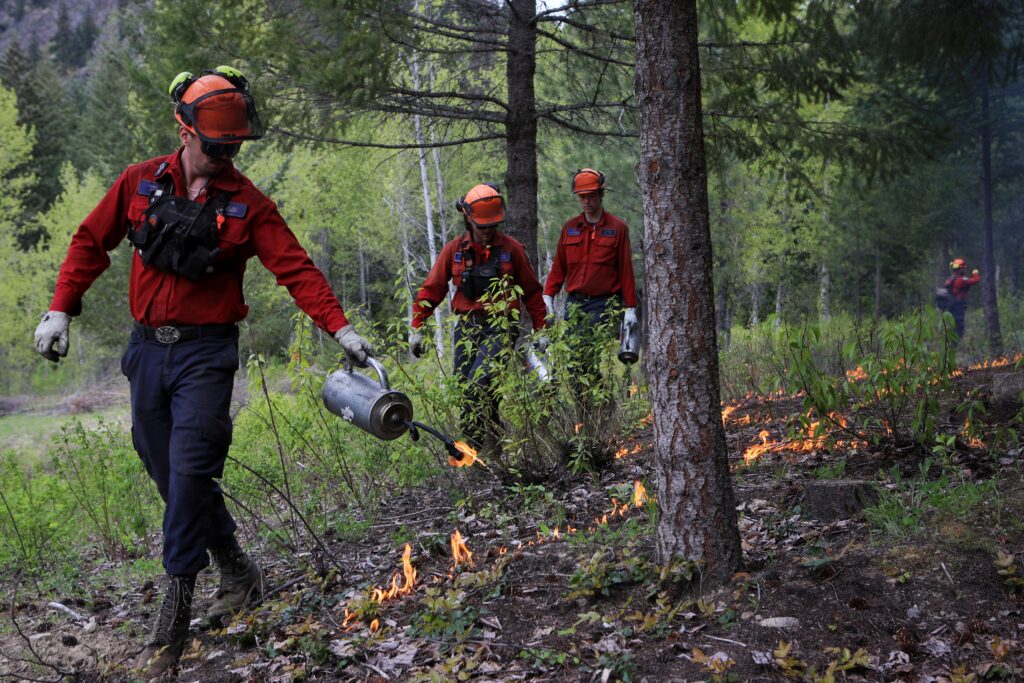
Members of B.C. Wildfire Service participate in a controlled burn with the Boothroyd Indian Band in Nlaka’pamux territory in 2024. Photo by Aaron Hemens
In addition to consulting with syilx community members, he also attended the inaugural National Indigenous Fire Gathering in snpink’tn (Penticton) last fall, where he met Indigenous fire expert and advocate Amy Cardinal Christianson.
“That gave me a lot of context around the work that needed to be done, in terms of prescribed burns back on the land,” he said.
Despite his ballet’s dystopian backdrop, however, he said it also offers hope and “a clear path forward.”

READ MORE: Ballet star brings Indigenous cultural stories to the stage
“That’s allowing Indigenous peoples to steward the land as they’ve done for thousands of years,” he said.
“It’s to go back to allowing us to practice these controlled burns that have cleared, protected … and cared for the land for thousands of years.”
Helping audiences process painful emotions such as “the grief, the fear, the anxiety, that a lot of us share,” he said, “is about that future and the path forward that we know.”
And like many Indigenous narratives, he described the production’s narrative as cyclical, not linear.
“We know that past, present and future are connected. We know that we can look to the past to ground us in the present and shape our future,” he said.
“That knowledge is not grounded in one place — these traditions are not something from the past. They’re alive with us now.”
The post Tla’amin choreographer sets the dance stage ablaze with wildfire-themed ballet appeared first on Indiginews.
From Indiginews via This RSS Feed.