

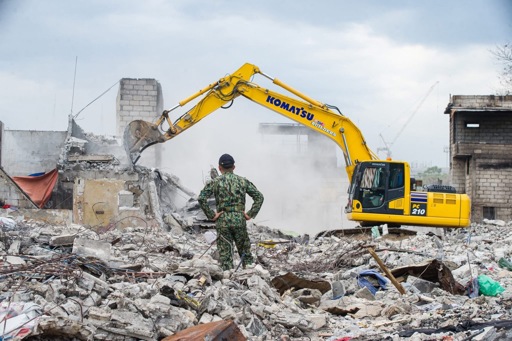
“It appears that the authorities want to shortcut processes in favor of landowners and do away with holding proper consultations, providing relocation areas, among others.”
MANILA – While the ordinary Filipinos are reeling from the economic impacts of the oil price shock, at least five urban poor communities became targets of demolitions this April.
“The poor have become collateral damage. Many of these demolitions did not undergo consultation, some don’t even have proper relocation for the affected residents,” Mimi Doringo, secretary general of urban poor group Kadamay, told Bulatlat in Filipino. “When people resisted the demolition, they experienced harassment. The police showed no respect and we can clearly see that in the demolitions that took place this April.”
The National Housing Authority demolished houses in the NIA Road, Quezon City, on April 9. The families said that they received no notification about the demolition and they were promised a rental subsidy and a relocation in San Ildefonso, Bulacan. Seven individuals were arrested for defying the demolition of their houses.
The Quezon City Housing Community Development and Resettlement Department said in a report by Philippine Star that the ongoing demolition will pave the way for seven 12-storey residential buildings, targeted for completion in December 2027.
However, the Center for Trade Union and Human Rights (CTUHR) said that the residents were not consulted prior to the demolition for the plans of the local government. They underscored that the forced eviction and the violence that transpired during the demolition is a human rights violation.
“It is ironic that government housing buildings will supposedly be built in the ruins of an urban poor community that has just suffered a devastating fire and a violent demolition. If there is real compassion for the urban poor, this will not happen,” said Kamz Deligente, CTUHR executive director.
Since April 13, residents of Panday Creekside in Taguig City have been resisting the demolition of their houses, which saw the deployment of a sniper from the Philippine National Police SWAT force.
“The presence of SWAT and sniper is part of the standard security protocol to ensure the safety of all, the residents, and the operatives, and other actors in the demolition,” said Taguig City Police in a statement.
Gabriel Carmen, spokesperson of Karapatan – National Capital Region, said that the Taguig City Hall rejected their letter of assistance to heed the demands of the residents to stop the demolition. Instead, he was threatened with arrest and had been subjected to a blotter.
“There is no legal basis for holding us, and we have done nothing wrong. What is happening now in Panday Creekside, Taguig, is a clear violation of the residents’ right to housing and their human rights,” he said in a video statement.
Doringo also reported that she received another report of demolition in Cambridge, Cubao, affecting over 30 families. “The people were calling out for help while we were here camping-out in DSWD because of the failure of the government offices,” Doringo added.
Demolitions did not only happen in Metro Manila.
On April 9, CTUHR also reported demolition against residents of Barangay Bolod in Panglao, Bohol, with three residents hurt due to the tensions.
CTUHR also reported that 100 families in Matina Aplaya, Davao City were subjected to demolition of their homes on April 14. On the same day, a demolition operation also started at Purok 6B Riverside, Bambang, Los Baños, Laguna. The team claimed that they were merely measuring the area but their operations already started.
“If only the NHA and the Department of Human Settlements and Urban Development (DHSUD) respect the urban poor’s right to decent housing and due process, forceful eviction from homes should not happen,” said Deligente. “It appears that the authorities want to shortcut processes in favor of landowners and do away with holding proper consultations, providing relocation areas, among others. This is despicable.”
Eviction or demolition should be discouraged, according to Section 28 of the Urban Development and Housing Act (UDHA). If it will be allowed under certain circumstances such as in areas which prove to be dangerous or due to the implementation of government infrastructure projects. Under the law, it is mandatory to provide notice to the affected residents and to conduct proper consultations.
A previous Bulatlat report stated that there are loopholes in the UDHA, since the scope of “danger areas” could be twisted to the disadvantage of the residents. Moreover, Kadamay also condemned the gaps in the law, which in turn, could only legitimize demolition and delay it, rather than prevent it from happening.
Read: Urban Development and Housing Act merely meant to delay demolition of urban poor communities
In a historical overview of housing programs and policies in the Philippines, urban poor think-tank Inklusibo, found a pattern of aggression perpetrated by government actors against the urban poor transpiring during a demolition. These include forced home invasions, confrontations marked by gunshots, firing of teargas, and hitting of truncheons and ballistic shields.
“To this day, people have no decent housing, stable livelihoods, no living wages, and we remain severely lacking in the services that the government is supposed to provide,” Doringo said. “If these are not addressed, the urban poor will continue to fight until our needs are met.” (RVO)
The post 5 demolitions in April flagged as rights violations of urban poor appeared first on Bulatlat.
From Bulatlat via This RSS Feed.