

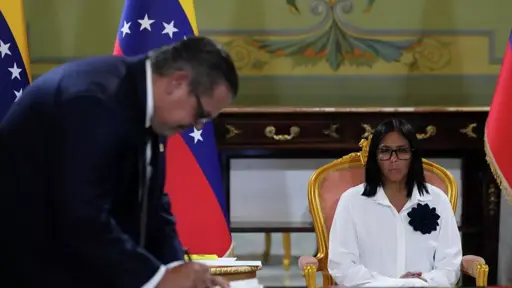
Venezuelan Acting President Delcy Rodríguez led the signing of an agreement between the state-owned Petróleos de Venezuela (PDVSA) and the US company Chevron to exchange energy assets. This step is expected to have a certain impact on Venezuela’s energy market.
The agreement includes the transfer of a license for a gas field to Venezuela in exchange for the incorporation of the Ayacucho 8 block, located in the Orinoco Oil Belt, into the production for PetroPiar, Chevron’s joint venture with PDVSA.
“This exchange agreement… will allow us to make significant progress in terms of production,” said Rodríguez, adding that the income derived from that production will go “directly to the benefit of the people of Venezuela.”
Como parte de los avances en nuestra agenda energética, celebramos la firma de nuevos acuerdos entre PDVSA y el Ministerio de Hidrocarburos con Chevron. Estas nuevas alianzas nos permitirán elevar la producción petrolera y dirigir esos ingresos al bienestar de los venezolan@s. pic.twitter.com/usXQexd4jE
— Delcy Rodríguez (@delcyrodriguezv) April 14, 2026
Rodríguez also said that “Chevron has been in Venezuela for more than a century,” and that the company “can serve as an example,” because “in the worst moments, they remained in the country and, today, they show clear signs of continuing to move forward.”
The acting president further emphasized the need to “move toward a Venezuela without sanctions” and to provide “institutional legal security to investors coming to Venezuela.” She stated that this is not “a fleeting or momentary investment, but rather we are betting on the future.”
Major challenges for achievable goals
Werther Sandoval, an expert in the Venezuelan oil sector, told Sputnik that, although the precise details of the agreement have not been disclosed, “an increase in oil production is expected, and probably before the deadline set by Chevron itself, as Venezuela has wells in deferred production that require investment.”
“The most delicate problem is PDVSA’s electrical system, affected by the US blockade and in need of investment,” the analyst said. This is relevant in the context of the current US sanctions, which, as Rodríguez stated, should be lifted to ensure full legal security for investors.
“Venezuela currently hovers around a million barrels [per day], with ups and downs,” said Sandoval. “Chevron has the capacity for higher production in the four companies where it participates. It has just increased its stake from 30% to 49% in one of them, which shows its interest in the ultra-heavy crude, necessary for its refineries on the Mexican Gulf coast.”
“An increase in production between 260,000 and 390,000 barrels seems conservative and achievable to me,” he added.
He further stated that, according to statements by US Secretary of State Marco Rubio, Washington’s interest is not only in oil but also in “geopolitical control to reduce space for energy companies from other countries.”
“A very significant game of tensions is shaping up, where the Venezuelan government must act delicately, always favoring national interests and respecting agreements with its major allies,” commented the expert.
Delcy Rodríguez Urges US to Lift Illegal Sanctions, Calls for ‘Maturity’ in Bilateral Relations
The president of Chevron in Venezuela, Javier La Rosa, described the asset exchange as the first step of a new stage aimed at strengthening energy cooperation between Washington and Caracas.
Chevron’s increased participation contrasts with other multinationals. ExxonMobil and ConocoPhillips are engaged in international litigation against Venezuela over expropriations carried out during the term of former President Hugo Chávez. These processes have resulted in the immobilization of PDVSA’s assets in the Caribbean and Europe.
For Venezuela, the agreement represents an injection of capital and technology into a sector whose production has decreased from a peak of 3.2 million barrels per day in 2008 to current levels of nearly one million barrels per day. As Sandoval summarized, the expectations are conservative but achievable, as long as the challenge of electrical infrastructure is addressed and the Venezuelan authorities carefully navigate the complex geopolitical landscape.
(Sputnik)
Translation: Orinoco Tribune
OT/SC/SF
From Orinoco Tribune via This RSS Feed.