

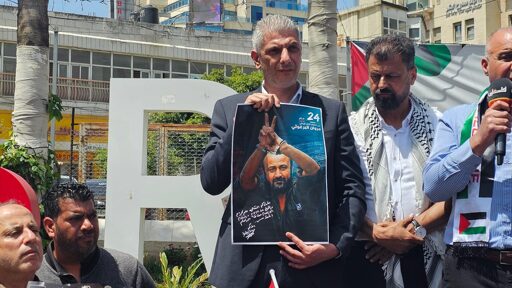
For over five decades, Palestinians have observed Palestinian Prisoner’s Day on April 17 as a national day to honor the thousands of Palestinian political detainees held in Israeli occupation prisons, highlight their struggle, and demand their freedom.
In commemoration of the day, which is considered by Palestinians as a sacred occasion of patriotism and loyalty, Peoples Dispatch spoke to Mr. Raed Abu al-Hummus, head of the Palestinian Commission of Detainees and Ex-Detainees Affairs.
Abu al-Hummus, who is also a freed Palestinian prisoner, assumed his new position in the commission with the rank of minister in February 2025, amid highly challenging political and security circumstances.
On the one hand, the restrictions imposed by the Israeli occupation authorities as part of the crackdown on the Palestinian Prisoners’ Movement has made the work of the commission formidable.
On the other hand, the appointment of Abu al-Hummus came immediately following the Palestinian Authority’s decision to cut the stipends of many Palestinian prisoners, under pressure by the United States and the European Union. This in turn, has further burdened the commission, while dealing with the prisoners and their families.
Moreover, the commission has been abandoned by the concerned international human rights organizations, above all the International Committee of the Red Cross (ICRC), which seem to have complied with Israel’s arbitrary measures.
Abu al-Hummus, however, confirmed that the staff of the commission work with a high level of dedication and devotion, and deal with prisoners and their families with great protectiveness and understanding.
“Most of our staff are freed prisoners, who consider the issue of prisoners a personal humanitarian concern not a career,” he argued.
A silent genocide
Underscoring the intense suffering of Palestinian political detainees held in Israeli prisons after October 7, Abu al-Hummus said that while the Israeli genocide was in full swing and live-streamed in Gaza, another silent genocide began inside Israeli prisons and has continued till the moment.
The senior Palestinian official noted that severe torture, deliberate medical neglect, and starvation led to the death of at least 89 Palestinian prisoners inside Israeli jails since October, 2023.
Read more: “We are here to kill you”: Released Palestinian prisoner exposes torture and medical neglect in Israeli prisons
“This is a record-breaking toll in the history of the Palestinian Prisoners’ Movement,” he asserted, adding that the commission also received information about other unidentified fatalities among the detainees, who are kept inside morgues under the administration of the Israel Prisons Service (known as Shabas).
The tally also reveals that the Shabas has already begun to execute Palestinian prisoners by implementing slow killing methods, even before the unlawful bill that mandates the execution of Palestinian prisoners by hanging was endorsed by the Israeli Knesset last month.
Israeli rights groups and lawmakers file petition to overturn the death penalty bill
Regarding the death penalty bill, Abu al-Hummus clarified that it has not entered into force yet, because it is still under review by Israel’s Supreme Court, after a number of Arab lawmakers in the Israeli Knesset and legal rights group Adalah had filed petitions to overturn the law.
The law targets up to 117 prisoners, serving life sentences, but it would not be applied retroactively to Palestinian prisoners currently held in Israeli jails, according to Adalah Director Hassan Jabareen
Yet, Abu al-Hummus speculates that the Israeli government is pushing towards making the law applicable to the special forces of Al-Qassam’s Brigades (known as Al-Nukba), for their role in the October 7 attacks, maybe through legal loopholes.
Challenges facing the Palestinian Commission of Detainees and ex-Detainees affairs
The Palestinian minister explained how the mechanisms and dynamics of the commission’s work after October 7, are different from what was in place prior to that.
Before becoming the head of the Palestinian Commission of Detainees and Ex-Detainees Affairs, Abu al-Hummus was the liaison officer in charge of coordinating the communications between the commission and the prisons, as well as with the ICRC. From his unique vantage point, he has seen how the situation has transformed since October 7.
After October 7, the commission has faced numerous difficulties while attempting to get information about the conditions of the prisoners, particularly those who died inside the prison.
The commission has 65 lawyers who handle their responsibilities in all Israeli military courts and prisons, and submit requests to visit prisoners continuously. Yet, the sheer number of Palestinian prisoners held in Israeli jails and the heavy restrictions imposed by the Israeli authorities, have made these fundamental tasks next to impossible.
Many of the commission’s lawyers were banned from conducting visits on the pretext that they had obtained details from some prisoners more than they were allowed to, or for writing down notes on their hands during the visits.
Moreover, the lawyers were not allowed to conduct any visit for over five and a half months following October 7, because Israel had declared a state of emergency that included detention facilities.
The lawyers were later given the permission for visits, but the challenges have not stopped there as the earliest appointment for each visit was one month and a half after the request was submitted.
When the lawyers arrive at the gates of the prisons, a state of emergency is declared until the prisoners reach the room, where they would meet their lawyers.
In many cases, lawyers are kept for two or three hours without being able to see the prisoners, whom they are supposed to meet. In this case, the Shabas record the visits as if they were conducted, so the prisoners lose the opportunity of meeting their lawyers till the next visit.
The Shabas have used another pressure method when it comes to lawyers’ visits. When prisoners are allowed to have visits, they are tortured from the moment they are taken out from their prison cell until they reach the visiting room.
During the harrowing journey, they are blindfolded, restrained with legcuffs and handcuffs, and dragged in the passageways in spaces where cameras are not installed.
As a result, some prisoners have passed on a message to their lawyers not to return in order to avoid being tortured.
Read more: The Palestinian Prisoners’ Movement: the struggle behind bars
The international community proved to be a facade for the global imperialist capitalist system, says Abu al-Hummus
Abu al-Hummus slammed the international community for its inaction and complete silence towards the Israeli occupation’s flagrant violations against the Palestinian people, in general, and the prisoners, in particular, which have become more evident in the aftermath of Israel’s genocidal aggression on Gaza.
“The last couple of years have exposed the international community and its organizations that proved to be a facade for capitalism and imperialism. They only serve this system, which the United States has led through a unipolar world order,” he asserted.
“These organizations that pretend to be advocating and safeguarding human rights, only serve the global imperialist capitalist system from which they have basically emanated,” the prominent Palestinian official added.
Abu al-Hummus revealed that the ICRC has not paid the needed efforts to locate Palestinians, who were kidnapped by the Israeli Occupation Forces (IOF) from Gaza and subjected to forced disappearance.
“The Palestinian Commission for Detainees and Ex-Detainees Affairs has taken this task upon itself, and used untraditional methods such as reaching out to Israeli sources of information to locate the whereabouts of the Palestinian hostages, and get as much information as possible about their conditions,” he stated.
Abu al-Hummus counts on popular movements across the globe to save Palestinian prisoners
In spite of his deep disappointment in these organizations, Abu al-Hummus counts on the influence of popular solidarity movements across the globe to bring about change and hopefully liberation for the Palestinian people.
“When we read the history of other peoples, we remember that the demonstrations, which swept through the streets of France, contributed to the liberation of Algeria, while mass protests in the United States pushed towards ending the US war on Vietnam,” he maintained.
“It is now the time for the Palestinian people to be liberated with the support of people of conscience around the globe, by bolstering cooperation within an internationalist framework,” Abu al-Hummus continued.
It is a heavy price that we will pay while standing tall, Abu al-Hummus affirms
Abu al-Hummus concluded with a tone of defiance and pride, saying: “The brutality the Palestinian Prisoners’ Movement has endured at the hands of the Israeli occupation, is a heavy price that our people have paid for choosing resistance.”
“Despite all the atrocities, we will pay this price while standing tall. We will never bow, and we will never abandon our prisoners alone in their struggle. We will spare no effort to improve their conditions, until we free them all,” Abu al-Hummus reaffirmed.
The post “We will never abandon our prisoners alone in their struggle,” says former Palestinian prisoner appeared first on Peoples Dispatch.
From Peoples Dispatch via This RSS Feed.