

In the span of roughly 10 minutes, Israel created one of the bloodiest days in Lebanon’s history.
On April 8, Lebanon was the target of indiscriminate military aggression on par with the 2024 Pager Attacks, as Israeli forces conducted a series of coordinated airstrikes across southern Lebanon, the Bekaa Valley, Dahieh, and parts of greater Beirut. Israel described the bloody offensive as “Operation Eternal Darkness,” while in Lebanon it has been widely referred to as “Black Wednesday.” The attacks, which resulted in the deaths of over 300 people, the injury of thousands, and widespread infrastructural damage, are a continuation of a deliberate Israeli strategy of terrorism. The purpose of Israel’s attacks on civilians are not only to enforce its geopolitical objectives in the region, but to destroy societal resilience through psychological warfare. To this concentrated and violent display of brutality the Lebanese government has only responded to with an impotent charade of diplomacy and the dark course of normalization.
Israel, acting as always with U.S. military and diplomatic support, rained down over 160 munitions across Lebanon’s capital, striking residential neighborhoods, schools, hospitals, and markets; from Hai al-Selloum and Barbour to other densely populated areas like Corniche al-Mazraa, which are not usually targeted.
I saw pieces of my neighbors on the ground. These men were like moons, so young and full of life. One of them was supposed to get married next week.
I saw the bombing up close in Dahieh, in southern Beirut. As I stood outside a building at the start of the wave, the blast did not register at first beyond anything more than pressure—a sudden collapse in the air that seemed to push through my chest before the noise finally arrived. And then everything broke at once; glass snapping inward, car alarms howling, and people shouting names that disappeared under the roar of an Israeli warplane. In a nearby street another building was struck by an Israeli airstrike and we watched it fold into itself in a cloud of dust and debris that swallowed the sky. For a few suspended seconds it felt as though Dahieh had been lifted out of time, until the smell of burning concrete and fuel, and the sight of people stumbling and bloodied, brought us back into reality.
A report from LBCI News highlighted the scale of devastation the wave of attacks wrought across Beirut alone. A local reporter described a refrigerated container sitting outside of Rafic Al-Hariri Hospital that sources said held at least 95 unidentified bodies. In the chaotic moments after the Israeli wave on April 8, residents pleaded for excavation equipment or anything that would help them find their friends and family, an untold number of whom are still missing.
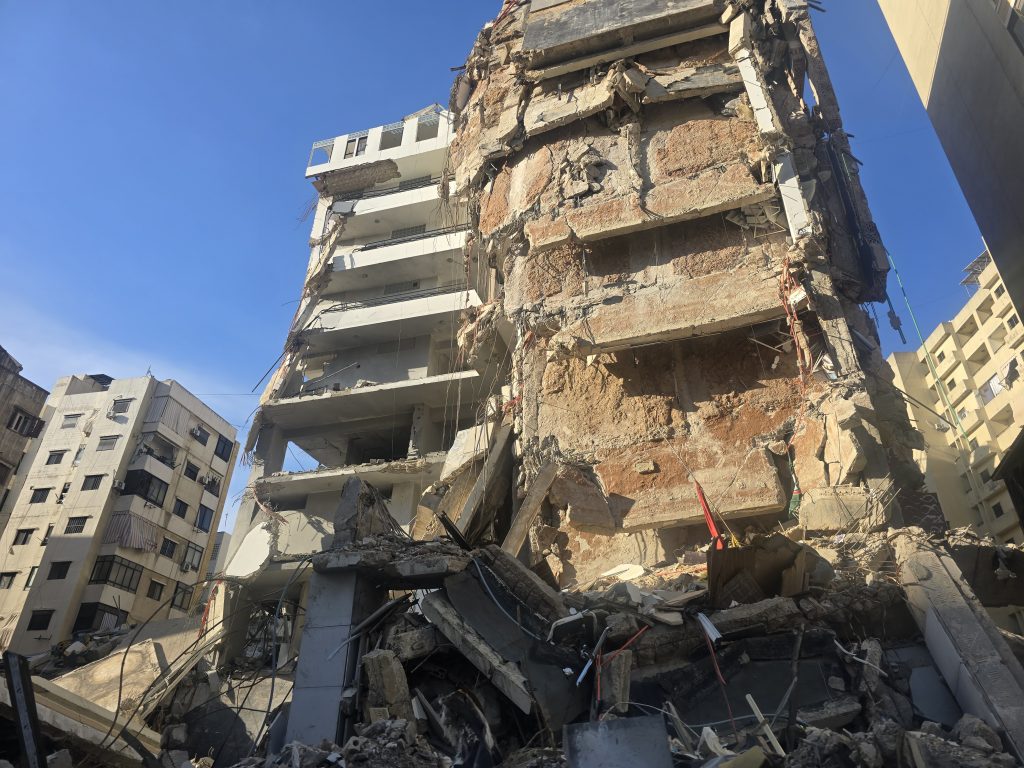
An apartment building severely damaged by Israeli bombs on April 8 in Beirut. Photo by Roqayah Chamseddine
In the hours that followed, I was among thousands in Dahieh who found themselves suspended in a state of disbelief and the grotesque, stomach-churning anticipation of another wave of attacks. The mechanical cries of ambulances, the soft weeping of people searching aimlessly through the rubble, and the sound of collapsing concrete carried on into the next day. Near the tight-knit community of Bir Hassan, where at least 10 men were killed during the wave of Israeli airstrikes, I spoke with Ali, a local resident forcibly displaced from the southern Lebanese town of Bint Jbeil, who walked me through the rubble-strewn aftermath. Ali recalled, in vivid detail, the immediate shock that followed the Israeli attack and the sheer brutality of the moment, which still felt almost unreal. He described it bluntly, saying: “I don’t know what to tell you. I saw pieces of my neighbors on the ground. These men were like moons, so young and full of life. One of them was supposed to get married next week.”
Days after the attack, I visited near an airstrike close to Tallet al-Khayyat where I weaved through vehicles that had been reduced to burned-out steel carcasses, their frames warped and hollow but for a handful of items belonging to their owners. Botflies lingered in slow, deliberate circles. A member of Lebanon’s civil defense team, his voice heavy with matter-of-fact exhaustion, would explain that the flies had come for scattered body parts; Israeli airstrikes hit with such force that traces of human flesh still clung to the ashen concrete.
The people of this nation are forced to endure not only Israeli bombs, but the slow suffocation of the government’s normalization with the invader.
Even after committing a shameless massacre, the Israeli war machine was not satisfied. The skies overhead continued to be occupied by U.S.-made Israeli aircraft, circling like vultures. The psychological dimension is arguably the most insidious feature of this assault, and it plays out in the political sphere. The people of this nation are forced to endure not only Israeli bombs, but the slow suffocation of the government’s normalization with the invader.
The language of “diplomacy”’ and “stability” has been implemented like a tightening vice around the local population by members of the Lebanese government, namely Prime Minister Nawaf Salam, President Joseph Aoun, and Foreign Minister Yousef Rajji. The current situation echoes past patterns. In the Israeli invasion of 1982, massacres were followed by intense Western pressure that would culminate into the May 17, 1983 agreement — an attempted normalization treaty between Lebanon and Israel negotiated under military occupation, which was ultimately rejected by popular and political resistance. The same structure of Western pressure reemerged in 2006, when, in the aftermath of the July War, international diplomatic efforts led to security frameworks under UN Security Council Resolution 1701, widely understood as an attempt to reshape the internal balance of power and undermine native resistance, namely that of Hezbollah. This, too, failed—and not because pressure was absent, but because of the resilience of Lebanon’s resistance community and the collective refusal to turn the aftermath of the war into political submission.
In recent weeks, Lebanon has been shaken by mass protests, as people across Beirut have risen not just to oppose the government’s push toward normalization with Israel, but to expose the fragile legitimacy of a state that has long abandoned large parts of its people. In particular, south Lebanon, which has been forced to endure decades of loss without meaningful support from state institutions, has been thrust into sharp focus. These protests made clear that the population whose suffering no longer fits within the margins of official amnesia continues to view resistance — born in the streets, in the villages, and in the very soil of our occupied lands — as their only truly justified shield.
The war waged against us by the United States and Israel is inseparable from the political struggle unfolding within Lebanon. Seen in this historical light, what we are facing is not only an existential battle for the land of our forefathers but for the soul of this nation.
From BT News via This RSS Feed.