

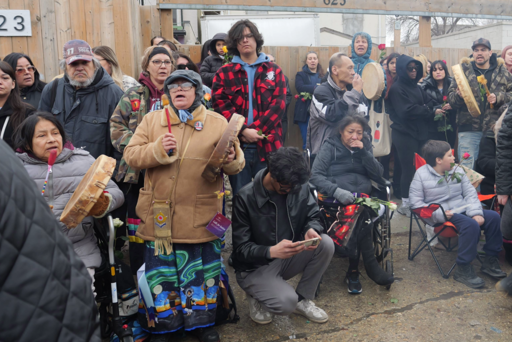
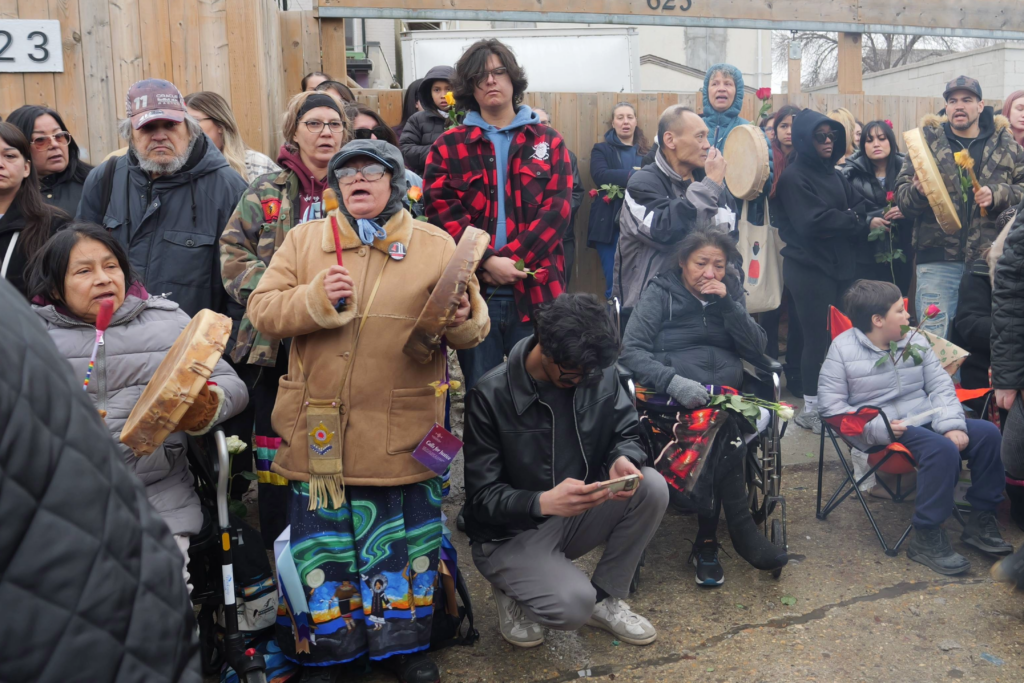
Loved ones and supporters drum, sing and pray at an April 11 vigil near the place Leah Faye Keeper’s remains were found in Winnipeg. Photo by Crystal Greene
Content warning: This story includes details about missing and murdered Indigenous women, girls and Two Spirit people (MMIWG2S+). Please read with care for your spirit.
About 150 people attended a vigil last Saturday for Leah Faye Keeper in Winnipeg, held in a backlane near where the missing Anishinaabe woman’s partial remains were found five months ago.
Attendees offered tobacco and flowers into a sacred fire lit there in memory of the 32-year-old mother of two, who police identified last week from DNA tests.
Keeper, from Sagkeeng First Nation, was last seen in the city’s North End nearly three years ago, leaving behind daughters who are now eight and 13.
The vigil, held by a backlane garage on the 600-block between Selkirk and Pritchard avenues, included singing, drumming, and handing out roses and candles.
Loved ones remembered Keeper as a petite, athletic jingle dress dancer with a big personality, who loved to sing and make others laugh and feel welcomed.
“Leah was known by her family as a vibrant and outgoing spirit,” her family’s obituary noted, “someone who could light up a room with her presence and her distinctive, joyful laugh.
“She was deeply loved by those closest to her. As a proud mother of two children, Leah carried a deep love for her family.”
‘I brought Leah in, and somehow she disappeared’
According to Marilyn Courchene, her aunt, she “met up with the wrong people later on, which caused her to go into addictions,” she said at the vigil.
Ultimately, it was “the land that helped her overcome her addictions, all of the medicines that made her stronger,” Courchene said.
To detox, Keeper drank medicinal teas harvested from the land.
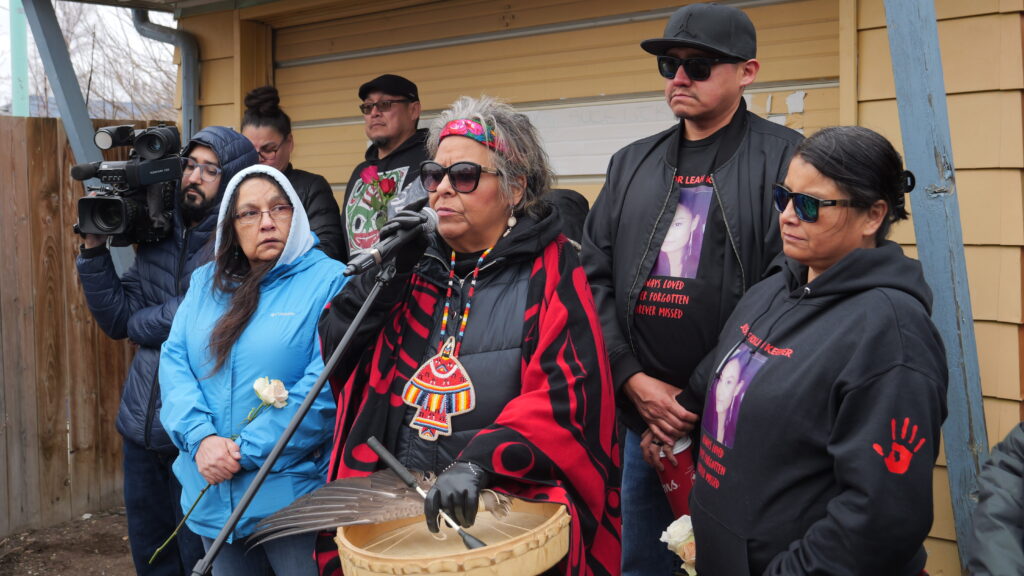
Sagkeeng First Nation member Marilyn Courchene, aunt of Leah Faye Keeper, speaks at an April 11 vigil after the 32-year-old’s remains were identified by Winnipeg police. Photo by Crystal Greene
Ahead of Saturday’s vigil, Courchene blamed authorities including Child and Family Services (CFS) for urging Keeper to return to Winnipeg to be vaccinated before her death.
“I think we could’ve had Leah still today, had I not listened to the CFS workers and the nurses that wanted Leah to come back into the city during COVID,” said Courchene at an April 8 press conference.
“I brought Leah in, and somehow she disappeared from their hands, and that’s where this started.”
But after moving back to Winnipeg, Courchene recalls her niece falling out of balance and into old patterns — before eventually asking for help to heal on her home reserve.
Courchene said loved ones reported Keeper missing four months after she was last seen because they “were used to her taking off,” but said blame lies with authorities, not her family.
“What I don’t like is when they said that, ‘Well, why did you wait so long?’” Courchene said at the vigil.
“It was the system that lost her, it wasn’t us.”
‘Our people matter’
Courchene recounted how Keeper’s late mother Ingrid, from Little Grand Rapids First Nation, fought to prevent CFS from apprehending her daughter, like her other children had been.
So her mother asked a close friend to take her daughter into her care in Sagkeeng First Nation, signing a kinship agreement as “sister-friends” so she could remain connected as Keeper grew up.
They had “found a solution on their own,” Courchene recalled, “a loophole against CFS.”
In Winnipeg, Keeper went on to study to be a health care aide and health unit clerk at Urban Circle Training Centre, and worked at the Health Sciences Centre Winnipeg Women’s Hospital.
She dreamed of becoming a nurse, family members said.
When she was last heard from in July 2023, she had called her adoptive mom telling her she wanted to go back to Sagkeeng for substance use treatment because she had relapsed.
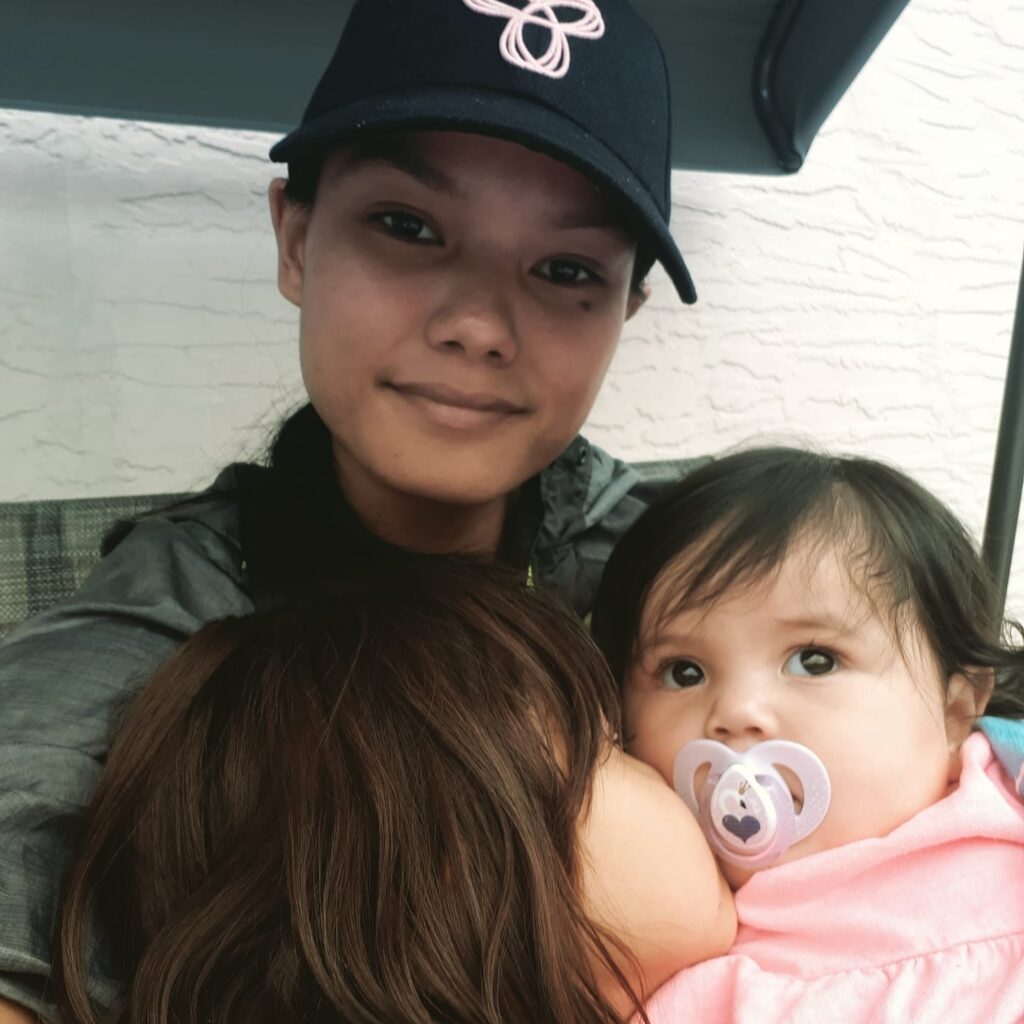
Leah Faye Keeper was 32 when she was last seen in 2023. She is survived by two daughters, now aged eight and 13. Photo courtesy Leah Keeper/Facebook
After her partial remains were identified, on April 7 police notified Keeper’s family, who held a press conference the next day.
The Winnipeg Police Service (WPS) said it found her remains last November, according to a media release, but DNA testing only confirmed they belonged to Keeper recently.
“The Winnipeg Police Service has notified Leah’s family of this tragic news, and … is in the process of reaching out to community leaders,” said the release, which said the homicide unit was investigating it as a “suspicious death.”
“Our thoughts are with Leah’s family and loved ones, as well as the Indigenous community.”
READ MORE: [With ‘grief and a desire for change,’ community gathers to remember MMIWG2S+ in ‘Winnipeg’](https://indiginews.com/mmiwg2s/winnipeg-womens-memorial-march-2026/)
But the Chief of Sagkeeng First Nation decried the WPS for how they communicated the news to her community.
“The way that the police are announcing the tragedy in our community is not very culturally sensitive,” said E.J. Fontaine at the press conference.
He said “a simple phone call” would have shown that “our people matter.”
“The police chief is trying to change the culture of that police force,” he added, “but this would have been a great opportunity for them to demonstrate a kinder way.”
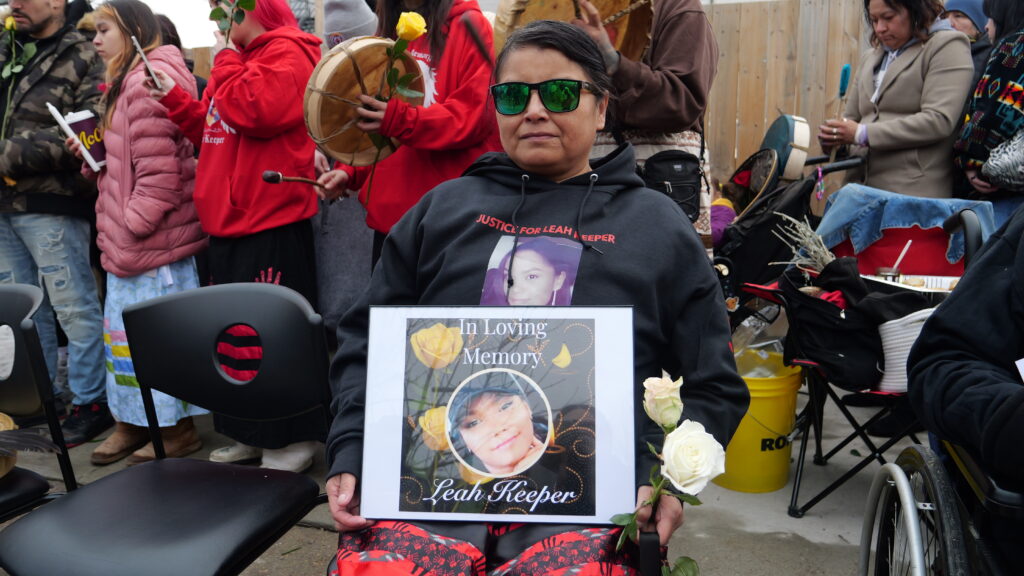
Colleen Keeper holds white roses and a poster bearing a photo of her niece, Leah Faye Keeper, at a vigil in Winnipeg on April 11. Photo by Crystal Greene
‘I’ve been searching for Leah since day one’
The Southern Chiefs Organization posted on Facebook that “Leah’s life touched many people,” adding that “Leah is remembered. She is loved. She is not forgotten.”
But as they remembered, family members said they were also left with many unanswered questions in the wake of her death, for instance how and where she was living at the time, and who she was with.
“I’ve been searching for Leah since day one,” said Darryl Contois, founder of the volunteer group Evelyn Memorial Search Team.
He recalled how Keeper’s adoptive mother Beverley Courchene had contacted him and shared her daughter’s photo.
Along with the Bear Clan Patrol, Contois co-ordinated ground searches, going “door-to-door,” and putting up missing flyers.
“I did talk to Leah,” said Contois at the April 8 conference, “between Selkirk and Pritchard.
“She was in a tent; the guy she was with was very aggressive. I asked her if she was safe.”
He said she replied, “Yeah.” He told her he’d come by to check on her later.
“And I did,” he said, “but she wasn’t there.”
READ MORE: ‘Bring her home’: How Buffalo Woman was identified as Ashlee Shingoose
Contois gave detectives a description of who Keeper was with at the time, and where he talked to her.
That place was in the same lane near where she was later found by police last November.
“We walk the streets, we go into meth houses, trap houses,” said Contois, “we go where families wouldn’t think to go.”
It was only three blocks from where the WPS reported that she was last seen in July 2023, when she was seen getting into a black truck near the corner of Selkirk Avenue and Salter Street.
‘Last protocol for Leah’
On Saturday, her aunt called for more land-based healing programs like the one that had helped her niece detox.
Recently, the federal government has cut funding to some national organizations advocating for missing and murdered Indigenous women, girls and Two Spirit people (MMIWG2S+).
Melissa Robinson, who directs that file for the Assembly of Manitoba Chiefs (AMC), called for “redirection” of those budget cuts to other organizations so essential services can continue.
“We here at AMC — in our unit — 100 per cent support all families that come to us,” said Robinson, also a co-founder of Morgan’s Warriors.
“We don’t pick and choose.”
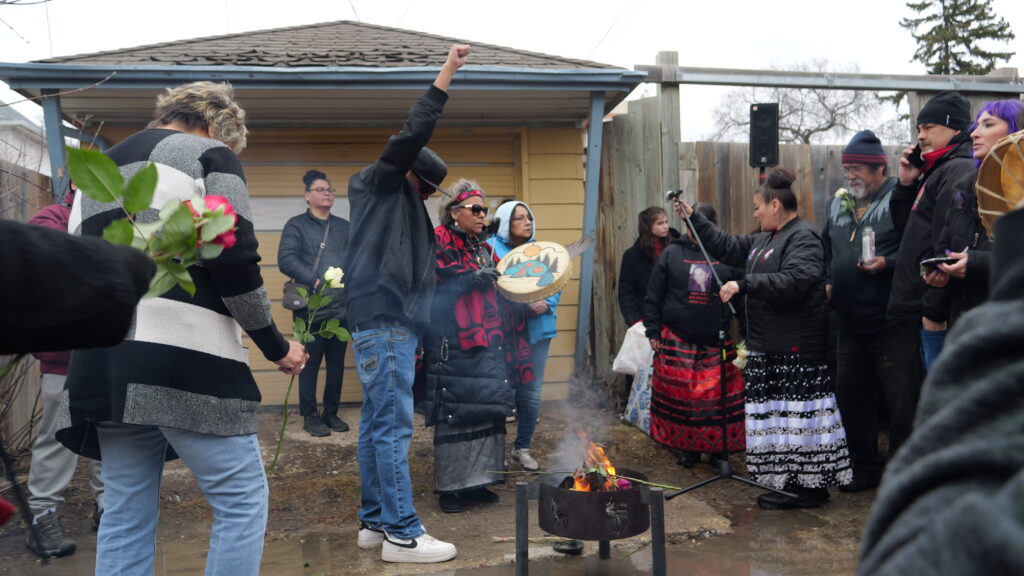
People offer tobacco and roses into a sacred fire at a backlane vigil for Leah Faye Keeper on April 11. Photo by Crystal Greene
Courchene reminded the crowd that, in 2019, the National Inquiry into Missing and Murdered Indigenous Women and Girls recommended a national action plan on the crisis — but that the call remains incomplete.
She added that basic human rights to equality are still lacking for Indigenous Peoples in employment, education, safety, and health care.
“Within those 231 calls to action, maybe they could have given to us [and] delegated ten things to do,” Courchene said.
“We as the grassroots people could have got this done faster, with less money. Now, they’re condemning our women here that tried their best.”
She said community organizations are already well-positioned to help address the crisis, for instance offering women “more land-based healing” services.
“We have the answers,” she said. “No more institutions. No more putting our people in jail. They can heal better on the land.”
But to do that, she added, Indigenous organizations “need that money.” She urged Prime Minister Mark Carney to rethink his government’s funding cuts.
As her obituary stated, Keeper has spent time in her final years “reconnecting with her culture and participating in traditional practices with family in Sagkeeng, working toward healing and wellness.”
Courchene lamented the fact Keeper wasn’t able to receive proper Anishinaabe protocols sooner.
Now she has been identified, her family plans to hold two memorial services this weekend.
The first will be at St. Kateri Tekakwitha Indigenous Church in Winnipeg on Saturday evening. The second memorial is planned for at the Turtle Lodge on Sunday afternoon in Sagkeeng First Nation, where Courchene said her niece did “a lot of healing.”
“In the protocols of our people, when we lose a loved one, we’re supposed to wash their bodies with cedar, and we cut our hair,” Courchene said.
“My sister can’t do that — she can’t wash Leah and do the last protocol for Leah.”
The post ‘Leah carried a deep love for her family’: Mother of 2 mourned at Winnipeg vigil appeared first on Indiginews.
From Indiginews via This RSS Feed.