

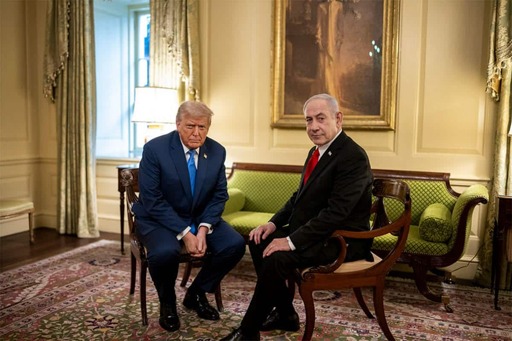
There are times when international perceptions shift slowly. And then there are breaking points. What’s happening with Israel falls into the latter category. For decades, U.S. support for Israel had withstood wars, occupations, and constant denunciations from international organizations. It was a virtually untouchable ally, protected by an exceptional bipartisan consensus. But something has cracked. This time, visibly.
The most recent episode in the U.S. Senate confirms this. On Wednesday, an initiative championed by Bernie Sanders sought to block the sale of 1,000-pound bombs and armored bulldozers to the Israeli army. The resolutions failed. But the truly relevant fact was not the formal outcome, but what it revealed.
For the first time in years, a significant majority of Democrats broke ranks with the Party’s unquestioned support for Israel. Specifically, 40 of the 47 Democratic senators opposed the provision of bulldozers, and 36 of 47 opposed the shipment of bombs. Moreover, no Democratic senator with presidential aspirations supported the arms transfer. While official policy may not change immediately, the political message is hard to ignore: Washington’s internal support for Israel is no longer to be taken for granted.
This institutional breakdown did not emerge in a vacuum. It is the expression of a deeper erosion that has been accumulating since 2003. The war on Gaza — with tens of thousands of deaths — was the trigger. Then came the direct involvement in the escalation against Iran and the continued operations in Lebanon, where millions have now been displaced and thousands killed. Taken together, these episodes have fueled a growing perception: that Benjamin Netanyahu’s government is no longer acting in self-defense, but increasingly as an aggressive agent of territorial expansion and regional instability.
This shift is clearly reflected in public opinion. For the first time in decades, the majority of the United States public no longer has sympathy for Israel. A recent Gallup poll indicates that 41% of Americans feel closer to the Palestinians, compared to 39% who support Israel. The difference is narrow, but its significance is profound: the historical balance has been reversed. In 2001, Israel held a 35-point advantage, and for more than two decades, it remained stable.
The trend is confirmed by other data also. According to the Pew Research Center, 60% of Americans now hold an unfavorable view of Israel, compared to 53% a year ago and nearly 40% just four years ago. This represents a 20-point increase in an exceptionally short period. The breakdown is even more revealing: 80% of Democratic supporters express a negative view, but the phenomenon also extends to the Republican electorate, where 57% of adults under 60 disapprove of Israel.
The divide is primarily generational. Among young people aged 18 to 29, rejection reaches 75% in the general population, 85% among Democrats, and 64% among Republicans. Even in historically pro-Israel groups, such as white evangelicals, younger generations show much lower levels of support than their elders. There is no longer any clearly aligned segment of youth who still support Israel. And this fact, rather than describing the present, foreshadows the future.
For years, U.S. support for Israel rested on a combination of factors: strategic alliances, political affinities, and a narrative reinforced after 9/11, which tended to homogenize perceptions of the Middle East. That framework is now breaking down. Newer generations have witnessed another war: the devastation in Gaza, in real time.
It’s not just an ideological issue. It’s also visual and emotional. Images of mass destruction, bombings in densely populated areas, and trapped civilians have eroded the traditional narrative. And they have done so persistently. Even among sectors that don’t adopt radical positions, doubts are growing about whether Israel’s actions are driven by shared interests or whether, on the contrary, they are dragging the United States into conflicts that are not its own.
This is where criticisms from different sources unexpectedly converge. On the Left, the questioning revolves around human rights. In the Republican camp, especially among sectors linked to the MAGA movement, another criticism emerges: the idea that Israel drags the United States into conflicts that do not directly serve its interests. Influential figures within the conservative ecosystem, such as Tucker Carlson and Steve Bannon, have contributed to establishing a discourse that combines isolationism, distrust of traditional alliances, and, in some cases, a drift toward conspiracy theories.
The result is a profound transformation: Israel has ceased to be a unifying force in American politics and has become a point of division. The debate over military aid — unquestioned for decades — is becoming a dividing line. The $38 billion assistance memorandum through 2028 no longer seems untouchable, and voices are beginning to emerge that are suggesting changing or even completely overhauling it.
However, the paradox is evident. On the military front, cooperation between the two countries remains close and highly sophisticated. But this technical link coexists with an increasingly profound political and social erosion. Because the real damage isn’t in a single vote or an isolated poll. It’s in the progressive loss of a stable base of support within American society. If current trends continue, Israel could face, in the near future, an unprecedented new reality: the absence of solid and lasting political backing from both parties.
In that scenario, the damage ceases to be collateral. It becomes structural. And, unlike the immediate effects of war, its consequences will be more lasting, redefining not only the relationship between the United States and Israel, but also the Middle East’s place in Washington’s global policy.
This article was originally published in Spanish on April 16 in La Izquierda Diario.
The post The War on Iran Has Further Weakened the Bond Between the U.S. and Israel appeared first on Left Voice.
From Left Voice via This RSS Feed.