

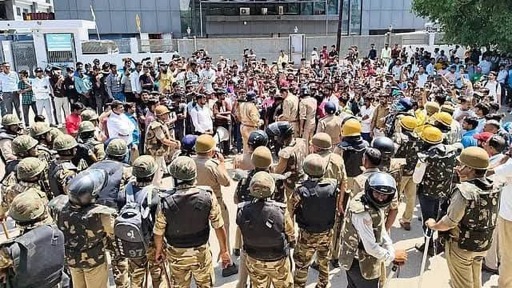
Large-scale protests and strikes have rocked the industrial center of Noida, in India’s largest state of Uttar Pradesh. Protesting workers have now rejected an announced wage increase on Tuesday, April 14, that falls far below their demands.
The state government announced an increase in the minimum wage for unskilled workers in two of its districts, Ghaziabad and Noida, by 21%, while unskilled workers in other urban areas of the state will get an increase of 15%. The remaining areas will see a mere 9% increase.
The agitating workers and all major trade unions have termed the so-called increase “insufficient” and vowed to continue their movement until wages are revised satisfactorily.
The Centre of Indian Trade Unions (CITU), one of the largest trade union federations in the country has supported the agitation and called the announcement a “sham” and much below survival levels.
CITU has also called for a national day of action in support of the agitating workers on April 16.
Thousands of workers from various factories and production units across Noida and other parts of India’s National Capital Region (NCR) went on strike last week and have been carrying out large-scale protests over low wages since then.
According to government sources, more than 42,000 workers participated in the protests and strikes held at more than 80 different places in Noida alone since April 9. In multiple places, demonstrations turned violent after security forces tried to disrupt their protests on Monday.
The security forces have carried out large-scale repression of the striking workers, with around 400 people already arrested and scores of others injured in baton charges carried out on Monday and Tuesday.
There are several unconfirmed reports of custodial violence and torture against the arrested workers as well.
The security forces have also arrested several trade union leaders and barred them from interacting with the media.
Wages below survival levels
The central demand of the workers is an increase in minimum wages from their current below-survival levels.
According to reports, most of the unskilled and skilled workers in Noida get less than Rs. 15,000 (USD 160) per month against the long-term demand of a minimum Rs. 26,000 (USD 278) raised by the trade unions.
“At the heart of the crisis is the ruthless exploitation of contract workers, who form the majority of the workforce. Paid Rs. 10,000-12,000 a month, forced into 10-13 hour workdays, denied double overtime, weekly rest, ESI, PF, bonus, job security, and even basic safety, they are treated as disposable labor,” claimed CITU in a statement on Tuesday.
The Uttar Pradesh government, where Noida falls, has not revised the minimum wages in the state since 2014.
Even after a 21% increase in wages announced on Tuesday the new monthly salary for workers in Noida and Ghaziabad will be a mere Rs. 13,690 (around USD 146 per month). In other parts of the state it will remain much below that mark.
Several workers claimed they are forced to live like destitutes as rising inflation in basic commodities makes it very difficult for them, living in urban areas mostly in rented accommodations, to manage a decent life for them and their families on these low wages.
Both CITU and agitating workers also cited the recent rise in the prices of cooking gas as one of the triggers of the ongoing strike.
India and most of the countries in South Asia and South-East Asia are facing the supply crunch of cooking gas and energy due to the US-Israeli war on Iran, leading to disruptions in supply and a rise in prices.
Read more: South Asia faces severe economic crisis due to US-Israeli war on Iran
Part of the wider national wave of struggle
According to the CITU, the present upsurge of the workers in the NCR must be seen as “part of a wider national wave of struggle … continuing the momentum of the historic 12 February general strike.”
On February 12, close to 300 million workers went on a day-long strike in India, demanding the withdrawal of four new labor codes introduced by the ultra-right-wing government, led by Prime Minister Narendra Modi, and other demands, including a proper living wage for all workers.
The agitating workers and trade unions also dismissed the government’s attempts to defame the movement by alleging it was sponsored by external and “anti-national” elements, with CITU calling it a malicious attempt to “delegitimize workers’ struggle.”
“This is not merely an industrial dispute-it is a valiant expression of direct class confrontation, where the state machinery is openly acting to defend corporate interests by suppressing workers’ rights,” CITU said in the statement on Tuesday.
The post Thousands of workers in India defy state repression to demand their rightful wages appeared first on Peoples Dispatch.
From Peoples Dispatch via This RSS Feed.